
The Service Award That Said Almost Nothing
by Cam Torre
Last updated
4 min read
Table of contents
- When Recognition Misses the Moment
- The Difference Between a Reward and a Memory
- Milestones Matter More Than Companies Think
Share this article
A few years ago, I was meeting a good friend for dinner after work. Let’s call her Jane. (Names and identifying details have been changed for privacy.)
She was coming from picking up her mail, and when she sat down, she dropped a small cardboard package onto the table between us and laughed.
“I think this is my ten-year service award.”
I remember getting genuinely excited for her. Ten years at one company is a big deal, especially now. Ten years means you’ve made it through reorganizations, difficult managers, great teammates, stressful launches, unexpected opportunities, and all the tiny moments that slowly add up to a career. It means you stayed long enough to build history somewhere.
I told her to open it.
She peeled back the tape, pulled out the packing paper, and opened a branded box with her company logo across the top. For a second, there was a little anticipation around the whole thing. You could tell she was being casual but wanted it to feel meaningful.
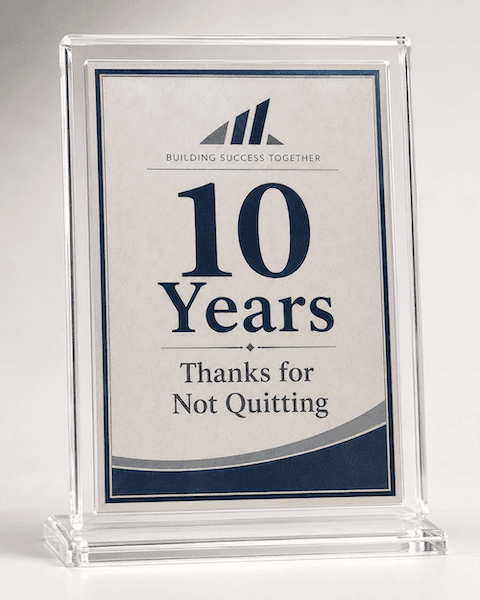
Inside was a plastic frame with her company’s logo and a neatly etched “10 Years.” Alongside it: a $100 Visa gift card and a brochure with a list of places where it could be used. She looked down at everything for a second, then flipped the brochure over like maybe she’d missed something.
I asked if there was a note. (There wasn’t.)
Had her team reached out about the milestone? “No,” she said with a small laugh. “I guess even I kind of forgot about it.”
So, I asked the obvious question: How did it feel? Her answer: “No one cares about stuff like that. The whole thing is lame.”
But I don’t think she believed that. Because Jane had given a lot to that company over those ten years. She relocated for the role, took on entirely new responsibilities, worked across departments, mentored people, survived multiple reorganizations, and built relationships that shaped her career and probably a lot of other people’s careers, too.
Jane certainly didn’t expect balloons to fall from the ceiling or some elaborate celebration. But ten years of your life feels like it should be acknowledged with a little more humanity than a plastic frame and an automated workflow.
And I think a lot of people have had some version of that experience.
When Recognition Misses the Moment
What ultimately stayed with me about Jane’s award wasn’t the gift itself. It was the total absence of reflection.
Here was a company investing real time and money into a program designed to celebrate loyalty, and it landed somewhere between indifference and disappointment. At first glance, it’s easy to assume no one cares. But that’s not true.
Jane cares deeply about her company. About her team. About the years she’s invested. And her company clearly values her. They’ve supported her growth, recognized her achievements, and invested in her career.
So, what broke?
I’d say the moment did. No one paused to reflect on what those ten years had meant to Jane or her company. No stories from teammates. No reminder of the challenges she had overcome or the impact she had made. The experience came and went in less than five minutes, which felt strange considering it represented an entire decade of someone’s working life.
Which is unfortunate, because anniversaries and milestones matter deeply to people.
We instinctively celebrate time everywhere else in life. Birthdays, weddings, graduations, retirements, anniversaries, reunions — these moments give us an opportunity to stop, reflect, and reconnect with the people around us. They help us mark growth and shared experience. Service anniversaries should be some of the most meaningful moments in an employee’s journey.
Especially now, when so many employees are searching for connection and meaning at work, these moments carry more emotional weight than organizations sometimes realize. A service anniversary isn’t really about tenure alone. It’s about contribution, growth, relationships, resilience, and shared history.
But in many organizations, Years of Service programs have been reduced to a date and a transaction.
The Difference Between a Reward and a Memory
I’ve experienced the opposite side of this myself.
I’ve now been at Workhuman for nearly ten years, and my experience couldn’t be more different than my friend’s. At my 1-year, 3-year, 5-year, and 7-year milestones, I’ve found myself staying up past midnight, waiting for the moment my anniversary award would be posted.
Not for the reward. For the messages.Opens in a new tab
We use our own Service Awards solution, and that means when the award arrives it’s full of messages. From my leaders. From my managers. And from my peers. Videos. Silly gifs. Pics I forgot someone ever took.
Each time I’ve hit a milestone, I’ve read through notes from teammates, reliving old projects, challenges, and moments I had long forgotten — projects we somehow survived together, difficult launches, funny mistakes, late nights, moments that shaped our careers in ways we didn’t recognize at the time. And each time, I’ve been reminded of the people behind the work.
I can tell you, what stayed with me wasn’t the reward attached to the milestone. It was the feeling I had of belonging, and mattering, to a whole lot of people in my life.
That’s the difference.
The best milestone experiences create reflection and connection. They help employees see the impact they’ve had, not through a corporate message, but through the voices of the people they worked beside every day. Done well, those moments reinforce culture in a way that policies and presentations never really can.
And that emotional layer matters a lot more than many organizations realize.

Milestones Matter More Than Companies Think
Service anniversaries are one of the few moments every organization already has built into the employee experience. Nearly every large company has some version of a Years of Service program because tenure matters everywhere. Yet despite how universal these programs are, many still feel oddly disconnected from the humans they’re designed to celebrate.
That creates a huge opportunity for HR leaders.
Not necessarily to spend more money or create bigger rewards, but to rethink the experience itself. The organizations getting this right are designing moments that feel participatory, social, reflective, and deeply human. They’re creating opportunities for peers and managers to contribute stories, appreciation, and shared memories instead of simply triggering a transaction tied to a date in the HRIS.
And the impact extends beyond the moment itself.
When employees feel genuinely seen and valued, those experiences strengthen culture, deepen belonging, and reinforce connection to the organization. Small improvements in how recognition is delivered can completely change how employees experience the milestone.
That’s something more organizations are starting to realize. Recognition isn’t really about the object. It’s about the emotional resonance surrounding the moment.
At Workhuman, we believe milestone moments deserve more.
Our Service Milestones experience (which is now available stand-alone to customers who don’t use Recognition) isn’t just about marking time. It’s about honoring the past, celebrating the present, and reinforcing connection for the future. When done right, these moments strengthen culture, deepen engagement, and turn tenure into something truly meaningful.
At their best, these moments tell employees something simple but powerful:
You mattered here.
Learn more about Workhuman’s Service Milestones solution here.
Cam Torre
Cam leads GTM Strategy & Operations at Workhuman, helping organizations and revenue teams connect strategy to execution in ways that drive growth, clarity, and better customer outcomes. His work spans sales productivity, forecasting, customer growth, and practical AI use cases that help teams operate with more focus, confidence, and impact.
Recommended for you
