
Moving From Taxonomy to Talent Signals: What It Takes to Be a True Skills-Based Organization
Last updated
7 min read

Most companies start their skills-based journey in a similar way: building (or buying) a skills taxonomy, mapping roles to skills, asking people to update their profiles. But, is that enough?
Taxonomies are useful. They give you cleaner understanding of a role. They improve talent search. They offer a shared language and a sense of order to admire. Your job descriptions get richer and internal and external hiring get a little clearer.
But after that, the system often stalls out.
That's because listing skills isn’t the same as knowing they exist and matter in your workforce now, at the level you need, in the places you need them, showing up in the work that counts. So while a taxonomy can name the skill, it can’t prove the skill. And without proof, leaders can't design work around it.
Now, don’t get me wrong. That’s not a knock on taxonomies. It’s just the reality of what taxonomies are good at (standardization) versus what skills-based organizations actually need (confidence they have the abilities they need to grow and deliver).
The bigger point is this: skills-based is the goal – but flagging skills isn’t the whole job.
If you’re missing any one of these, “skills-based” turns into a documentation project with a new label.
Why “skills-based” organizations are so important
There’s a reason the skills-based organization has become such a staple of workforce strategy. In the version of the future many leaders are aiming for, employees don’t have to guess what’s next or rely on who they know to get opportunities; managers and recruiters can proactively connect people to roles and projects based on their skills and potential, supported by AI that helps them grow and move over time. That’s the central promise laid out in Chief Talent Officer’s articleOpens in a new tab on becoming a skills-driven organization that can “know, grow, and connect” talent to opportunities.
The other reason “skills-based” organizations are more relevant than ever is that the ground is moving under the very nature of skills themselves. When AI can supplement business skills, leaders need a way to see what the irreplaceable, unmistakably human skills are from their workforce. The World Economic Forum has been tracking this shift for years: employers expect substantial skills disruption in the near term, and they’re increasingly explicit that the skills rising in importance aren’t only job-specific or technical – they’re human-centric capabilities like analytical and creative thinking, leadership and social influence, curiosity and lifelong learning, and resilience and agility.
WEF’s work on “New Economy Skills”Opens in a new tab (derived from their analysis of our Workhuman recognition data) goes even further, framing human-centric skills as the capabilities that help individuals and organizations adapt to change and lead transformation – in other words, the skills that determine whether all the technical investment actually turns into performance.
And here’s where that taxonomy-first approaches start to wobble: human skills are real, but they’re harder to “inventory” from traditional sources. You can map “data analysis” to a role. It’s a lot harder to credibly map “influences across teams” or “raises the bar under pressure” without seeing it in action.
There’s a strong business case behind the buzz. Deloitte’s research on skills-based organizationsOpens in a new tab consistently finds that organizations taking a skills-based approach are more likely to place talent effectively and retain high performers, and to build a reputation as a place where people can grow.
So, the goal makes sense: if skills are the currency, you can be more agile about moving the right talent to the right challenges, developing people faster, and widening access to opportunity.
The problem is that many organizations get stuck at the “currency printing” stage.
The stall point: taxonomies create consistency, not certainty
As Mercer has explained: a skills-powered organization needs a clear definition of skills and how they relate to jobs and profilesOpens in a new tab – and that usually starts with job architecture and a “manageable taxonomy or ontology.” That’s the connective tissue that lets skills show up consistently across talent processes.
We agree. You need that connective tissue. But connective tissue isn’t muscle.
- A taxonomy helps you answer: “What do we call this skill?”
- But leaders are trying to answer: “Who can actually do this – reliably – in the work we care about?”
And that gap is where most skills strategies quietly lose momentum. Because if the skills data isn’t credible enough to bet on, leaders won’t redesign work around it. They’ll keep defaulting to the proxies that feel safer: job titles, tenure, past roles, pedigree, who’s visible, who’s known.
Which raises a far more useful question than “do we have a taxonomy?”
Glad you asked! Because that’s where skill signals come in.
Treat skills like a signal system (not a library)
Once you accept that a taxonomy is necessary but not sufficient on it’s own, you have to pose a stark question: is your skills data trustworthy enough to use in real decisions?
If not, the answer is never: “let’s make a better taxonomy.” A taxonomy gives you a shared language. What it doesn’t give you is confidence. And confidence is the whole ballgame if you’re trying to do any of the things leaders say they want from a skills-based organization.
This is also why so many “skills transformations” drift into a weird limbo state. The taxonomy exists. The skills library exists. The UI exists. But the data doesn’t feel solid enough to bet on, so leaders keep making decisions the old way.
What’s needed is an operating model for obtaining skills evidence to validate the taxonomy – which requires affirmation from managers and also the peers who are witnessing those skills in practice.
If you want skills to become a real input to workforce strategy, you need to shift from “skills as static attributes” to “skills as signals.” Signals are different. Taxonomies standardize. Signals persuade. And leaders won’t redesign work around skills until they’re persuaded.
Signals must be:
- Current (not a yearly update)
- Contextual (tied to real work)
- Multi-source (not dependent on one person’s opinion)
- Useful for decisions (because they’re credible enough to act on)
It’s critical to put your taxonomies into conversation with these signals – building a reliable “talent signal system” that leaders can use to make calls without crossing their fingers.
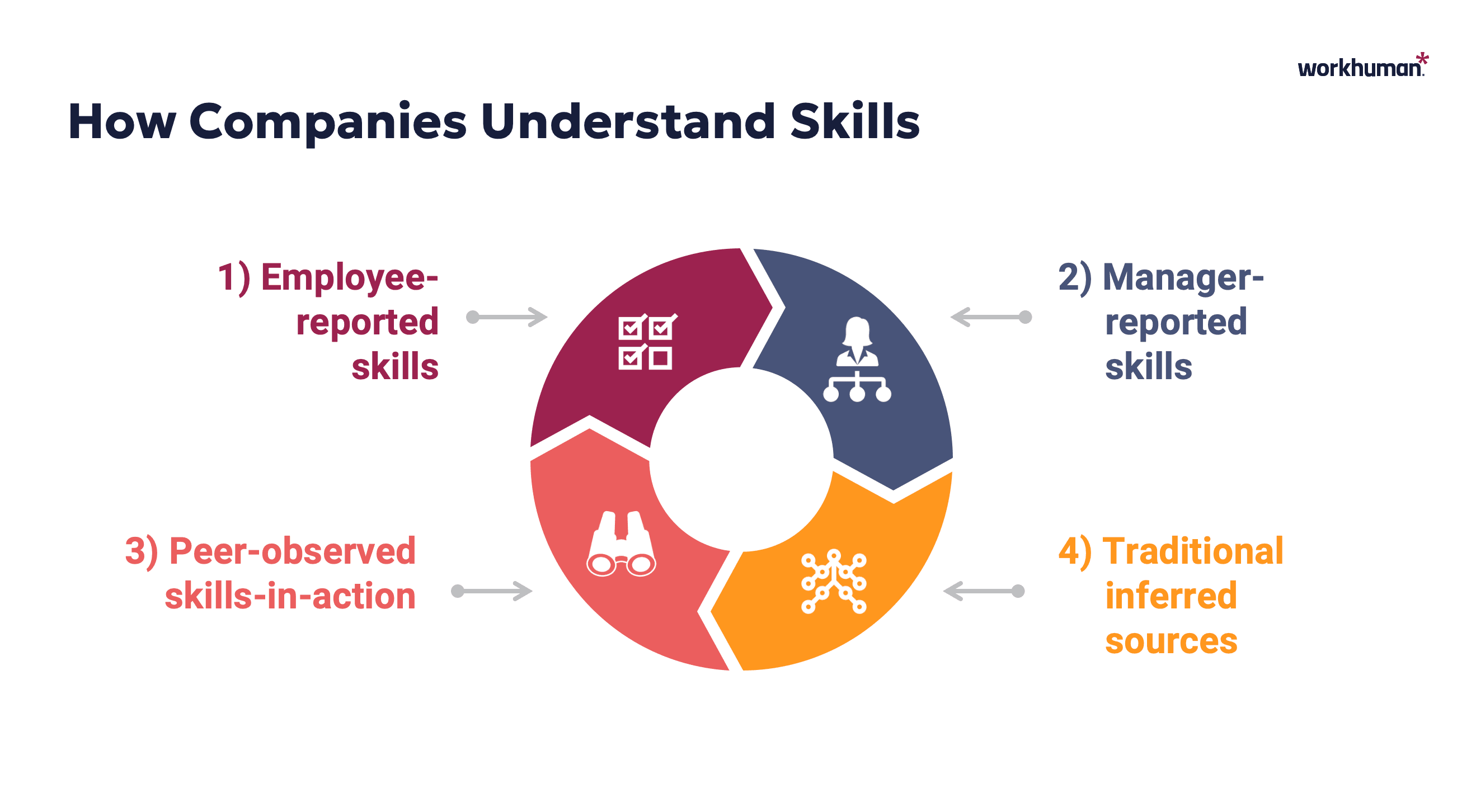
There are four kinds of signals you can combine for skills:
| 1. Employee-reported skills: Self-assessments are underrated because they can surface hidden skills and aspirations. They’re also messy: confidence varies, incentives aren’t neutral, and the data goes stale fast. |
| 2. Manager-reported skills: Managers can calibrate within a team and add performance context. But they don’t see everything–especially cross-functional work–and they’re human (read: bias and blind spots apply). |
| 3. Traditional inferred sources: Taxonomies, role-to-skill mapping, resumes, learning histories, and skills inference tools are useful for scale and baseline consistency. They also tend to produce “looks right” data that isn’t always decision-grade. |
| 4. Peer-observed skill-in-action: This is where recognition comes in. It is the missing ingredient in a lot of skills strategies: evidence that a skill is being practiced, in context, and recognized by the people who experienced it directly. Especially for human skills (collaboration, influence, coaching, raising standards) peer observation is often the only signal that captures the skill in context. |
When these inputs align, your confidence in the skills landscape goes up. When they don’t, it tells you where your skills story is fuzzy, inflated, outdated, or incomplete.
Another reason getting this whole signals picture matters: motivation and development are the engine for skills growth. When peers and managers are validating skills possession, they’re also validating skills acquisition.
It’s important to realize peer signals are both evidence, but also reinforcement. They show where a skill actually showed up in the work — and they increase the odds it shows up again. Gallup’s research with WorkhumanOpens in a new tab found only 26% of U.S. employees strongly agree their organization encourages them to learn new skills – while less than half strongly agree they have the skills they need to be exceptional at their current job.
See how Eaton uses data from their recognition program to see how work is actually getting done and what skills matter most to their workforce.
4 steps to get unstuck on skills
A skills-based organization isn’t something you declare you have as soon as you finish the taxonomy. It’s something that has to be practiced and encouraged. When you see skills showing up in real work, you want to continually reinforce the behaviors that keep them showing up.
So, how do you build it? Here are four steps:
1) Start with a small set of skills that actually matter to the business
A lot of skills programs fail by trying to boil the ocean. You don’t need 2,000 skills to start acting like a skills-based organization. You need a short list of “if we get these right, we win” capabilities – the skills tied to your strategy, your business model, and your near-term transformation priorities.
A practical way to start is to pick 10–20 strategic skills (emphasizing those human skills the WEF writes aboutOpens in a new tab, because those are the skills ONLY your humans can deliver) and decide what “good” looks like in your company.
2) Build confidence through triangulation (and be honest about what each input can’t do)
Deloitte has observed that Opens in a new tab this skills-based push is accelerating, and successfully. Skills-based organizations are more likely to place talent effectively and retain high performers. But if you want those outcomes, the signal you’re working from can’t be weak. That’s where triangulation becomes clutch. All four of the perspectives listed above become important pieces of the puzzle:
- Self-reporting tells you what people believe they can do (and want to do).
- Manager assessment adds performance context (but is limited by visibility).
- Inferred sources (taxonomy mapping, learning history, role-to-skill mapping) give you scale and standard language.
- Peer-observed skill-in-action gives you proof the skills are there and matter, with context-rich evidence that a capability showed up in real work.
3) Tie skills to work as it happens (and rethink work design)
Skills have to be connected to real work allocation: projects, gigs, internal moves, team formation, problem solving. That means understanding and rethinking how work happens: seeing how and where work is getting done, and then determining how it might need to change.
One reason this matters more now: work is being reorganized in response to AI and automation. For example, McKinsey has been explicitOpens in a new tab that the value in agentic AI comes through workflow-level redesign and change, not from sprinkling tools on top of existing processes. Without fundamental change in how skills are applied, companies won’t see any real shift in outcomes.
You might also be interested in our recent white paper: How Work Gets Done (Now)
4) Don’t forget the human multiplier: motivation and reinforcement
A lot of companies are counting on skills adaptability from employees – but they don’t always set up the conditions that make that adaptability possible. A true skills-based organization reinforces the behaviors that grow those strengths and rewards people for their efforts in expanding the skills the company needs.
So where can you start? Decide what behaviors you’re trying to make more common (cross-functional collaboration, coaching, experimentation, knowledge-sharing, lifting standards), then reinforce them consistently through feedback, recognition and rewards, staffing decisions, and the signals leaders send about what matters for the business.
The simple test for a skills-based organization
If your skills strategy is working, it should become easier to answer questions leaders actually care about:
- Where are our critical skills showing up in the work right now?
- Who is demonstrating them in moments that matter – across teams, not just within one manager’s line of sight?
- What are we doing to make those skills show up more often?
Taxonomies help you name skills. Talent signals help you trust them. And trust is what turns “skills-based” from a good idea into a different way of running the business.

Darcy Jacobsen
Darcy is a passionate storyteller and champion of workforce transformation, human connection, and recognition-driven culture. As an author on the Workhuman blog, she loves to connect deep research insights with modern workplace dynamics to uncover what really drives engagement, belonging, and happiness at work. With a background in communications and a master's in medieval history, she brings a unique perspective to her writing, taking deep dives into all topics around organizational psychology and the science of gratitude.
Recommended for you