
Service Milestones and the Psychology of Tenure
Last updated
18 min read
Table of contents
- Why does 10 years feel different from 9 years and 200 days?
- The work anniversary as a career checkpoint
- What actually accumulates with tenure?
- How do employees turn tenure into meaning?
- Recognition makes private meaning social
- A milestone is about the future, too
- Designing service milestones around meaning
- Let the reward extend the meaning rather than carry it
- Conclusion: What the years come to mean
- References
Share this article
Why does 10 years feel different from 9 years and 200 days?
Ten years at a company should not feel meaningfully different to us from, say, nine years and 200 days. But it sure does.
As humans, we like to imbue time with meaning. Birthdays. New Year's Day. Graduations. Anniversaries. We take a continuous stretch of experience, draw a line through it, and then that line itself means something to us – and often dictates our decisions.
Psychologists call these moments temporal landmarks. They separate one period of life from another and can prompt us to step outside the day-to-day, look backward, and think differently about what comes next.
In a series of studies, Hengchen Dai, Katherine Milkman, and Jason Riis found that behaviors associated with aspirational goals increased after landmarks such as the beginning of a week, month, year, or semester, as well as birthdays and holidays. They called this the fresh start effect (Dai, Milkman, & Riis, 2014).
New Year’s resolutions are a good lens to use to understand this effect. It’s not that we all suddenly become more virtuous on January 1. But that New Year’s Eve boundary helps us divide time into mental chapters. There is the person I was last year. There is the person I am now or want to be. The gap between the two is where we take stock.
A 2026 meta-analysis of 31 studies found an overall positive psychological effect of these temporal landmarks, but considerable variation depending on the type of landmark and context (Wang, Sheng, & Zhu, 2026). Of course, not every milestone produces a moment of profound self-reflection. But the study found that milestones do create psychological punctuation, so they have that potential.
A work anniversary is this kind of temporal landmark: a moment of psychological punctuation that gives us something unusually rich to reflect on – years of relationships, decisions, achievements, frustrations, learning, contribution, and accumulated history with one organization.
Not simply an anniversary to celebrate, it is a moment when an employee may be interpreting their relationship with the organization.
For HR leaders concerned with retention, performance, and the strength of the relationship people have with their work, that makes a service anniversary potentially very consequential. In fact, the milestone may create one of the relatively rare occasions when an employee steps outside the daily demands of the job and looks at an employment relationship over a longer horizon.
The first question, then, is not what the organization should give someone for reaching the date. It is what your milestone experience will help the employee to see.
The work anniversary as a career checkpoint
An employee reaching a milestone has a natural reference point available to them: This is where I was five years ago. This is where I am now.
That comparison can extend quickly beyond tenure. Has my career developed? Have I learned and grown? Have I built relationships that matter to me? Do I feel connected to the people around me and to what we are trying to accomplish? Is the organization still giving me something I value? And do I want the next period of my working life to happen here?
A work anniversary can therefore prompt more than a career assessment. It can become a moment of relationship assessment. It can be a moment that invites people to ask themselves why they stay, and to recommit their loyalty to their employer.
There is some workplace evidence that anniversaries can coincide with this kind of reassessment. Research conducted by CEB and reported in Harvard Business Review found increases in job-search activity around both the anniversary of joining an organization and the anniversary of moving into a current role. The researchers interpreted these occasions as natural moments for employees to compare their current circumstances with earlier expectations (CEB, as reported in Harvard Business Review, 2016).
That finding should not carry more weight than it can support. The CEB analysis was not published as a peer-reviewed academic study, and an increase in job-search activity around an anniversary cannot tell us what caused any individual employee to start looking. Its value lies in how it might fit with the broader temporal-landmark literature.
If boundaries encourage comparison between one period and another, then a work anniversary may function as a career checkpoint. It makes it easier to ask not simply how much time has passed, but what has happened during that time.
This does not mean every employee arrives at their anniversary performing a conscious stay-or-leave calculation. The process may be subtle. A milestone might prompt pride in how far someone has come, disappointment at how little has changed, gratitude for relationships built, or curiosity about what should happen next.
What matters is that the date provides a perspective that ordinary working life often does not. That creates both an opportunity and a vulnerability for employers. When an employee steps back from the immediate demands of work, the organization cannot control what they will see. An anniversary can surface reasons to stay, but it can also make stagnation, broken expectations, or disconnection easier to notice.
The milestone itself is therefore neither a retention mechanism nor a retention risk. It is a moment of increased visibility.
To understand what becomes visible, we need to look at what actually accumulates when someone spends years inside an organization.
What actually accumulates with tenure?
It is tempting to think about tenure as if attachment simply increases with time. Someone who has stayed 10 years must be more loyal than someone who has stayed two. Someone who has remained for 20 must be more attached still.
The psychology of staying is more complicated.
Time itself does not create affinity. What it does is provide more opportunity for the experiences, relationships, and investments from which attachment can develop.
The concept of job embeddedness offers one of the clearest ways to understand this process. Mitchell and colleagues proposed that people become embedded through three broad forces:
- links, the connections they have to other people and groups;
- fit, the compatibility they perceive between themselves and their job, organization, and wider environment; and
- sacrifice, what they believe they would give up by leaving (Mitchell et al., 2001).
Their original studies found that embeddedness predicted intentions to leave and voluntary turnover above more established factors such as job satisfaction and organizational commitment. A later meta-analysis involving 65 independent samples and 42,907 people found that on- and off-the-job embeddedness were associated with lower turnover intentions and actual turnover even after accounting for job satisfaction, affective commitment, and perceived alternatives (Jiang et al., 2012).
Embeddedness is not the same thing as tenure, and confusing the two would be a mistake.
Someone can spend many years with an organization without feeling especially connected to colleagues, well matched to the environment, or reluctant to give up what they have built. Employees can stay because of economic necessity, limited alternatives, inertia, or any number of practical reasons that have little to do with affection for an employer.
But longer tenure does create more opportunities for embeddedness to grow.
Over time, employees can develop relationships across teams and functions. They build expertise that has meaning in a particular organizational context. They earn trust, establish reputations, mentor other people, acquire institutional knowledge, and become associated with projects and moments that enter the shared memory of the organization.
Some of what accumulates is highly visible: promotions, awards, major pieces of work. Much of it is not. It is the colleague who knows who to call when something goes wrong. The manager who remembers why a decision was made three years ago. The person who helped someone through a difficult first month and may barely remember doing it.
Tenure creates history. That history does not automatically become attachment. But it gives employees more material from which attachment can be built. The longer someone remains, the more opportunities there are for their own story to become entangled with the stories of colleagues, teams, customers, and the organization itself. This is why tenure should not be treated as a proxy for loyalty. Years served tell us how long a relationship has lasted. They tell us much less about the quality of that relationship.
A more useful question is what has accumulated inside those years, and how much of it the employee has come to value.
A service milestone brings that history closer to the surface. But accumulated experience is not meaningful simply because it exists. Employees still have to make sense of it.
How do employees turn tenure into meaning?
Human memory is not an objective archive of everything that has happened to us. We select particular experiences, revisit them, connect them to one another, and gradually turn them into stories about where we have been and who we have become.
That process happens at work too.
Research on organizational nostalgia offers an unusually relevant lens for understanding it. Organizational nostalgia refers to sentimental or wistful feelings toward meaningful experiences from a person's organizational past. In three studies, Leunissen and colleagues found that organizational nostalgia increased perceived meaning in work and, through that meaning, was associated with lower turnover intentions (Leunissen et al., 2018).
Later research has developed the construct further. Leunissen and colleagues found associations between organizational nostalgia and outcomes including work engagement, organizational citizenship behavior, in-role performance, creativity, and support for organizational change (Leunissen et al., 2024).
The important point is not that nostalgia is inherently good, or that employers should try to make employees sentimental about the past. It is that the way people remember their organizational history can influence how they understand their work in the present.
A service anniversary gives employees a natural reason to retrieve that history.
That could be a project that changed the direction of a career. A team that accomplished something difficult. A manager who took a chance on someone before they were ready. The colleague who became a friend. A period of uncertainty that looked very different from inside it than it does years later.
These sorts of experiences are always part of the employee's tenure, but they are not always easily recalled. Much of working life is dominated by whatever is urgent now.
A milestone can widen the frame. It can make the employee consider not simply individual events but the larger story those events ladder up to.
This is an important lens, because meaning at work is associated with outcomes organizations care about. In a meta-analysis spanning 44 articles and 23,144 participants, Allan and colleagues found strong associations between meaningful work and engagement, organizational commitment, and job satisfaction, alongside substantial relationships with withdrawal intentions and other indicators of employee functioning (Allan et al., 2019).
Those findings do not explicitly say that encouraging someone to reminisce on an anniversary will make them more engaged or prevent them from leaving. But they do suggest that making those connections matters in those decisions.
A milestone is not important simply because it reminds someone that time has passed. The milestone’s psychological potential comes from giving that person an occasion to ask what the time has meant.
This is where traditional years-of-service programs can fall short. A certificate can accurately record tenure. A gift can acknowledge that the threshold has been reached. Neither, on its own, tells an employee why those years were significant.
For that, the employee's own memories matter. But so do the memories of other people.
Recognition makes private meaning social
There is a difference between believing that your contribution mattered and discovering that somebody else believes it mattered.
That difference sits at the heart of recognition.
Research on gratitude gives us one way to understand it. Across four experiments, Grant and Gino examined why expressions of gratitude influenced subsequent helping behavior. They found evidence that gratitude increased recipients' sense of social worth: the feeling that their actions were valued by another person (Grant & Gino, 2010).
That concept is particularly useful at a service milestone. “Congratulations on 10 years” tells an employee that the date has been recorded. “I still use that thing you taught me when I joined” tells them something about the effect they had on another person.
The second message praises the employee. It also provides evidence of impact.
That evidence matters because people are imperfect judges of the effect they have on others. An employee knows what they intended to contribute. Colleagues can show them where that contribution truly had impact.
Organizational support theory adds a second layer. Employees develop broader beliefs about whether their organization values their contribution and cares about their wellbeing. Those beliefs are shaped by patterns of treatment, fairness, support, rewards, and other organizational actions (Rhoades & Eisenberger, 2002; Eisenberger, Rhoades Shanock, & Wen, 2020).
At a milestone, recognition can therefore operate simultaneously at an interpersonal and organizational level. Other people remember what I contributed. The organization considers that contribution worth acknowledging.
The psychology of ritualhelps explain why making the experience collective may deepen its significance further. In their integrative review, Hobson and colleagues argue that rituals can serve social as well as emotional and goal-regulatory functions, helping groups create and reinforce connection (Hobson et al., 2018).
That makes a useful distinction possible between an anniversary and a celebration. The anniversary happens because time passes. The celebration is something a community chooses to do with that fact.
A system can automatically identify that someone has reached 10 years. That is operationally useful. But the psychological value of the milestone may depend more on what happens after the system notices.
Workhuman's 2026 Humans at Work Barometer research has shown the size of that opportunity. Among 6,024 employees across 10 countries, 33% said they had never received service-milestone recognition at all, while 61% said they had never experienced milestone recognition that felt like a meaningful celebration of their work. (Workhuman, 2026).
The study also found a strong relationship between the richness of the milestone experience and whether employees described it as meaningful. Among those whose experience included only one component, 31% considered it meaningful. For milestones involving six or more components, the figure was approximately 87%–90%. Yet peer messages and memories appeared in only 21% of milestone experiences (Workhuman, 2026).
These findings do not establish that adding components mechanically causes meaningfulness. Nor should six components become another threshold for program designers to optimize.
The more important finding is conceptual. Meaningful service milestones will be more than transactions. They involve multiple forms of acknowledgement, a sense of occasion, and other people. They connect an individual's personal history with a social history.
That is why peer participation should not be treated as decoration around the “real” award.
The employee has one perspective on their tenure. Other people hold pieces of the story they cannot supply themselves.
People hold each other’s stories through their own memories of work. A colleague can remember the moment someone's support made a difference. A former manager can describe how much an employee has grown. A team member can explain how that person's behavior changed the way the group works.
Those memories convert an abstract period of employment into evidence of influence, relationships, and contribution.
The organization may know how long someone has been there. It is the people around them who know how their tenure has mattered.
A milestone is about the future, too
A service milestone naturally directs attention backward. That is part of its value.
But it should not leave the employee in the past.
The same temporal-landmark literature that helps explain why people reflect on previous periods also connects landmarks with future-oriented behavior. Dai, Milkman, and Riis' original work was fundamentally about aspirational action: boundaries can create a sense that one period has ended and another is beginning (Dai et al., 2014).
More recent work on organizational nostalgia makes the relationship between past and future particularly interesting. In 2026, van Dijke and colleagues examined whether nostalgic reflection on workplace experiences influenced the way employees prioritized personal work goals. Across a two-wave field study, a daily-diary study, and an experiment, they found evidence that organizational nostalgia helped employees prioritize work goals they personally considered important (van Dijke et al., 2026).
Looking backward, in other words, need not trap people in the past. It can help clarify what matters for the future.
That has implications for how organizations think about long-tenured employees. A 10-year anniversary does not only mark the completion of 10 years. It also marks the beginning of year 11.
Someone looking back at the work that felt most meaningful may also be identifying the kind of contribution they want to make next. The relationships that mattered may clarify the kind of team they want to be part of. The capabilities they developed may make them aware of skills they want to deepen or use differently.
This is not an argument for turning a service celebration into a development meeting. Doing so could easily make the recognition feel instrumental.
It is, however, an argument against making the milestone feel final or ossified. A milestone should feel very much like a part of that employee’s present — to remind them not just of why they have stayed, but why they continue to stay.
Long-tenured employees can be particularly vulnerable to being defined by their own history. Expertise becomes expectation. Reputation becomes a fixed view of what someone is good at. The person who has reliably done one thing for years can gradually become the person everyone assumes should keep doing it.
A meaningful milestone can acknowledge an established identity without implying that the employee's most valuable work is behind them.
That matters for the business case too. There is no strong body of evidence showing that one well-designed service anniversary causes an employee to stay. It would be misleading to position a milestone celebration as a discrete retention intervention.
But high-quality recognition is consistently associated with longer-term retention outcomes. Gallup and Workhuman followed nearly 3,500 employees from 2022 to 2024 and found that employees who had received high-quality recognition at the beginning of the study were 45% less likely to have changed organizations two years later (Gallup & Workhuman, 2024).
The significance of that finding is not that a milestone award can buy another five years of tenure. It is that recognition sits within a larger employee relationship that can influence whether people continue to see a future with the organization. The milestone makes that relationship unusually visible.
For organizations, that future orientation matters beyond retention. Employees who can see where they have contributed, what work has been most meaningful, and where their strengths have mattered are better positioned to understand how they can continue creating value. A well-designed milestone is therefore not simply a retrospective culture moment. It can reconnect an employee's accumulated experience to the contribution the organization needs next.
If an employee reaches 10 years after a decade of feeling overlooked, constrained, or disconnected, a generous celebration is unlikely to rewrite the preceding experience. If the same employee has spent those years receiving evidence that their contribution matters, forming strong relationships, and continuing to grow, the milestone has something much richer to bring into view.
This is why service milestones cannot be separated from the quality of the employee experience that surrounds them.
The anniversary does not create a relationship — it reveals it. And because the employee is standing at the beginning of another period as well as the end of one, the most valuable signal may be one that acknowledges both.
We know what you have contributed here. And we are still interested in what you might contribute next.
Designing service milestones around meaning
Academic research does not give organizations a formula for the perfect service anniversary. There is no evidence that a particular gift, number of messages, or set of program components will reliably produce attachment or retention.
What the literature does provide is a more useful design principle: Build the milestone around the meaning of tenure, not simply its duration.
And of course, that must start long before the anniversary itself.
Make the milestone credible in the context of the wider employee experience
A service anniversary is not a substitute for recognition during the years between milestones. Job embeddedness develops through relationships, fit, and valued investments. Perceptions of organizational support develop through repeated evidence about whether the organization values a person's contribution. A milestone that arrives after years of neglect has very little credible history to surface.
This means years-of-service programs should not operate as an isolated track that appears every five years while everyday recognition is left to chance. The milestone is most powerful when it feels like a culmination of an ongoing relationship: one important moment in a broader pattern of being seen.
That is also why the experience should be consistent with what the employee really knows about the organization. An extravagant celebration cannot create authenticity if the rest of the employee experience contradicts its message.
Replace generic congratulations with specific evidence of impact
The practical implication of the social-worth research is not simply “ask peers to participate.” It is to ask them to say something worth hearing.
Generic praise confirms that people showed up for the occasion. Specific stories help the employee understand how their work exists in other people's memories.
That requires a different kind of prompt. Instead of asking colleagues only to congratulate someone, ask what they remember. What did this person teach you? When did they make a difficult situation easier? What contribution are you still benefiting from? What is different because they were here?
The aim is not to manufacture sentimentality. It is to surface evidence. A milestone becomes more psychologically meaningful when the employee can see connections between their own recollection of the years and the effect those years had on other people.
Make participation relational, not hierarchical
A career is rarely lived through an org chart. The people who matter most to someone's experience may include former managers, peers, direct reports, mentors, project partners, and colleagues who now work somewhere entirely different in the organization, but are part of their work circle.
A milestone designed only around the employee's current reporting structure risks presenting a very thin version of their history. Yet, traditional service-award practices have often reinforced exactly that structure: a senior leader presents the award, gives a speech, or the CEO invites the employee to a special lunch.
Those gestures may be well intentioned, and leadership participation can certainly add meaning. But when the experience is organized primarily around the seniority of the person delivering the recognition, it risks becoming more about who is bestowing the honor than about the employee who earned it.
The research reviewed here points in a different direction. If meaning comes partly from relationships, shared history, and evidence of contribution, then the people most important to the experience may not be the most senior people in the room. They may be the colleague who worked beside the employee for six years, the former manager who gave them their first opportunity, the direct report they mentored, or the project partner who remembers exactly what they contributed when things were difficult.
Leadership recognition can be part of the experience. It should not define the experience.
The question should not really be: Who should congratulate this person? It should be: Who helped make these years what they were?
Make meaningful moments easier to create
The research also exposes a practical challenge: the kind of milestone experiences described here don’t happen by accident.
The right colleagues must be identified and invited to participate, when the anniversary approaches. Memories and messages must be gathered into an experience. Rewards need to reflect individual choice and local relevance.
And all of this needs to happen consistently across teams, locations, and levels of seniority.
At scale, relying informally on managers, email chains, cards, or one-off celebrations introduces a big risk: the quality of the milestone becomes dependent on who happens to remember, how much time they have, and how good they are at creating an experience.
A meaningful milestone needs a mechanism that can consistently bring that experience together. That need for automation gives technology an important role here. The more reliably a system can handle timing, participation, prompting, and delivery, the more space there is for the human part of the experience to remain genuinely human.
Let the reward extend the meaning rather than carry it
An anniversary shouldn’t be reduced to a plaque or a gold watch. But tangible rewards still have an important part to play. The mistake is asking them to do the work that recognition itself should be doing.
Workhuman's 2025 Global Rewards Research found that employees frequently use recognition rewards in ways that extend beyond the workplace. Seventy percent reported redeeming points for gifts for someone else, while 56% had used rewards in ways connected to the wellbeing of family or friends (Workhuman, 2025).
That suggests a more expansive way to think about the service award. A reward can become part of the employee's personal memory of the milestone. It might fund an experience, become an object used for years, or create something meaningful for somebody the employee cares about. Its value, then, is not simply transactional. It can help the recognition travel.
That makes choice and localization important. Organizations cannot know in advance what will become meaningful in an employee's life. Giving people agency over the reward allows them to connect the milestone to something that matters beyond the workplace.
Remember, the reward should reinforce the memory. It should not be expected to create it.
Celebrate the history without closing the story
Finally, a strong service milestone should acknowledge the employee's past without defining them by it.
This is especially important for people with long tenure. The more history someone has in an organization, the easier it becomes to see them primarily through the contributions they have already made.
Recognition should make those contributions visible. But it should also communicate continued possibility. That does not require formal career planning during the celebration. It can be as simple as the orientation of the message. Not only: Look at everything you have done, but also: We are glad you are still becoming something here.
For HR leaders, that provides a more useful standard for evaluating a service-milestone program than whether every anniversary was processed correctly and on time.
- Did the experience help the employee see something meaningful about their history?
- Did the people who mattered have a way to participate?
- Did the recognition make contribution specific and visible?
- Did the reward extend the experience rather than replace it?
And, perhaps most importantly, did the milestone feel like the end of a transaction or the beginning of another chapter?
Conclusion: What the years come to mean
A service milestone begins with a number: 1, 3, 5, 10, 20. But the number is not what gives the moment psychological weight.
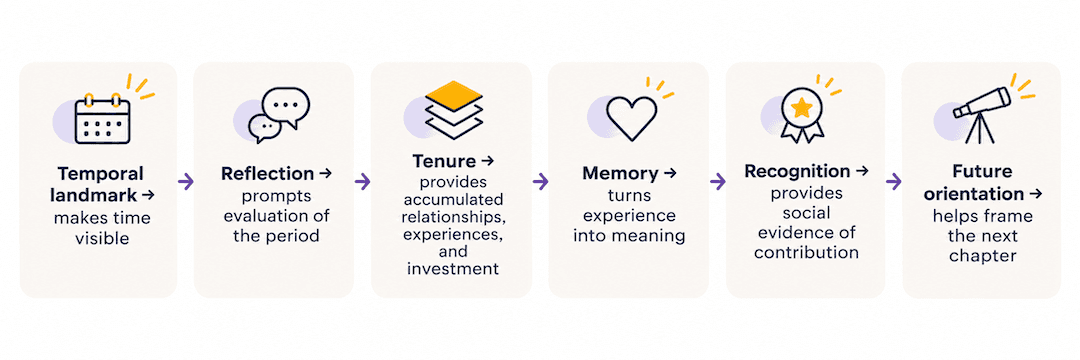
The research shared here is not Workhuman's research. And some of it is more telling than others. But together, I think it points the way to a richer process. Temporal landmarks can make time unusually visible. Tenure gives employees a history to examine. Memory helps turn that history into meaning. Recognition introduces the perspectives of other people, making contribution socially visible. And the boundary between one chapter and the next can bring the future into view as well as the past.
None of this means a work anniversary can manufacture loyalty or prevent someone from leaving. It means the moment deserves more ambition than simply rewarding elapsed time.
By the time employees reach a milestone, they have already lived the story. The organization's opportunity is to help them see what that story contains: the work they shaped, the people they affected, the relationships they built, and the ways they grew.
Tenure tells us how long someone has been at your company. A meaningful service milestone helps answer the more important question: Did those years build a relationship worth continuing?
References
Research specifically testing the effects of years-of-service programs remains limited. This paper therefore draws on several adjacent bodies of evidence, including temporal landmarks, job embeddedness, organizational nostalgia, gratitude, perceived organizational support, meaningful work, and ritual. These sources may help explain the psychological processes that make service milestones significant, but it's important to note that most of the studies are not specifically about service milestones.
Throughout, associations are distinguished from causal findings, and evidence from broader psychological research cannot not be treated as direct proof of the effects of service-milestone programs.
Allan, B. A., Batz-Barbarich, C., Sterling, H. M., & Tay, L. (2019). Outcomes of meaningful work: A meta-analysis. Journal of Management Studies, 56(3), 500–528. https://doi.org/10.1111/joms.12406Opens in a new tab
Dai, H., Milkman, K. L., & Riis, J. (2014). The fresh start effect: Temporal landmarks motivate aspirational behavior. Management Science, 60(10), 2563–2582. https://doi.org/10.1287/mnsc.2014.1901Opens in a new tab
Eisenberger, R., Rhoades Shanock, L., & Wen, X. (2020). Perceived organizational support: Why caring about employees counts. Annual Review of Organizational Psychology and Organizational Behavior, 7, 101–124. https://doi.org/10.1146/annurev-orgpsych-012119-044917Opens in a new tab
Gallup & Workhuman. (2024). The Human-Centered Workplace: Building Organizational Cultures That Thrive. https://www.workhuman.com/resources/reports-guides/the-human-centric-workplace-gallup-report/
Grant, A. M., & Gino, F. (2010). A little thanks goes a long way: Explaining why gratitude expressions motivate prosocial behavior. Journal of Personality and Social Psychology, 98(6), 946–955. https://doi.org/10.1037/a0017935Opens in a new tab
Harvard Business Review. (2016). Why people quit their jobs. Harvard Business Review, September 2016. [Reporting research conducted by CEB.]
Hobson, N. M., Schroeder, J., Risen, J. L., Xygalatas, D., & Inzlicht, M. (2018). The psychology of rituals: An integrative review and process-based framework. Personality and Social Psychology Review, 22(3), 260–284. https://doi.org/10.1177/1088868317734944Opens in a new tab
Jiang, K., Liu, D., McKay, P. F., Lee, T. W., & Mitchell, T. R. (2012). When and how is job embeddedness predictive of turnover? A meta-analytic investigation. Journal of Applied Psychology, 97(5), 1077–1096. https://doi.org/10.1037/a0028610Opens in a new tab
Leunissen, J. M., Sedikides, C., Wildschut, T., & Cohen, T. R. (2018). Organizational nostalgia lowers turnover intentions by increasing work meaning: The moderating role of burnout. Journal of Occupational Health Psychology, 23(1), 44–57. https://doi.org/10.1037/ocp0000059Opens in a new tab
Leunissen, J. M., van Dijke, M., Wildschut, T., & Sedikides, C. (2024). Organizational nostalgia: The construct, the scale and its implications for organizational functioning. British Journal of Management, 35, 816–838. https://doi.org/10.1111/1467-8551.12740Opens in a new tab
Mitchell, T. R., Holtom, B. C., Lee, T. W., Sablynski, C. J., & Erez, M. (2001). Why people stay: Using job embeddedness to predict voluntary turnover. Academy of Management Journal, 44(6), 1102–1121. https://doi.org/10.2307/3069391Opens in a new tab
Rhoades, L., & Eisenberger, R. (2002). Perceived organizational support: A review of the literature. Journal of Applied Psychology, 87(4), 698–714. https://doi.org/10.1037/0021-9010.87.4.698Opens in a new tab
van Dijke, M., Leunissen, J. M., Wildschut, T., & Sedikides, C. (2026). Organizational nostalgia facilitates prioritization of important personal work goals. Journal of Vocational Behavior, 166, 104231. https://doi.org/10.1016/j.jvb.2026.104231Opens in a new tab
Wang, X., Sheng, G., & Zhu, Y. (2026). Psychological effects of temporal landmarks: A meta-analysis of affective, cognitive, and self-regulatory processes. Acta Psychologica, 270, 107747. https://doi.org/10.1016/j.actpsy.2026.107747Opens in a new tab
Workhuman. (2025). The Tangible Value of Appreciation: 2025 Workhuman Global Research Study – Rewards. https://www.workhuman.com/resources/reports-guides/2025-workhuman-global-rewards-research/
Workhuman. (2026). 2026 Humans at Work Barometer. https://www.workhuman.com/resources/reports-guides/2026-workhuman-global-barometer-report/

Darcy Jacobsen
Darcy is a passionate storyteller and champion of workforce transformation, human connection, and recognition-driven culture. As an author on the Workhuman blog, she loves to connect deep research insights with modern workplace dynamics to uncover what really drives engagement, belonging, and happiness at work. With a background in communications and a master's in medieval history, she brings a unique perspective to her writing, taking deep dives into all topics around organizational psychology and the science of gratitude.