
10 Non-Monetary Incentives to Reward Employees in 2026
by Ryan Stoltz
Last updated
7 min read
Table of contents
- What are non-monetary incentives?
- What is the purpose of non-monetary incentives?
- What are the benefits of non-monetary rewards?
- What are the main types of non-monetary incentives?
- 10 examples of non-monetary incentives for employees
- How to implement non-monetary incentives
- Common challenges with non-monetary incentives
- How non-monetary incentives support employee engagement
- Frequently asked questions
Share this article
Employees do not experience every reward the same way. A timely thank-you from a manager, an extra day off after a demanding launch, or the chance to lead a visible project may stay with someone longer than a generic perk.
That is the appeal of non-monetary incentives: They recognize contribution in ways that can feel personal, immediate, and relevant. But they work best when they complement – not replace – fair pay, work-life balance, reasonable workloads, and a healthy employee experience.
This guide explains what non-monetary incentives are, the benefits and trade-offs, 10 practical examples, and how to build a program employees perceive as meaningful and fair.
What are non-monetary incentives?
Non-monetary incentives are rewards, recognition, opportunities, or benefits delivered in a form other than cash compensation. Employers use them to acknowledge contributions, reinforce behaviors, support growth, or make work more sustainable.
HR teams often use the term in two ways. In the narrow sense, it means no-cost or low-cost recognition, such as praise, visibility, mentoring, or a stretch assignment. In the broader sense, it also includes non-cash rewards with financial value, such as extra paid time off, merchandise, meals, or experiences. Clarifying which definition your employee benefits wellness program uses sets better expectations.
Common categories include employee recognition, flexibility and time, professional development, wellbeing and community benefits, and symbolic or experiential rewards.
What is the purpose of non-monetary incentives?
At their best, non-monetary benefits help employees answer three practical questions:
- Was my contribution noticed?
- What behavior or outcome did the organization value?
- Will good work lead to meaningful support, opportunity, or appreciation?
That makes incentive design a culture decision. Recognizing collaboration reinforces collaboration. Offering development signals that growth matters. Providing recovery time after an intense project signals that wellbeing matters. The reward communicates what the organization values, so the criteria and delivery matter as much as the reward itself.
What are the benefits of non-monetary rewards?
Well-designed rewards can strengthen the employee experience without reducing every contribution to a cash transaction. Their value depends on relevance, quality, fairness, and follow-through.
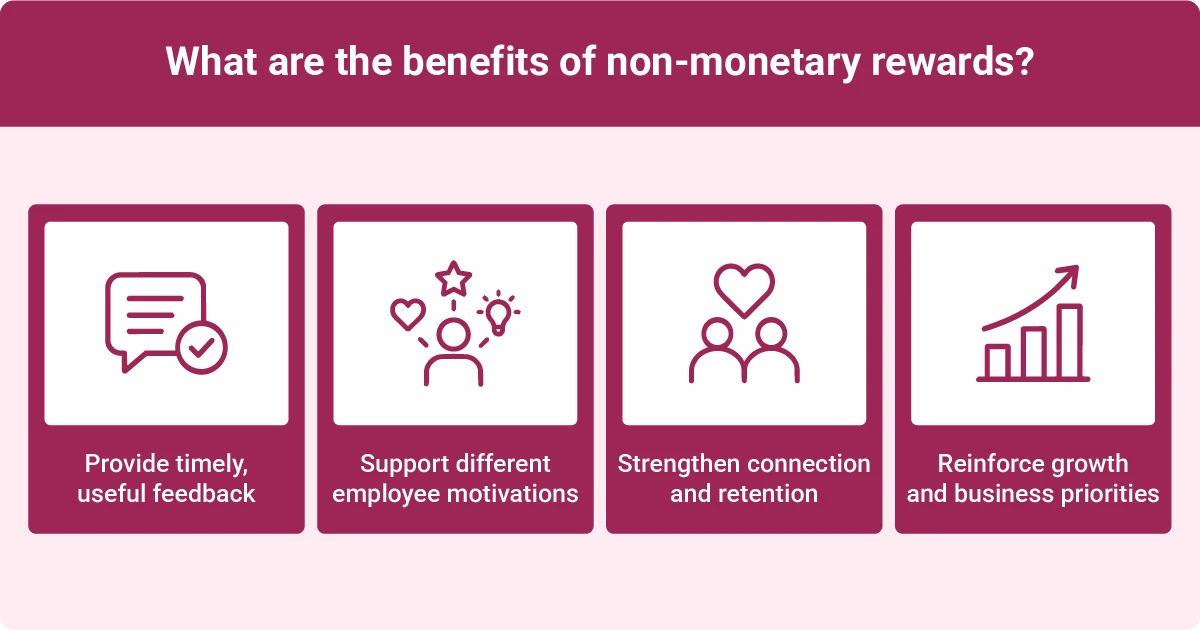
Provide timely, useful feedback
Annual compensation decisions are important, but they are infrequent. A specific acknowledgment close to the contribution gives feedback when it is most useful. The strongest recognition names what happened, why it mattered, and which value or goal it advanced.
Respect different sources of employee motivation
Some employees value public appreciation; others prefer a private note. One person may welcome a development opportunity, while another needs flexibility or recovery time. Offering choice makes the incentive more personal and reduces the risk of offering rewards that do not motivate employees and that they do not value.
Strengthen connection and retention
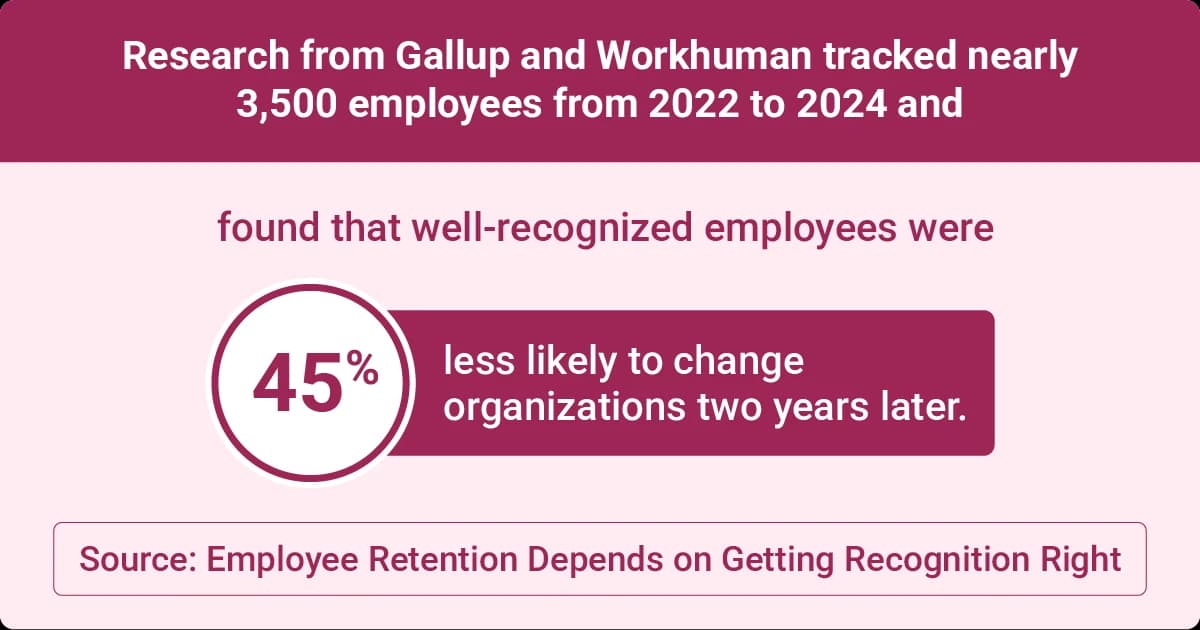
Longitudinal research from Gallup and Workhuman, “Employee Retention Depends on Getting Recognition RightOpens in a new tab”, tracked nearly 3,500 employees from 2022 to 2024. It found that well-recognized employees were 45% less likely to have changed organizations two years later.
That finding does not mean a thank-you alone prevents turnover; it shows the potential value of high-quality recognition as part of a broader employee experience.
Reinforce growth and business priorities
Non-monetary rewards can direct attention toward priorities such as learning, customer service, safety, innovation, or collaboration.
Gallup and Workhuman, in the research “Employee Upskilling Is Vital in Rapidly Evolving Job Market”, found that employees who said learning a new skill was commonly recognized in their workplace were 56% more likely to strongly agree they were motivated to learn new skills. The practical lesson is to recognize the behaviors that help the organization and its people grow.
What are the main types of non-monetary incentives?
- Recognition and appreciation: Specific praise, peer-to-peer recognition, manager acknowledgment, values-based recognition, and visibility for meaningful contributions.
- Time and flexibility: Extra paid time off, flexible schedules, shift choice, predictable scheduling, recovery time, or meeting-free focus blocks.
- Growth and opportunity: Mentorship, sponsorship, stretch assignments, job shadowing, learning time, and leadership exposure.
- Wellbeing and community: Wellness resources, caregiver flexibility, volunteer time, community activities, and support for sustainable ways of working.
- Symbolic or experiential rewards: Personalized keepsakes, meals, experiences, charitable options, celebrations, or other non-cash rewards.
10 examples of non-monetary incentives for employees
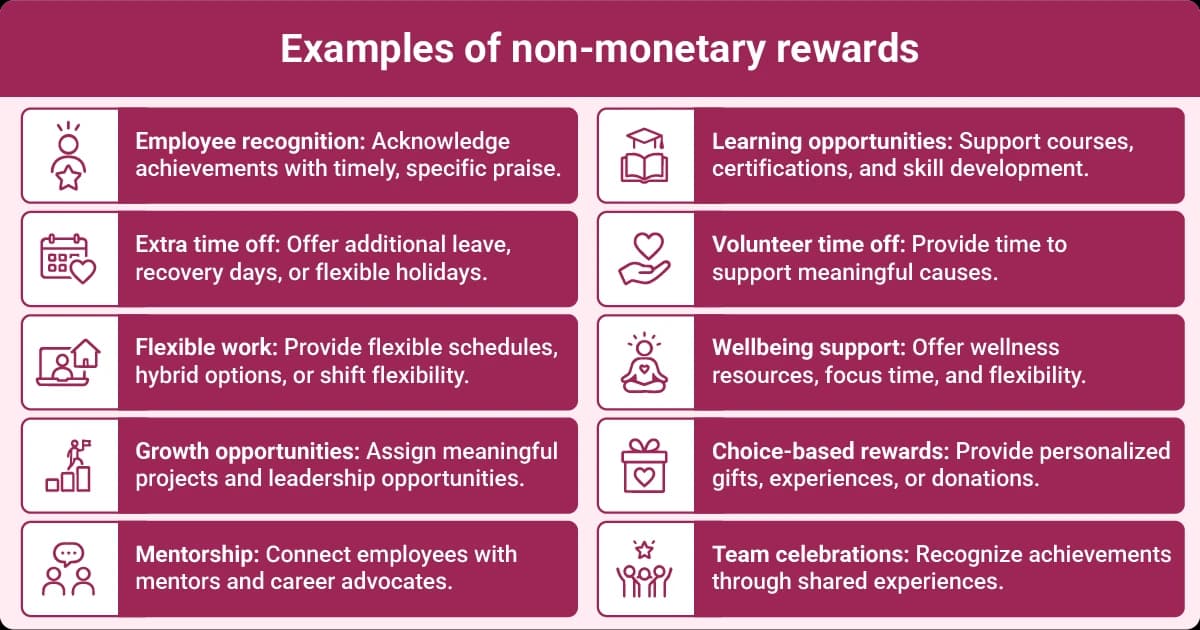
- Specific employee recognition: A peer or manager could give a timely acknowledgment. They should name the action, the impact, and the value it demonstrated. Ask whether the recipient prefers public praise, a private message, or both. A structured employee recognition program can help make this practice more consistent. Best practices for employee recognition programs to help this program reach its potential.
- Extra paid time off or recovery time: Offer an additional day off, a summer Friday, birthday leave, or a post-project recovery day. Publish clear eligibility criteria and plan coverage so employees can use the time without returning to an unmanageable workload.
- Flexible work arrangements: Consider role-appropriate options such as flexible start and end times, shift swaps, predictable scheduling, hybrid days, or compressed hours. For jobs that cannot be done remotely, offer an equivalent form of flexibility rather than a second-class experience.
- Stretch assignments and visibility: Invite an employee to lead a project, present to senior leaders, join a cross-functional group, or own a process improvement. Pair visibility with decision-making authority, coaching, and time; do not use “development” as a label for unsupported extra work.
- Mentorship and sponsorship: Mentors provide guidance, while sponsors advocate for opportunities. Match participants based on goals and track access so these relationships do not depend only on informal networks.
- Learning and development: Provide paid learning time, job shadowing, courses, conference access, or certification support. Connect the opportunity to the employee’s growth goals and give them room to apply what they learn.
- Volunteer time off: Give employees time to support causes they choose, participate in service days, or contribute professional skills to community organizations. Offer alternatives for employees who cannot join scheduled events.
- Wellbeing support: Examples include wellness days, focus time, meeting-free blocks, counseling resources, caregiver flexibility, movement options, or mindfulness programs. A broad approach avoids treating gym access as a universal solution. Explore employee wellness program ideas.
- Choice-based non-cash rewards and experiences: Options may include merchandise, meals, donations, local experiences, or personalized keepsakes. Let employees choose, and localize the employee appreciation gift ideas wherever possible. These rewards are non-cash, but they are not necessarily no-cost.
- Team celebrations and meals: Mark a shared achievement with an inclusive meal, virtual event, off-site activity, or collective recognition moment. Include remote and frontline employees, and account for dietary, accessibility, scheduling, and cultural needs.
How to implement non-monetary incentives
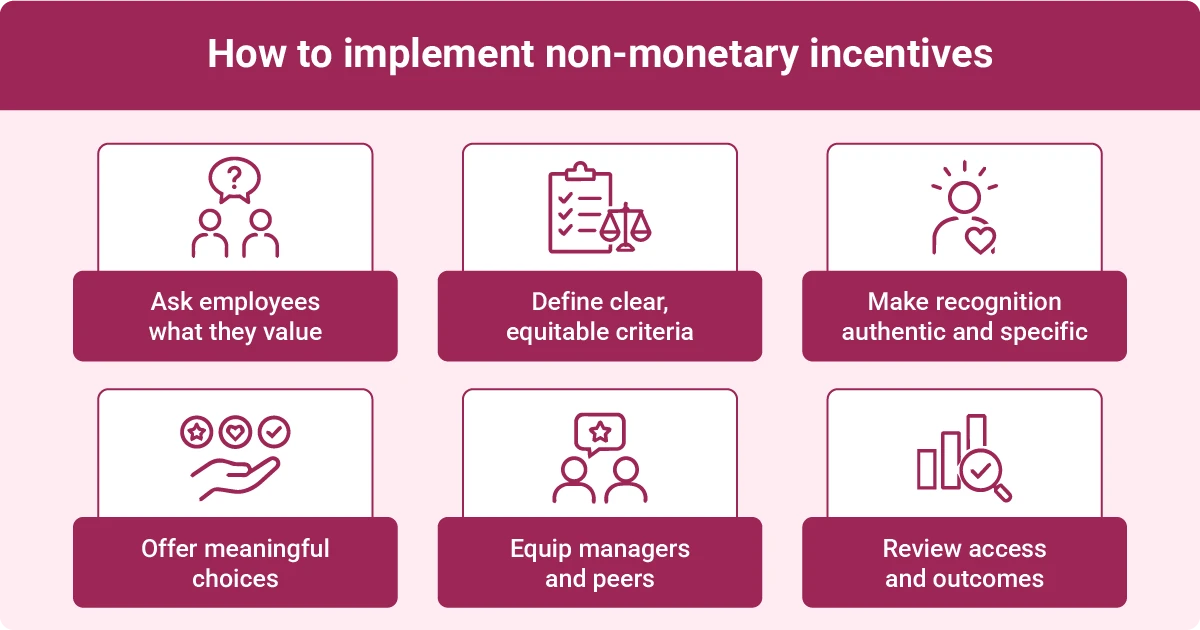
Ask employees what they value
Use a short survey, focus groups, manager check-ins, or employee resource groups to learn how people prefer to be recognized. Ask about public versus private praise, time versus experiences, growth opportunities, and barriers to participation. Revisit preferences periodically rather than assuming they stay fixed.
Define clear, equitable criteria
Explain which contributions are eligible, who can nominate or approve, how often incentives may be given, and what guardrails apply. Review participation by role, shift, location, tenure, and other relevant groups to identify access gaps. A program cannot feel fair if visibility determines who gets recognized.
Make recognition authentic and specific
Generic praise can feel like a transaction. The Gallup and Workhuman research, “Is Your Employee Recognition Really Authentic?” emphasizes that recognition should feel meaningful, honest, earned, and tied to a contribution or priority. Give managers examples and prompts, but leave room for a human voice.
Offer choice without creating friction
A curated set of options is usually more useful than either a single reward or an overwhelming catalog. Make eligibility, selection, approval, and claiming easy to understand. The recognition moment should not be followed by an administrative obstacle course.
Equip managers and peers
Managers are important sources of recognition, but they should not be the only ones. Enable peer-to-peer appreciation, clarify when a formal award is appropriate, and train people to describe impact rather than rely on vague compliments.
Review access and outcomes
Track more than the number of awards or perks distributed. Review participation patterns, time to recognition, use or claim rates, employee preferences, perceived fairness, and feedback on program quality. Compare these signals with employee satisfaction, engagement, and retention trends without assuming that one program caused every change.
At scale, technology can help establish a consistent process without making recognition feel automated. Social Recognition® from Workhuman® is designed to support peer-to-peer and manager recognition in the flow of work, connect appreciation to company values, and give program teams visibility into participation and administration.
Common challenges with non-monetary incentives
- A one-size-fits-all approach: The same incentive can delight one employee and disappoint another. Use choice and preference data instead of demographic assumptions.
- Unequal access: Remote, frontline, part-time, newer, or less visible employees may receive fewer opportunities. Audit participation and design equivalent options across roles.
- Perks masking structural problems: Recognition cannot repair inequitable pay, chronic understaffing, unclear expectations, or an unsustainable workload. Address the underlying issue instead of adding a perk on top of it.
- Rewarding visibility instead of impact: Highly visible work is easier to notice than behind-the-scenes contributions. Encourage nominators to look for collaboration, prevention, care, knowledge sharing, and other less visible forms of value.
- Program fatigue or inconsistency: Enthusiasm fades when criteria change, budgets disappear, or leaders stop participating. Assign clear ownership, communicate changes, and sustain the practices you introduce.
How non-monetary incentives support employee engagement
Quality matters more than volume. An organization can distribute many perks and still leave employees feeling unseen if recognition is generic, access is uneven, or the underlying work experience is poor. Measure whether employees understand the program, can use it, and believe the process is authentic and fair.
Frequently asked questions
What are non-monetary incentives for employees?
Rewards, recognition, opportunities, or benefits provided in a form other than cash are all categorized under non-monetary compensation. Examples include praise, flexible work, extra time off, mentorship, learning opportunities, wellbeing support, experiences, and symbolic rewards.
How do non-monetary incentives differ from monetary incentives?
Monetary incentives are delivered as money, such as salary increases, bonuses, commissions, or cash awards. Non-monetary incentives are delivered in another form. Some are free or low-cost, while others, including paid time off, merchandise, or experiences, still have financial value.
Are non-monetary incentives more effective than monetary incentives?
Neither category is universally more effective. Pay and cash incentives address compensation, while non-monetary incentives can provide appreciation, autonomy, growth, connection, or flexibility. The strongest approach starts with fair compensation and uses relevant incentives to reinforce the employee experience.
What are low-cost non-monetary incentives?
Examples include a specific thank-you, peer recognition, a handwritten note, choice of assignment, meeting-free focus time, job shadowing, a mentoring conversation, or an opportunity to present work to a broader audience. Low cost should not mean low effort or generic praise.
Can non-monetary incentives replace a raise?
No. Recognition, flexibility, or development should not be used to avoid an appropriate pay increase or to compensate for expanded responsibilities. Use non-monetary incentives as a complement to fair and transparent compensation practices.
How can non-monetary incentives improve employee morale?
They can show that contributions are noticed, give employees more choice or support, and create moments of connection. The effect depends on whether the incentive is sincere, relevant, fairly distributed, and backed by a healthy work environment.
Conclusion
The most effective non-monetary incentive is not necessarily the most expensive or visible. It is the one that fits the employee, clearly connects to a real contribution, and is delivered through a process people trust.
Start with one behavior or moment you want to recognize, ask employees what would feel meaningful, and test a small set of options. When appreciation is specific, access is equitable, and follow-through is reliable, incentives become more than perks.
Build a recognition experience employees can trust. Explore Social Recognition from Workhuman.

Ryan Stoltz
Ryan is a search marketing manager and content strategist at Workhuman where he writes on the next evolution of the workplace. Outside of the workplace, he's a diehard 49ers fan, comedy junkie, and has trouble avoiding sweets on a nightly basis.
Recommended for you