10 Effective Leadership Communication Skills Every Leader Should Master
Table of contents
- What is leadership communication?
- 10 critical communication skills every leader must have
- Real-world examples: Good vs. bad leadership communication
- Why is effective communication important in leadership?
- 8 practical tips and best practices for communicating effectively as a leader
- Common leadership communication challenges and how to tackle them
- Leadership communication skills for new managers
- FAQ
- Concluding thoughts: Why exceptional communication skills drive great leadership
Most leaders underestimate how much their communication style shapes team performance, retention, and trust. Research consistently links communication quality with leadership effectiveness ratings, yet many managers rely on instinct rather than intentional skill development.
Leadership communication skills are the verbal, written, and non-verbal methods leaders use to influence, align, and inspire their teams toward shared goals. These skills differ from general business communication through their emphasis on vision-casting, motivation, and stakeholder management rather than transactional coordination.
This guide defines the four core pillars of leadership communication: clarity, active listening, empathy, and adaptability. You'll learn practical techniques for each pillar, discover how to assess your current strengths and gaps, and access actionable frameworks for developing these capabilities across your organization.
Whether you're an HR leader designing development programs or a people manager working to strengthen your own effectiveness, you'll find research-backed strategies and real-world examples that translate directly into better outcomes for your team.
What is leadership communication?
According to researchers in the journal, Current Opinion in Psychology,Opens in a new tab leadership communication is the process of sharing your vision and goals to inform, motivate, and guide your team. Rather than simply delegating tasks, this leadership skill encourages you to help employees understand why their work is important and how it supports the rest of the team.
Effectively communicating your mission, goals, and objectives motivates employees to fulfill their responsibilities with minimal oversight or management. Strong communication skills can also keep your team on the same page, reducing the risk of confusion, errors, or differing values.
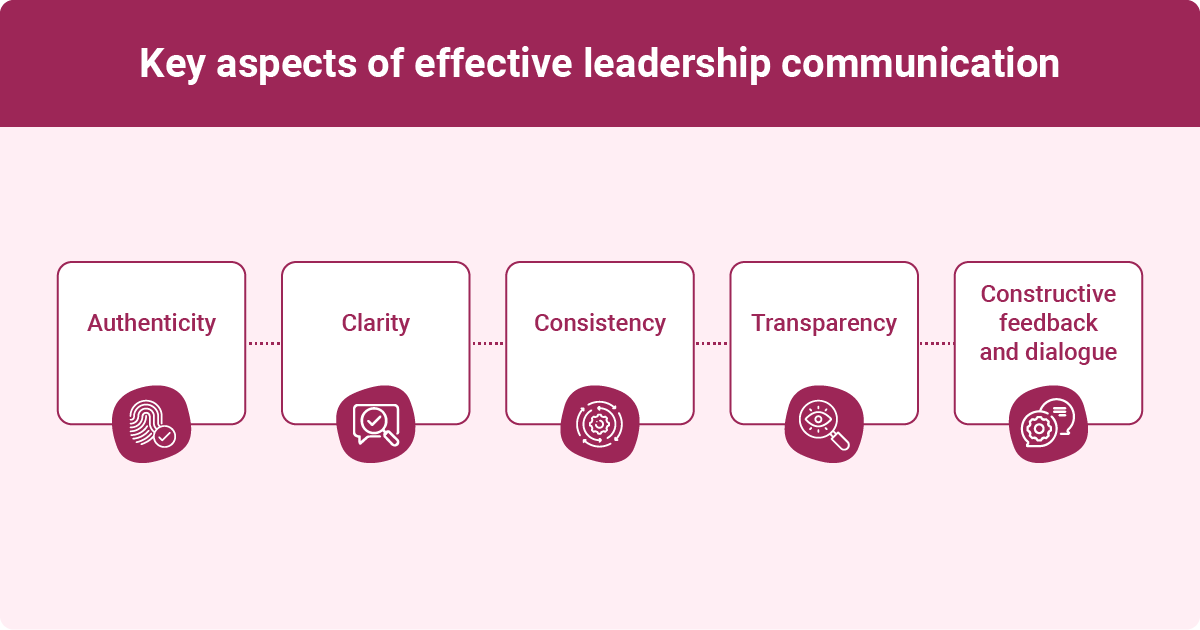
Key aspects of effective leadership communication
Leadership communication skills are complex and multilayered, requiring you to consider various aspects of how you interact with employees. Explore the primary aspects of effective communication skills in leadership.
Authenticity
Leading authentically can build trust and improve your relationships with employees. Authenticity is about making sure your team sees you as genuine, honest, and consistent.
You have to be aware of your personal strengths, weaknesses, and perceptions to ensure you're properly representing yourself. Focus on your relationship with employees by making time to socialize, get to know them, and share a little about yourself.
Clarity
An essential aspect of communication is delivering your message clearly and comprehensively. Clear communication will keep your teams aligned on goals, tasks, and values, and reduce the risk of mistakes or misconceptions holding back operations.
Clear leadership communication focuses on the who, what, when, why, and how of every task you delegate. This means you must clearly define roles, establish objectives and deadlines, and explain the task's importance while being as specific as possible.
Consistency
As an effective leader, you must be able to "walk the walk" and back up your words with action. Consistency is about following through on your promises and goals, establishing that you're putting in as much effort as the rest of your team. It's also about maintaining your standards and values, such as by not breaking rules or giving certain employees special treatment over others.
For example, when adopting a new software or tool, take the time to learn how to use it effectively yourself before teaching your team. This gives you an opportunity to lead by example and prove that you're willing to do everything you're asking your team to do.
Transparency
Transparency and honesty are crucial for building and maintaining trust with your team. Openly discuss the latest changes at your business, the reasoning behind decisions, and the challenges you're currently up against. This honesty can build mutual trust with employees and make them more likely to be open with you, including when addressing their personal challenges and concerns.
Constructive feedback and dialogue
Being able to effectively share constructive criticism and feedback is another crucial communication skill that can significantly impact your relationship with employees. Some people naturally handle rejection and negative feedback differently than others. Effective empathy and communication skills help you approach each conversation with sensitive, goal-oriented dialogue that makes each employee feel recognized and supported.
10 critical communication skills every leader must have
Effective communication in leadership requires you to combine various skills and competencies. So what are the essential communication skills for today's market? Here are ten essential skills in leadership communication that you should know.
1. Active listening
Effective communication focuses on more than just sharing ideas. You must also listen to and digest others' ideas and perspectives, especially when leading a diverse team. According to research in the Annual Review of Organizational Psychology and Organizational Behavior, active listening skills can improve clarity, collaboration, and your relationship with employees.
These skills encourage you not just to hear what others are saying but to genuinely put effort into understanding their words and non-verbal cues without judgment. Take time to ask clarifying questions, and minimize distractions to show that you genuinely care about their perspective.
2. Emotional intelligence
Emotional intelligence is your ability to process and manage your personal emotions and respond to the emotions of others around you. This key leadership communication skill can help you self-regulate, lead by example, and establish a healthy environment that supports positive communication. Practicing emotional intelligence exercises can also strengthen your empathy, decision-making, relationship-building, and conflict-resolution skills.
3. Adaptability to different communication styles
People communicate and listen in many different ways. For instance, some employees may require visual learning or verbal learning options when adopting new software and technology to effectively digest all the new information.
Adapting to employees' unique communication styles is a key leadership communication skill. As an inclusive leader, you may need to adjust how you share information based on the audience and situation. Practice different types of communication in leadership, such as direct and authoritative or amiable and team-focused, to learn what works best for your team.
4. Feedback delivery
Providing constructive, timely, and actionable feedback is a crucial leadership role. You can give feedback effectively by establishing trust, being specific, and framing criticism as opportunities for improvement. Focusing on employees' behavior rather than making criticism personal can make them feel safer and help them listen to what you actually have to say. Practicing healthy and constructive communication can also foster a culture of continuous feedback.

5. Body language
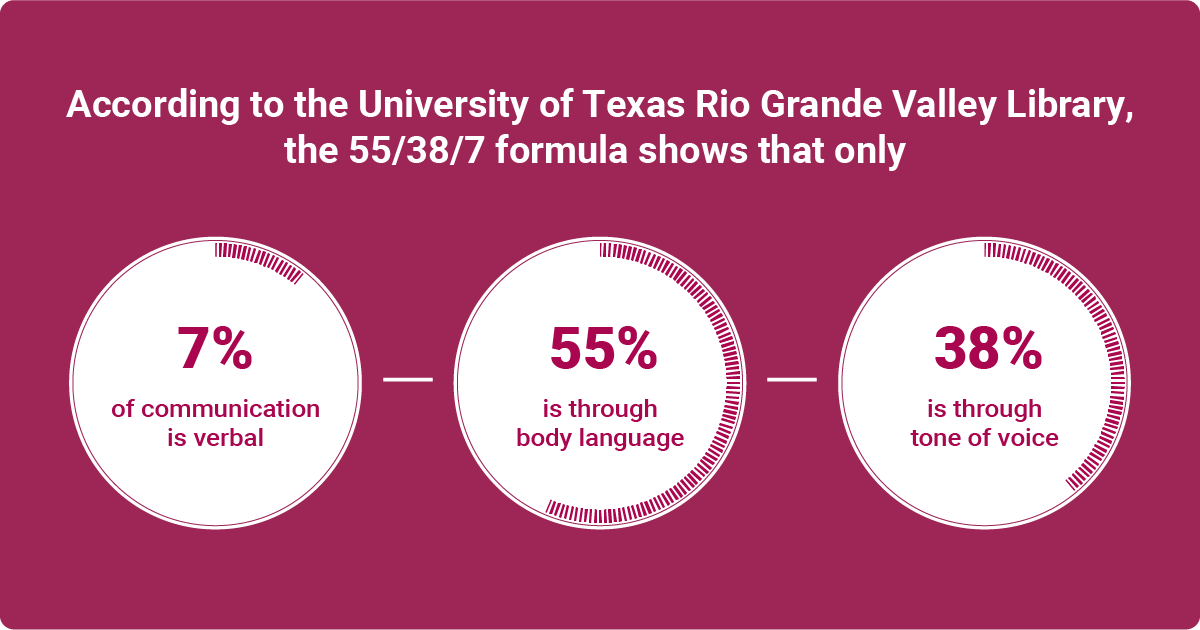
According to the University of Texas Rio Grande Valley Library, the 55/38/7 formula suggests that only 7% of communication is delivered verbally. 55% is delivered through body language and 38% through paraverbal cues, such as your tone of voice. This stresses the need to be aware of your nonverbal communication and to recognize the potential meaning behind employees' facial expressions, tones, and body language.
6. Delegation skills
At a basic level, delegation is about assigning responsibilities and tasks clearly based on each employee's unique strengths, goals, schedules, and other variables. Beyond that, effective delegation relies on clear communication to avoid confusion, motivate teams, and raise productivity.
As a leader, this often requires you to consider exactly how much you communicate with each employee. While you should comprehensively explain your reasoning and goals behind each task, you typically shouldn't micromanage every step of the process. Instead, trust employees and give them the autonomy to create their own personalized workflows.
7. Written communication
Communication skills tend to differ between the spoken and written words. Written communication skills can help you convey clear, concise, and effective messages through emails, reports, and other written materials.
Written communication gives you more time to consider and revise every word you use to effectively get your message across. However, without nonverbal communication, readers may interpret your message in many different ways. For instance, sarcasm is difficult to identify when written, so employees may misinterpret sarcasm when you use it or wrongly believe you're being sarcastic when you're not.
8. Presentation and storytelling skills
Being able to present information effectively and engage listeners is crucial for leadership, whether you're sharing details with employees, clients, or stakeholders. Practicing different ways to communicate ideas can help you adapt to different audiences, such as in meetings, conferences, and team briefings.
According to MakingStories.netOpens in a new tab , storytelling is a particularly powerful communication tool that lets you connect with others on an emotional and personal level. For instance, sharing how a new work process genuinely improves client or customer experiences can motivate employees to adopt it, because they'll understand why it's important.
9. Conflict resolution
As a leader, you should be able to address disagreements and conflicts in ways that foster understanding and collaboration. You can't just dismiss a conflict and tell people not to discuss it again. Instead, you must use your active listening, empathy, and problem-solving skills to understand and resolve the problem appropriately, prioritizing win-win outcomes whenever possible.
10. Inclusivity
Are you really having a conversation with your team if some members don't feel comfortable sharing their thoughts? Fostering a diverse and inclusive environment ensures that all voices are heard and valued in team discussions, establishing a sense of belonging and trust.
Tools such as Workhuman's® Inclusion Advisor™ can empower employees to make communication more meaningful and inclusive by recognizing everyone's unique contributions.
There's no room for bias in the workplace. Luckily, Inclusion Advisor helps to identify and mitigate ableist language, shifting the culture of your organization one recognition message at a time.
Real-world examples: Good vs. bad leadership communication
Even the “right” leadership communication skills can land the wrong way if the timing, channel, or phrasing is off. The examples below show how transparent, two-way communication builds trust during uncertainty — and how avoidance, inconsistency, or one-way messaging can quickly erode it.
Small shifts (private vs. public feedback, “here’s what we know” vs. silence, listening first vs. fixing fast) often make the difference between engagement and attrition.
Example 1: Transparent communication during restructuring
Setup: A CEO anticipates a restructure that will include role reductions. Before individual notifications go out, she holds an all-hands to share the strategic rationale, the decision timeline, and what won’t change. She’s clear about what she can’t answer yet, and she names the emotional impact directly.
What worked: Employees heard the “why” early enough to avoid a rumor mill. The CEO balanced business reality with empathy: “Here’s what we know today, here’s what we’re still working through, and here’s how we’ll keep you updated.” She also opened two-way channels (office hours, anonymous Q&A, manager toolkits) so communication wasn’t just broadcast.
Outcome: Remaining employees report higher trust in leadership and less uncertainty-driven distraction — improving retention and engagement after the change.
Example 2: Feedback that demotivated a high performer
Setup: In a team meeting, a manager calls out a top performer’s missed deadline as a “pattern,” without prior context or specifics.
What failed: Public criticism triggered defensiveness and shame, and the vague feedback (“be more proactive”) didn’t give the employee a clear path to improve. The manager also missed a crucial leadership move: separating the person from the problem and inviting dialogue.
Better approach: A private conversation, specific examples, and a co-created action plan (“Here’s what I observed; what got in the way; what support would help?”).
Outcome: The employee disengages and leaves within three months — a costly loss that started with a preventable communication misstep.
Example 3: Active listening that prevented attrition
Setup: A director notices a usually engaged team member withdrawing. She schedules a 1:1 focused on listening, not performance.
What worked: She asks open questions, reflects back what she’s hearing, and validates feelings before problem-solving. Only after the employee feels heard do they collaborate on practical solutions (reprioritizing work, clarifying expectations, and agreeing on check-ins).
Outcome: The employee stays, performance rebounds, and trust in leadership deepens.
Why is effective communication important in leadership?
Clear, healthy, and practiced communication plays a critical role in leadership effectiveness. As per ‘11 Ways Employee Recognition Builds Better Managers’, as much as 70% of the variance in employee engagement can be attributed to their immediate supervisors, underscoring the direct impact of leadership communication on employees.

Discover 11 ways managers can boost engagement, productivity, and retention through recognition.
What are the benefits of good leadership communication?
From delivering feedback to delegating tasks, leadership communication skills support various aspects of management and human resources (HR) responsibilities. Explore the core benefits of these skills to understand why communication is so important in leadership.
Sets the tone
Effectively communicating tasks and goals can establish the attitude, values, and overall atmosphere you want to develop within your organization. Leading by example with healthy dialogue, nonverbal communication, and practice models appropriate behavior for the rest of your team. For instance, taking time to get to know each employee can encourage them to get to know one another, too, building company culture.
Creates unity and purpose
Effective communication can align teams by helping employees understand the significance of their work. For instance, an employee may be more likely to double-check their spreadsheets for errors if they recognize how much time the accounting team loses correcting mistakes.
Additionally, establishing a culture of open, honest communication supports collaboration and trust between employees, according to research in the Journal of Business and Management. A sense of unity can elevate productivity, morale, job satisfaction, and motivation, especially when working towards shared goals.
Boosts morale and engagement
Transparent communication builds trust, value, and purpose with employees while prioritizing clarity and specificity. An investigation in the Lakhomi Journal: Scientific Journal of Culture found that more transparent internal communication can develop a stronger company culture that supports employee engagement, morale, and motivation.
It can also give employees a stronger sense of belonging within your organization, making them more likely to engage with and support other colleagues and teams.
Clarifies expectations and reduces confusion
Clear communication sets expectations early to avoid misunderstandings, misaligned goals, and other operational setbacks. Be sure to define specific roles, goals, deadlines, and anticipated outcomes. Create opportunities for employees to ask questions when sharing the information and throughout the work process. Additionally, share specific expectations in writing, over email, or with other tools to reduce the risk of employees forgetting or misremembering key details.
Builds trust and rapport
Honest communication can strengthen your relationship with teams by building trust and unity. Beyond that, socializing with your team helps you build organic rapport and encourages them to socialize with each other, too. Practicing communication on easier days at work can then teach everyone how to communicate effectively with one another when solving problems or working under tight, stressful deadlines.
What are the hidden costs of miscommunication in leadership?
Miscommunication can negatively impact your team and organization more than you might expect. These are a few ways that ineffective communication can impair your leadership capabilities.
Productivity anxiety and stress
A lack of clear direction can leave employees confused about their responsibilities, their sense of purpose, and whether they're doing their jobs correctly. According to research by Educons University's Faculty of Business EconomicsOpens in a new tab , such misdirection and confusion can contribute to stress, reduced efficiency, and decreased employee well-being.
Distrust in leadership can also make it harder for employees to effectively digest feedback, take on new tasks, or believe the words you say.
Stalled innovation and risk avoidance
Poor communication can also hinder creative thinking. According to research in Revista de Gestão e Secretariado, employees will be more likely to develop creative solutions to problems if they understand all the goals and variables related to the issue. An open, judgment-free environment also helps make employees feel more comfortable brainstorming and sharing ideas.
Furthermore, ineffective communication can encourage risk-averse behavior. For instance, an employee who negatively interpreted feedback about their performance may not feel comfortable trying a new approach to their work if they're worried about getting in trouble again.
Breakdown in team cohesion and collaboration
Miscommunication can erode trust and collaboration among team members. Unclear goals, roles, and values may create conflict in day-to-day operations, especially if no one knows the "right way" to do things. Additionally, withheld or inconsistent information can create distrust and conflict between teams, making them less likely to trust you or anything anyone else says within your organization.
Frequent errors and rework
Ineffectively communicating tasks, expectations, or processes can also contribute to mistakes and unnecessary rework. For instance, failing to explain how employees should format spreadsheets can result in sheets being written and interpreted differently.
Communication-caused errors may negatively impact various aspects of your organization. For example, an incorrectly formatted order form could cause shipping delays, reduce inventory, and temporarily increase costs. A study in SSM - Qualitative Research in Health showed that communication gaps in healthcare can lead to diagnostic and treatment errors, potentially endangering patients' lives.

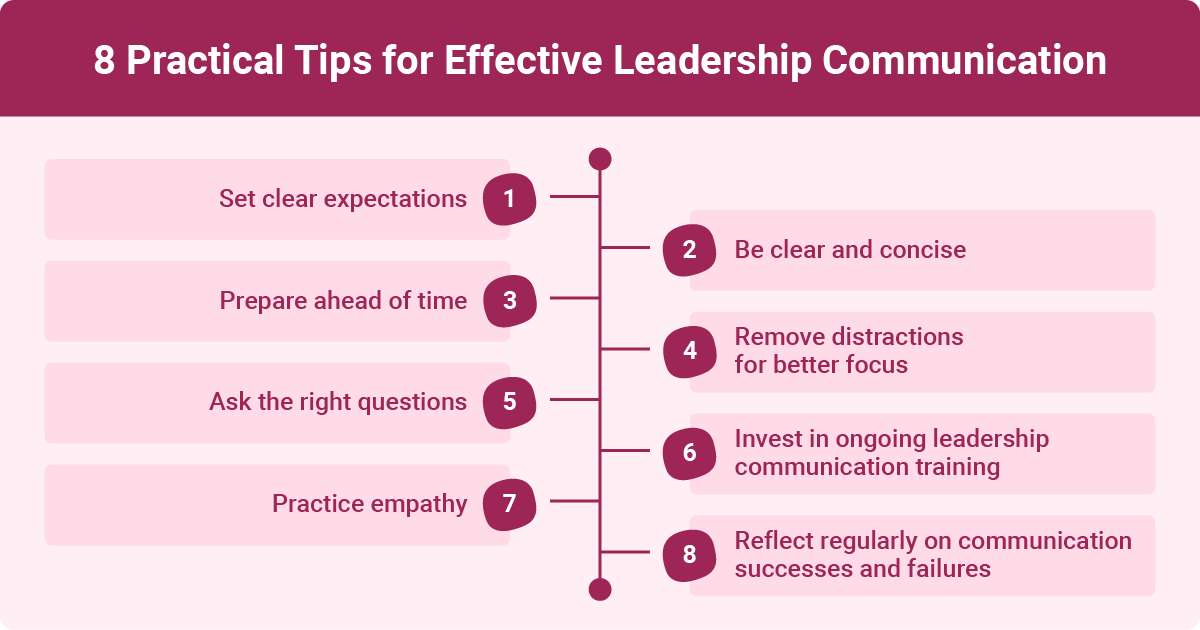
8 practical tips and best practices for communicating effectively as a leader
Learning how to improve your leadership communication skills is a continuous process as you adapt to new employees, teams, and industry trends. Implement these actionable communication tips and practices to improve your most important leadership competencies.
1. Set clear expectations
Setting clear expectations with well-defined goals and guidance keeps team members aligned, even when working on different tasks. This can foster a shared understanding within your team and reduce the risk of errors.
Key aspects of clear employee expectations include:
- Timeline: Establish deadlines and the amount of time you expect them to reasonably spend on each task.
- Responsibilities: Set fixed roles between team members to keep employees aligned and avoid duplicate work.
- Purpose: Explain why the task is significant and how it supports your organization, team, and customers.
- Quality: Are mistakes, such as typos, acceptable, or should outcomes be perfect, finished product-level quality?
- Quantity: Will they need to complete this task multiple times or create a specific number of outcomes?
2. Be clear and concise
Clarity and brevity are crucial in leadership communication, but balancing both can be quite challenging. You want to be specific and comprehensive when sharing important information, but not at the risk of losing your team's attention.
Try combining written and spoken work to avoid unnecessary complexity while still delivering all essential information. For instance, when sharing progress at a meeting, you can use a presentation to showcase specific data. Alternatively, you could provide only a brief overview during the meeting and then send all the statistics and numbers later in an email for employees to browse on their own schedule.
3. Prepare ahead of time
Preparing for leadership communication in advance can improve its effectiveness. Preparation strategies include:
- Taking time to understand your audience's needs and cultural backgrounds
- Tailoring your message around each unique individual
- Writing down and sharing your expectations and goals for the conversation
- Rehearsing dialogue in a mirror or with a colleague
4. Remove distractions for better focus
Nonverbal communication is crucial for effective communication. To promote this, try to eliminate distractions when talking to your team so they can focus on all cues. Strategies to reduce distractions and improve focus include:
- Encouraging active listening
- Limiting the use of phones during meetings
- Reducing background noise
- Introducing a "conversation ball" during group discussions
- Identifying tangents and practicing ways to steer the conversation back
5. Ask the right questions
Asking the right questions enhances your leadership communication by letting you learn more about your employees and their workflows. Try asking open-ended or probing questions rather than short-answer or yes-or-no questions to encourage thoughtful, conversational responses.
Asking questions can also show employees that you genuinely care about their perspective, further supporting trust and engagement.
6. Invest in ongoing leadership communication training
Effective leadership qualities and skills must be regularly learned and relearned to maintain healthy dialogue and trust. Investing in continuous leadership communication training supports your long-term professional development and growth. More importantly, the right courses and programs can help you learn how to meet and communicate with your current team at their level.
7. Practice empathy
According to research from Vaasa University of Applied Sciences, empathy skills help you identify employees' needs, recognize their nonverbal communication, and connect with them on an emotional level. This can build feelings of trust, safety, and comfort on your team, contributing to a more open and creative environment.
Practice empathy as a leader by:
- Actively listening to employees
- Validating employees' opinions and concerns
- Showing vulnerability and admitting to mistakes
- Considering how employees' needs and at-home lives impact their work
- Practicing patience and understanding in difficult situations
8. Reflect regularly on communication successes and failures
Self-reflection is a powerful, ongoing practice for improving communication in leadership. It supports personal growth, long-term leadership development, and your understanding of how others interpret your current communication style. Keeping a reflection journal, conducting regular self-assessments, and following other strategies can enhance your communication effectiveness over time.
Common leadership communication challenges and how to tackle them
Explore the most common challenges in leadership communication and actionable strategies to overcome them.
Balancing transparency with confidentiality
Leaders should be transparent and honest when communicating with their teams without compromising confidential or sensitive information. Setting boundaries about what you can and can't share within your team establishes clear expectations and affirms that you're not hiding information dishonestly.
Ensuring consistent messaging across different teams
Delivering consistent messages can be challenging when working with different teams, departments, roles, and priorities. Establishing a centralized communication channel for key messages keeps teams aligned, even in remote, hybrid, and distributed environments.
Navigating language barriers in diverse teams
Language barriers naturally impair communication, especially in global or multicultural environments. Fortunately, you can easily mitigate potential comprehension errors by offering translation or language support. Additionally, encourage employees (and yourself) to minimize jargon and use visual aids when possible.
Overcoming communication fatigue in teams
According to an independent researcher Thejan Anil,Opens in a new tab , communication fatigue caused by overloads of emails, notifications, and meetings can contribute to stress and limit the amount of information employees actually retain. Strategies to reduce communication fatigue include:
- Streamlining communication
- Prioritizing essential messages
- Limiting unnecessary meetings
- Encouraging team members to "unplug" when needed
Breaking down information silos
Information and data silos are the parts of your organization that isolate information and prevent it from being shared. Examples include personal laptops with important files not on the cloud or employees unwilling to share information with their teammates.
You can break down these silos by unifying your communication channels, fostering cross-departmental collaboration, and encouraging transparency.
Leadership communication skills for new managers
The shift from individual contributor to people leader is one of the toughest career transitions — and many first-time managers are expected to figure it out as they go.
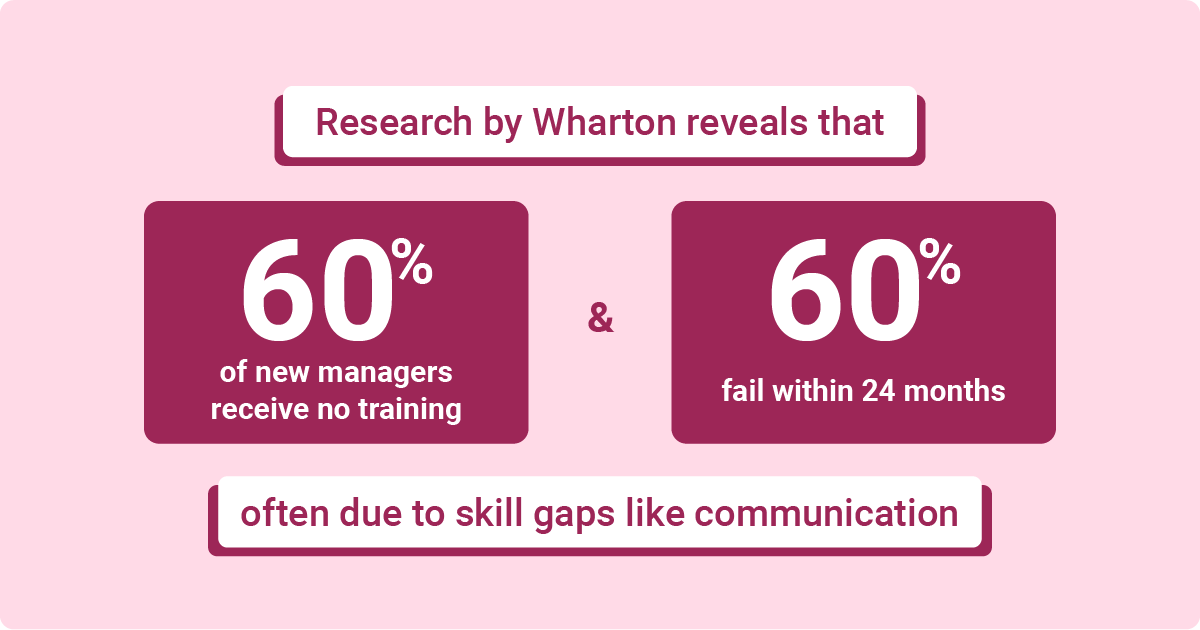
One widely cited data point: research referenced by Wharton, ‘Managing to Fail? Why New Leaders Need Training’, notes that 60% of new managers report receiving no training when they step into their first leadership role, and separate research cited in the same piece says 60% fail within their first 24 months, often due to skill gaps that include communication.
New managers often lean on technical expertise to build credibility, but leadership credibility is also relational: setting expectations clearly, addressing issues early, and building trust through consistent, two-way dialogue. The good news is that you don’t need to become a “perfect communicator” overnight — you need a few repeatable habits that prevent avoidable missteps.
Common communication challenges for new managers
- Balancing friendship with former peers while establishing authority: Aim for warmth and clarity. Over-indexing on either creates confusion.
- Delivering constructive feedback for the first time: Many managers avoid hard conversations altogether — a dynamic reflected in the research titled ‘Two-Thirds of Managers Are Uncomfortable Communicating with Employees’ is that 69% of managers are often uncomfortable communicating with employees, including giving direct feedback.
- Communicating decisions you didn’t make (or don’t fully agree with): Don’t “spin.” Share context, explain what’s changing, and focus on what you can do for the team (support, resources, next steps).
- Managing up: Practice translating team friction into business language: risks, trade-offs, and the specific ask you’re making.
Quick wins for new manager communication
- Schedule recurring 1-on-1s immediately and protect them. Even onboarding toolkits like ‘The First 90 Days: From Learning through Executing’ recommend weekly check-ins early on to build trust and clarify expectations.
- Over-communicate your availability and channels: “If it’s urgent, Slack me; if it’s complex, book time.”
- Ask more questions than you answer in your first 90 days: Use open-ended prompts and reflect on what you’re hearing before you problem-solve.
- Find a mentor or peer group to reality-check how your messages are landing.
FAQ
What are the most important communication skills for leaders?
The most important leadership communication skills are the ones that consistently build trust and clarity.
In practice, that usually means: active listening, clear and concise messaging, emotional intelligence (empathy + self-awareness), giving and receiving feedback, setting expectations, and communicating through change.
Strong leaders also tailor their message to the audience and choose the right channel (1:1, team meeting, written update) so the message lands the way it’s intended.
How can I communicate more clearly and concisely as a leader?
Start by getting to the point early: lead with the decision, the “why,” and the next step. Use simple language, cut filler, and limit each message to 1–3 key takeaways. If you’re asking for action, be specific about who owns it and when it’s due.
A helpful quick check before you hit send or speak: “What do I want people to know, feel, and do after this?”
How do I give constructive feedback without damaging relationships?
Give feedback privately, promptly, and with specific examples. Focus on observable behavior and impact (not personality), and invite dialogue: “Here’s what I noticed, here’s how it affected the work, and I’d like to understand what happened.”
Then co-create a forward-looking plan: what “good” looks like, what support is needed, and when you’ll follow up. Done well, feedback strengthens relationships because it signals trust and investment.
What role does Emotional Intelligence play in leadership communication?
Emotional intelligence is what helps leaders communicate with both clarity and care. It shapes tone, timing, and how you respond under pressure.
Leaders with strong EI read the room, manage their reactions, and acknowledge emotions without getting derailed by them. That’s especially critical during change, conflict, or high-stakes decisions — when people need both transparency and empathy to stay engaged.
Concluding thoughts: Why exceptional communication skills drive great leadership
Communication plays various essential roles in great leadership, from establishing expectations to building a healthy rapport. Mastering communication is essential for leadership success, but it requires you to continuously learn and relearn various other soft skills, including empathy, emotional intelligence, and active listening.
Workhuman can help you identify your team's strengths, skills gaps, and needs to further develop your leadership communication skills.
About the author
Ryan Stoltz
Ryan is a search marketing manager and content strategist at Workhuman where he writes on the next evolution of the workplace. Outside of the workplace, he's a diehard 49ers fan, comedy junkie, and has trouble avoiding sweets on a nightly basis.