
5 Signs of Toxic Work Culture and How to Address Them Effectively
by Ryan Stoltz
Last updated
13 min read
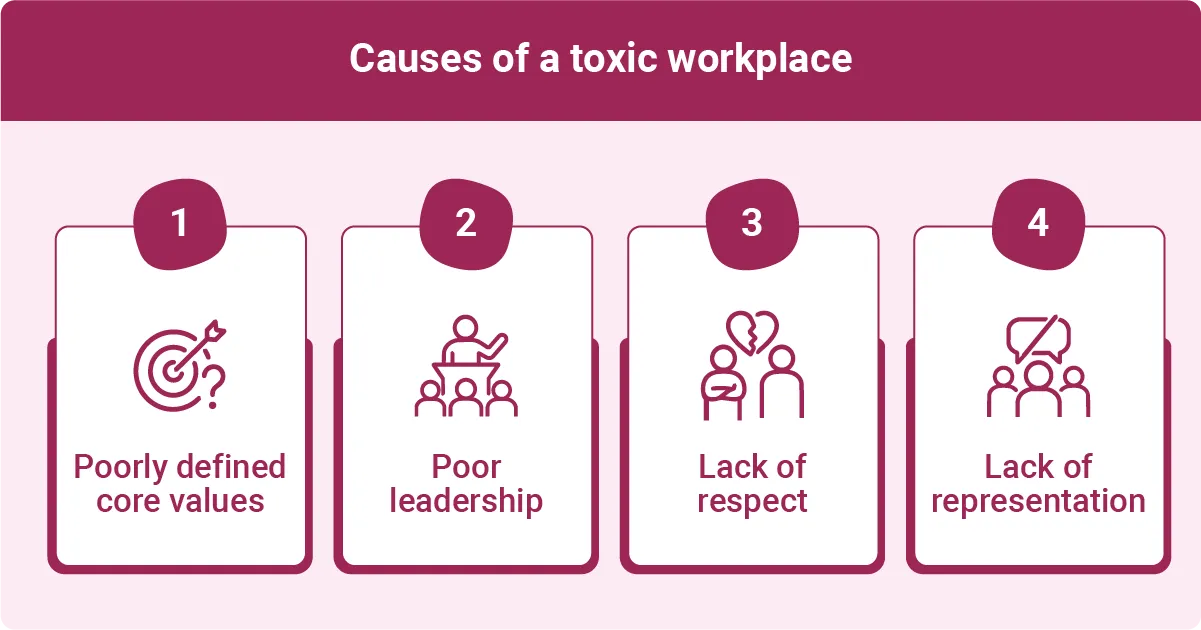
Table of contents
- What is a toxic work environment?
- Signs to identify a toxic company culture
- What are the causes of a toxic workplace?
- What are the effects of toxicity in the workplace?
- How can senior leaders help address a toxic environment at work?
- How can employees manage stress and thrive in an unhealthy work environment?
- The role of technology in combating toxic workplace culture
- Conclusion
- FAQs
Share this article
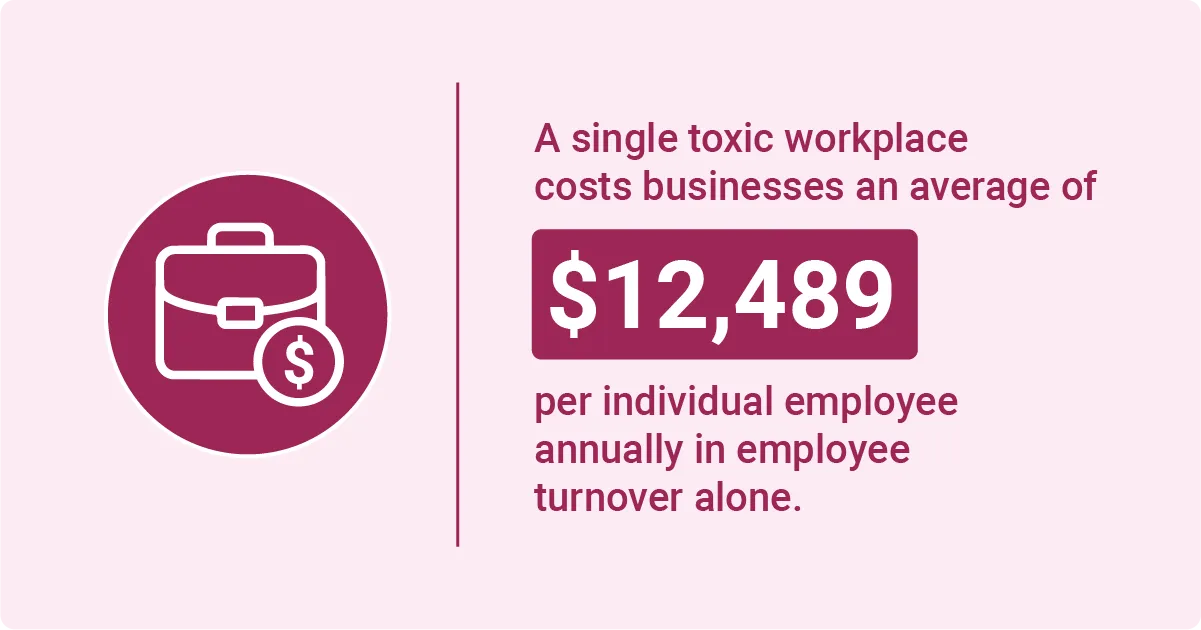
A single toxic workplace costs businesses an average of $12,489 per individual employee annually in employee turnover alone, as per Harvard Business School’s research “The Unacceptable Cost of Toxic WorkersOpens in a new tab”. That figure doesn't account for the costs of disengagement, absenteeism, and the slow erosion of a team's morale.
A toxic work culture translates to unchecked toxic behaviors, poor leadership habits, and structural failures. Employees start dreading Mondays, and managers stop listening. High performers leave without warning, and nobody seems surprised.
This article breaks down the signs of a toxic workplace, what causes them, and how they affect your people and your bottom line.
What is a toxic work environment?
Toxicity in a workplace isn't defined by a single bad day or one difficult colleague. It's systemic. It shows up in how decisions are made, how conflicts are resolved, how leadership communicates, and how employees treat one another.
Research published in MIT Sloan Management Review titled “Toxic Culture Is Driving the Great Resignation” identified toxic culture as the single strongest predictor of employee attrition. It's 10 times more powerful than compensation in driving people to quit.
Signs to identify a toxic company culture
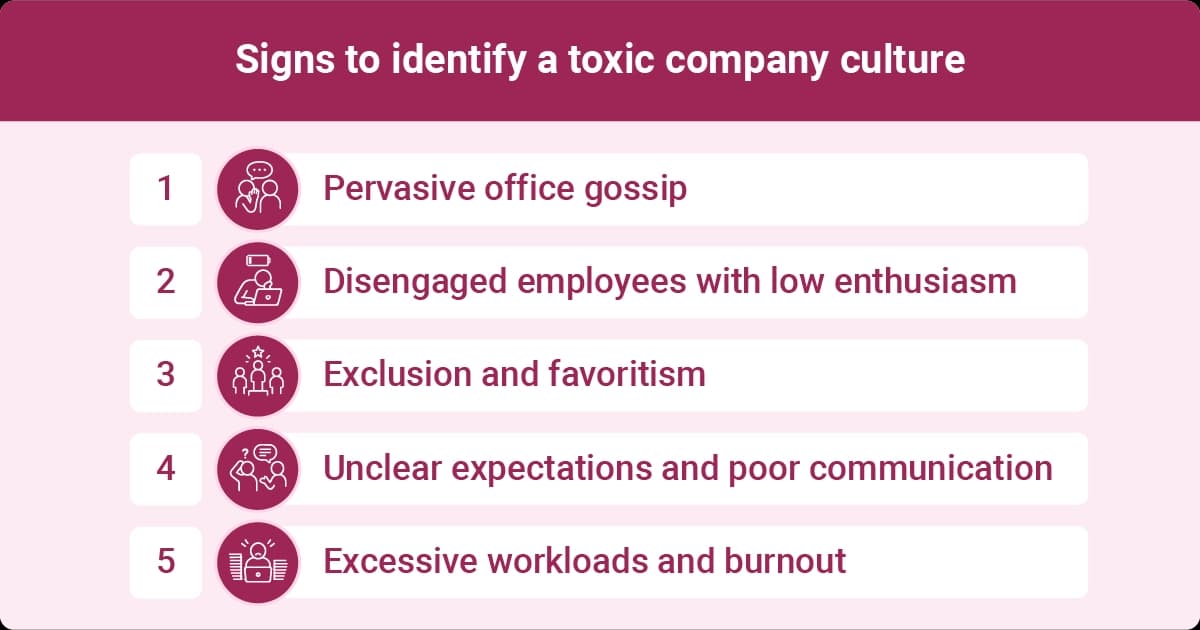
How do you know a workplace is toxic? Often, the signs are visible long before they're acknowledged. Here are common indicators to watch for.
Pervasive office gossip
Gossip often flourishes in hostile work environments. When employees talk about each other behind their backs, it can signify a negative style of communication that ultimately causes distrust, drama, distractions, and, in the worst cases, bullying.
Gossip becomes toxic when it hinders employees from communicating openly with each other or turns malicious, such as when employees spread hurtful rumors about others.
When people don't feel safe raising concerns openly in a toxic work environment, whisper networks fill the void.
This often shows that there is a problem with clear communication from leadership, unclear decision-making processes, or a corporate culture that punishes directness.
Disengaged employees with low enthusiasm
A recent Gallup poll, “Employee Engagement Strategies: Fixing the World's $8.8 Trillion Problem”, found that disengaged employees are in the majority, not the minority. In the United States, only 23% of workers are engaged at work, with disengagement costing the global economy an estimated $8.8 trillion in lost productivity.
Low engagement and overall employee morale can feed into a vicious cycle. Unhappy employees can seep negativity into the workplace, which then infects everyone else.
If you notice low enthusiasm and actively disengaged employees, it's important to get to the root of the issue, as it can have a big negative impact on your bottom line.
A workplace culture assessment can help leaders identify where enthusiasm is faltering before it becomes a full-scale retention crisis.
Workhuman® has identified four core drivers of employee experience and engagement, the 4 Es of employee engagement. These are tools that organizations can use to rebuild connection and enthusiasm among their teams.
Exclusion and favoritism
In a toxic culture, favoritism and exclusion often coexist. When current employees receive preferential treatment based on personal relationships rather than merit, it poisons team dynamics and breeds resentment.
Workhuman’s research, “A Scientific Guide to the Biases That Will Kill Your Culture," focusing on organizational behavior and workplace biases, shows that favoritism frequently stems from affinity bias: the tendency to favor people who look, think, or behave like ourselves.
This creates invisible hierarchies within teams that undermine their sense of belonging and erode trust in leadership's fairness.
Exclusion operates similarly. When employees are left out of meetings, social events, or key decisions without explanation, they quickly internalize the message that they don't belong. Over time, this diminishes engagement, creativity, and the willingness to contribute.
Unclear expectations and poor communication
When employees don't know what's expected of them, anxiety fills the gap. Unclear roles, shifting priorities, and a leadership culture that treats information as a privilege are hallmarks of a bad work environment.
In some cases, this can lead to conflicts between team members regarding who's responsible for what.
The lack of clear communication compounds every other problem. Conflicts that could be resolved with transparency instead fester, and mistakes get repeated because feedback isn't given.
Harvard Business Review research, “Why Psychological Safety Is the Hidden Engine Behind Innovation and Transformation”, has consistently shown that psychological safety depends heavily on clear communication from leadership. Where that's absent, silence and disengagement take over.
Excessive workloads and burnout
Employee burnout has become so common that it risks being normalized. But it remains one of the clearest indicators of a toxic work environment.
Employees may experience excessive stress for many reasons. Common contributors include being overworked, feeling uncertain about expectations, disagreeing with bosses or co-workers, or struggling with communication.
Fear of failure and difficulty communicating with team members and supervisors may cause chronic stress, which can eventually lead to employee burnout.
Through the report, “Burn-out an occupational phenomenon: International Classification of Diseases”, the World Health Organization classifies burnout as an occupational phenomenon characterized by exhaustion, cynicism, and reduced professional efficacy.
Toxic workplaces often wear excessive workloads as a badge of honor, expecting employees to answer emails at midnight and deliver under perpetually unrealistic expectations, making work-life balance feel impossible.
What are the causes of a toxic workplace?
Toxicity rarely has a single source. It tends to emerge at the intersection of weak company values, poor leadership, and structural failures that allow toxic behaviors to go unchallenged.
Poorly defined core values
A company without well-defined company values can suffer from internal inconsistencies and a lack of brand identity. Promoting strong values gives employees a sense of belonging within a company, and an organizational identity to internalize and act on.
When those values are vague, ignored in practice, or replaced with fake positivity, they provide no protection against toxic behavior.
The gap between stated company values and lived experience is one of the most demoralizing things an individual employee can witness. When a company espouses work-life balance while celebrating 70-hour workweeks, employees learn quickly that the values are performative.
Poor leadership
Leadership is both the most common cause of toxic workplace culture and the most powerful lever for changing it. Toxic leadership styles set the behavioral norms that the rest of the organization follows.
A manager who dismisses direct reports' concerns, takes credit for team accomplishments, or uses fear as a motivational tool doesn't just harm the individuals on their team. They signal to the entire organization that this behavior is acceptable, even rewarded.
Research titled “Stress is Killing YouOpens in a new tab” from experts in applied psychology at the American Psychological Association found that 75% of workers identify their immediate supervisor as the most stressful part of their job.
Leaders who fail to address issues, even when they don't personally perpetuate them, are equally complicit. Silence in the face of toxicity is tacit endorsement.
Lack of respect
All of these behaviors damage relationships, lower employee morale, and create an atmosphere of fear rather than collaboration.
When employees don't feel that they are treated fairly by colleagues or management, they withdraw. They share fewer ideas, take fewer risks, and invest less of themselves in their work. The result is a workplace that becomes increasingly transactional and, eventually, hollow.
Lack of representation
When leadership teams and organizational structures fail to reflect the diversity of their workforce, underrepresented employees receive a clear message: this place was not built with you in mind.
Lack of representation isn't just an ethical concern. It has measurable consequences for engagement and retention. The McKinsey research titled “Diversity wins: How inclusion matters” has found that companies in the top quartile for ethnic and racial diversity are 36% more likely to achieve above-average financial returns.
Conversely, homogenous leadership cultures tend to perpetuate the very biases that make workplaces toxic for those on the margins. Your priority should be to improve company culture efforts around representation. It's a human imperative and a business one.
What are the effects of toxicity in the workplace?
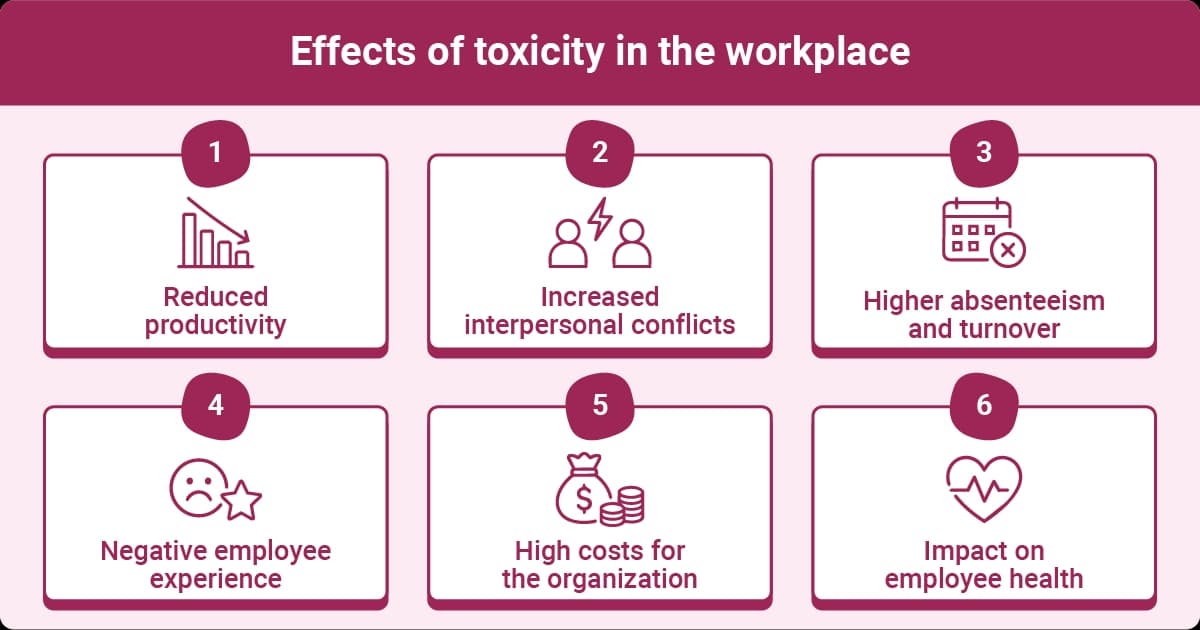
The effects of toxic work culture are wide-ranging and compounding. They begin with the individual employee and spread to the entire organization.
Reduced productivity
Toxic environments make people miserable and less effective. Employees who feel psychologically unsafe, overworked, or undervalued redirect enormous cognitive energy toward self-protection.
They feel that they have to consistently monitor office politics, manage anxiety, and avoid conflict. This is energy that would otherwise go into their work.
A study titled “The importance of happiness in the workplace” by researchers at the University of Warwick found that happy employees are 12% more productive than their disengaged counterparts. In hostile work environments, low productivity isn't just a symptom of a bad day. It becomes the baseline.
Increased interpersonal conflicts
Toxic workplaces are breeding grounds for interpersonal conflict. In a dog-eat-dog atmosphere where favoritism, lack of clear communication, and unclear accountability are present, misunderstandings escalate rather than resolve.
Trust between colleagues breaks down. Competition becomes zero-sum. People stop covering for each other and start guarding themselves.
Conflict at this level fragments teams, reduces collaboration, and consumes management time that would be better invested in employee growth and strategy.
Higher absenteeism and turnover
Toxicity drives people out, first mentally, then physically. Employees in toxic workplaces take more sick days, report higher levels of work stress and stress-related illness, and ultimately leave at significantly higher rates.
The MIT Sloan study, “Toxic Culture Is Driving the Great Resignation”, found that toxic culture was far and away the leading predictor of industry-adjusted employee attrition during the Great Resignation.
The high cost of replacing a single employee ranges from 50% to 200% of their employee's annual salary, depending on the role, as per the SHRM report “The Myth of Replaceability”.
Organizations struggling with a toxic work culture that goes unaddressed find themselves in a cycle: high employee turnover increases workload for those who remain, which increases employee burnout, which drives more turnover.
Negative employee experience
Employee experience encompasses everything from onboarding to offboarding, and toxic culture degrades it at every stage.
Workhuman's Employee Experience Index research demonstrates a strong link between positive employee experience and favorable outcomes, including innovation, willingness to go beyond job requirements, and resilience under pressure.
In a toxic environment, employees lose their sense of purpose. The implicit agreement that the organization will treat them fairly in exchange for their commitment breaks down. When that happens, neither money nor perks can rebuild the loyalty that's been lost.
High costs for the organization
The financial high cost of a toxic work culture is staggering and often underestimated.
Beyond the direct cost of employee turnover and recruitment, organizations pay through low productivity, increased absenteeism, higher rates of workplace incidents, and the management time consumed by conflict resolution.
In the article “Gallup Releases New Findings on the State of the American Workplace”, Gallup estimates that disengaged employees cost U.S. businesses between $450 billion and $550 billion per year in lost productivity.
Organizations pursuing changing toxic work culture initiatives that ignore the financial case are missing a powerful argument for change.
Impact on employee health
The employee health consequences of toxic workplaces are well-documented and serious. Chronic stress in the workplace is associated with elevated cortisol levels, increased risk of cardiovascular disease, sleep disturbances, and suppressed immune function.
Psychologically, employees in toxic environments are significantly more likely to experience mental health issues such as anxiety, depression, and employee burnout.
The physical symptoms, fatigue, headaches, and gastrointestinal problems, are equally real. The American Institute of Stress, in its article on productivity anxiety, estimates that work stress costs U.S. employers more than $300 billion annually in absenteeism, diminished productivity, and healthcare costs.
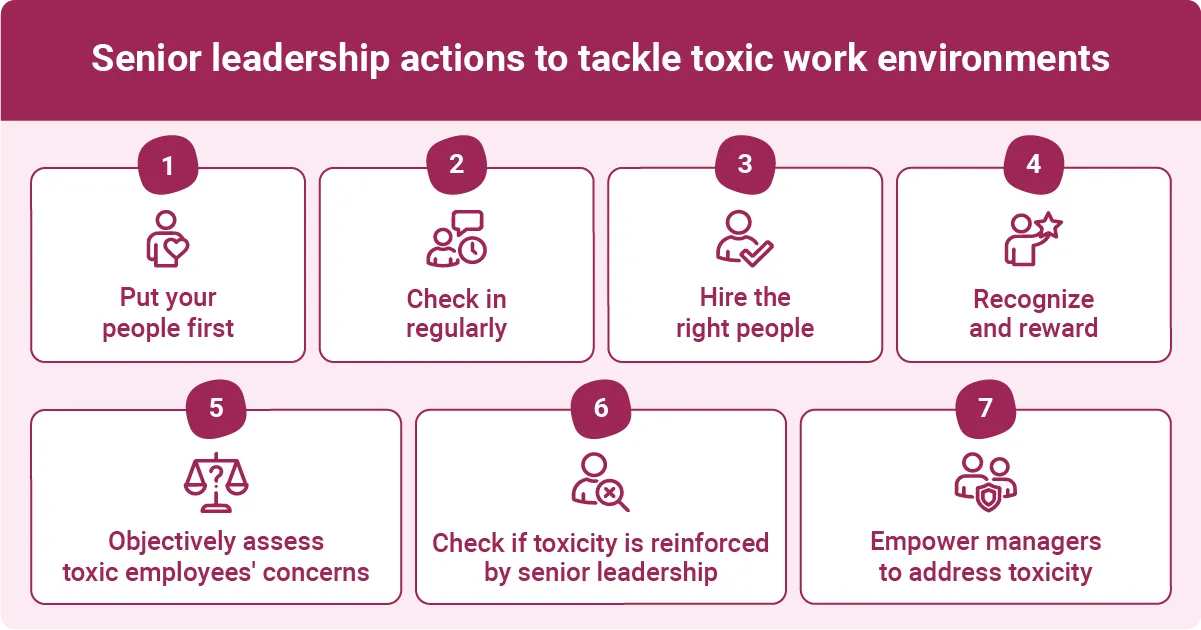
How can senior leaders help address a toxic environment at work?
Addressing toxic culture is ultimately a leadership responsibility. Lasting change requires senior leaders who are willing to examine their own role in the problem and use their authority to create something better.
Put your people first
A people-first, or employee-first culture, is an approach that aims to support and recognize employees to help them feel more connected to the organization and motivated to do their best work.
At the end of the day, it's your people who keep your company running. If they don't have the resources they need to thrive, they can't excel.
Your first step to fostering a positive workplace culture is to learn about your employees and their needs. This means creating opportunities to have meaningful, honest conversations with the people at your company.
Ask them about current barriers keeping them from doing their best work, and involve them in brainstorming solutions that address their specific needs.
Set a precedent of open, honest, and clear communication through wellness surveys or soliciting other forms of feedback.
Check-in regularly
One of the simplest and most effective tools a leader has is the structured check-in checklist. Not the performative "how's everyone doing?" at the start of an all-hands, but regular, intentional conversations designed to hear what people are actually experiencing.
More frequent check-ins with employees play a crucial role in combating a toxic work culture. Workers who check in with their boss at least weekly are:
- More than 2x as likely to trust their manager
- Nearly 2x as likely to respect their manager
- 5x less likely to be disengaged
- Nearly 2x as likely to believe they can grow in the organization
Regular check-ins foster clear communication, allowing employees to express concerns, seek guidance, and feel heard. These interactions build trust, connection, and a sense of belonging, which are essential in preventing employee burnout and disengagement.
Workhuman's research on check-ins identifies twelve specific practices that make these conversations meaningful. Leaders who check in consistently are better positioned to catch culture problems early, before they calcify into norms.
Hire the right people
While fixing your company's culture starts at the top, don't forget to look at who you hire at all levels of your organization. In some cases, attitude may even be more important than skill set when choosing the right employees for your team.
While employees can learn skills that help them do their jobs, it's harder to train someone out of their toxic behaviors. Picking employees who have positive, team-oriented attitudes and strong communication skills can help you staff your organization with people who resist toxicity.
If you find yourself choosing the wrong people over and over again, look at your hiring process. Evaluate where you're sourcing your employees and what strategies you're using during the hiring process to filter out candidates with toxic tendencies.
This is also a talent acquisition opportunity to build for diversity. The importance of a strong company culture fit should never be used as a proxy for similarity. It's an evidence-based assessment of how a candidate's values align with your organizational mission.
Recognize and reward
To combat a toxic culture, find ways to practice gratitude in the workplace daily. Simple gestures like thanking your employees for their work can go a long way. Implementing a recognition program can take it a step further.
Recognizing successes, both personal and professional, makes your team feel appreciated and fosters a greater sense of belonging.
Employees who feel that their company values their effort are likely to feel happier, which can improve workplace attitudes and contribute to a culture of celebration rather than one of toxic competition.
Workhuman's Social Recognition® platform enables organizations to build a culture of appreciation that is continuous, peer-driven, and visible.
When recognition is embedded into the daily rhythms of work, it reinforces the behaviors and company values the organization actually wants to see.
Objectively assess toxic employees' concerns
Not every complaint from a difficult employee is evidence of toxicity, and not every concern raised in a toxic workplace is unfounded.
Leaders must develop the capacity to assess grievances objectively, separating legitimate systemic issues from individual behavioral problems.
This requires a degree of intellectual honesty that is uncomfortable. Even employees who behave poorly may be responding to genuine organizational failures.
Dismissing all difficult employees as "troublemakers" is a way of avoiding accountability. Taking every grievance at face value without investigation is equally unhelpful.
Structured, confidential feedback mechanisms and clear boundaries around escalation pathways help leaders navigate this with more consistency and fairness.
Check if toxicity is reinforced by senior leadership
This is the step most leadership teams skip, and it's the most important one. Toxic cultures persist because someone with authority is either modeling toxic behavior, tolerating it in others, or failing to address a toxic employee before their behavior affects the wider team.
Leaders who are serious about toxic culture at work must be willing to hold a mirror up to themselves and their peers.
This means asking hard questions: Are we rewarding results regardless of how they're achieved? Do we have leaders who consistently produce high numbers but leave a trail of burned-out, departed employees behind them?
If the answers are uncomfortable, that discomfort is diagnostic.
Empower managers to address toxicity
Senior leaders set the strategy, but managers are on the frontlines of culture. Empowering them means giving them training opportunities in conflict resolution and the authority to address behavioral problems without waiting for HR approval.
Managers who feel unsupported become conflict-avoidant, which is itself a driver of toxicity. When they have the tools, they follow suit and become the most effective force multiplier available to a senior leadership team.
Toxic culture checklist:
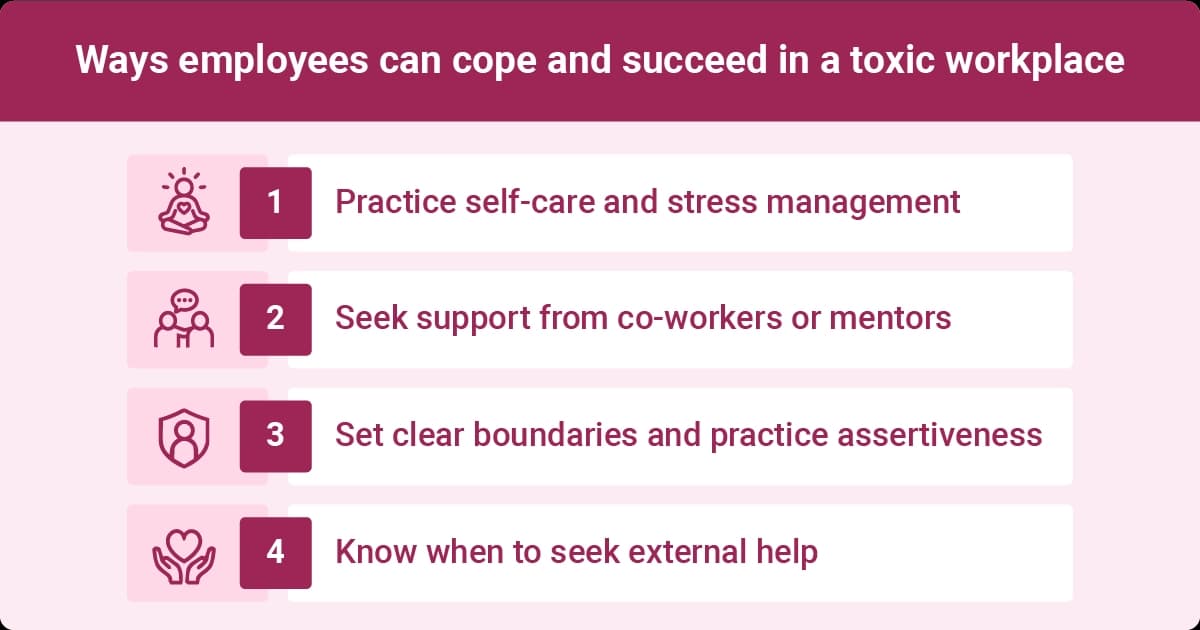
How can employees manage stress and thrive in an unhealthy work environment?
While organizational change must come from the top, employees aren't powerless. There are practical, evidence-backed strategies for protecting your well-being and maintaining your effectiveness even in a difficult work environment.
Practice self-care and stress management
Mental stress and work stress are professional hazards that require active management.
A research paper titled “Mindfulness-Based Interventions to Reduce Burnout in Primary Healthcare ProfessionalsOpens in a new tab”, published in Frontiers in Psychology, confirms that mindfulness-based interventions significantly reduce occupational work stress and employee burnout symptoms, even in high-pressure work environments.
Practically, this means protecting sleep, avoiding the sleep disturbances that chronic stress causes, moving your body regularly, taking real breaks during the workday, and finding recovery activities outside of work that genuinely restore you.
These aren't solutions to a toxic organization. They're tools for staying intact while you navigate it or work to change it.
Seek support from co-workers or mentors
Isolation amplifies the effects of a toxic environment. Finding even one trusted colleague with whom you can debrief, validate experiences, and problem-solve makes a measurable difference.
A study titled “Explaining the Variable Effects of Social Support on Work-Based Stressor-Strain Relations” shows that strong peer relationships buffer the psychological impact of organizational stress.
Mentors outside your immediate team or organization can offer perspective, advocacy, and guidance that may be difficult to access internally.
If a formal mentorship program exists at your organization, use it. If not, build informal relationships with people whose judgment you trust and who have no stake in your immediate political work environment.
Set clear boundaries and practice assertiveness
Toxic workplaces frequently push employees toward overcommitment through guilt, peer pressure, or the implicit threat of professional consequences for saying no. Learning to set clear boundaries assertively is both a self-protection skill and a dignity-preserving one.
Assertiveness is not aggression. It means clearly and calmly stating what you can and cannot do, what you will and will not accept, and what you need in order to do your work well.
It means saying "I can take this on, but something else will need to move" rather than absorbing excessive workloads indefinitely. In a genuinely toxic environment, this won't always be welcomed, but it's essential to your long-term sustainability.
Know when to seek external help
There is a point at which internal coping strategies are insufficient. That’s when toxic behavior crosses into sexual harassment, discrimination, or legal action territory.
It’s also when your mental health or physical health is deteriorating, or when informal attempts to address the problem have failed repeatedly.
At that point, escalating to HR is a legitimate step, with the understanding that HR's primary obligation is to the organization, not to individual employees. If the issue involves illegal conduct, consulting an employment lawyer is worth considering.
This is an important resource in work environments where going to a direct supervisor isn't a safe option. Knowing when you've reached your limit isn't a weakness. It's self-awareness.
The role of technology in combating toxic workplace culture
HR tools have evolved well beyond administrative functions. Today, platforms that facilitate recognition, feedback, and performance management play a direct role in shaping an organization's culture.
Workhuman's Conversations® tool provides a structured framework for meaningful manager-employee dialogue.
It can replace the dreaded annual performance review with ongoing, growth-focused conversations that build trust and surface culture problems before they become crises, turning employee growth from a once-a-year checkbox into an ongoing conversation.
By embedding performance management into a continuous, human-centered process, it shifts the dynamic from evaluation to partnership.
When managers have a regular, supported structure for checking in, the early warning signs of toxic work are far less likely to go unnoticed.
Workhuman's Social Recognition® platform addresses one of the most corrosive elements of toxic culture: the feeling of invisibility. When employees are recognized, it reinforces a sense of belonging and value that makes disengagement far less likely to take hold.
Recognition also creates a data trail. Organizations can see patterns in who is being recognized, in which teams, and under which managers, allowing HR to identify toxic pockets before they spread across the broader workplace culture.
Technology alone cannot fix a toxic workplace. But deployed thoughtfully, as part of a broader organizational strategy, it provides the infrastructure for healthier clear communication and a more positive company culture.
Conclusion
A toxic work culture is not inevitable, but it is persistent, because it tends to be self-reinforcing. Breaking that cycle requires clarity about what's actually happening, courage to name it, and a sustained commitment to doing things differently.
For leaders, that means examining your own role first, then using every tool at your disposal to build a healthy work environment where people can do their best work.
For employees, it means protecting yourself, finding support, setting limits, and knowing that a workplace that damages your mental and physical health is not one you are obligated to simply endure.
The healthiest organizations aren't the ones that are never toxic. They're the ones that take the warning signs seriously, respond quickly, and build structures that make toxic workplace culture harder to take root in the first place.
FAQs
Here are the answers to some additional frequently asked questions about toxic work cultures.
How does a bad work environment affect employees?
A bad work environment affects employees by making them feel demoralized and disengaged. It can lead to excessive stress, fatigue, depression, and anxiety, and even feelings of burnout.
Employees in a toxic work environment may feel unmotivated, which can decrease their productivity. They may have a harder time engaging with others and communicating openly about their needs and boundaries.
What qualifies as a toxic work environment?
There's no formal classification system that qualifies a work environment as toxic. Ultimately, it's up to the people in that environment to determine whether it's healthy for them.
In general, toxic environments are ones where internal conflicts prevent individuals from fulfilling their responsibilities or otherwise keep them from enjoying life and achieving the goals they define for themselves.
What are the signs of a toxic employee?
These may be signs of a toxic employee:
- Shows entitlement beyond what's earned
- Demonstrates aggression toward others
- Deploys passive-aggression and defensiveness
- Holds values that don't align with the company's
- Acts selfishly
- Is unwilling to listen
- Refuses to accept criticism
- Gossips and creates drama
- Takes credit for the work of others

Ryan Stoltz
Ryan is a search marketing manager and content strategist at Workhuman where he writes on the next evolution of the workplace. Outside of the workplace, he's a diehard 49ers fan, comedy junkie, and has trouble avoiding sweets on a nightly basis.
Recommended for you