How to Combat Burnout with Employee Recognition & Wellbeing Programs
Last updated
4 min read

The business world moves fast; sometimes faster than we can keep up with—especially over the last three years—leading to stress, subpar work, and poor emotional wellbeing for employees.
Not surprisingly, then, business leaders have been determined to understand how to combat burnout in the workplace.
Protecting the wellbeing of employees is the most effective way to ensure they don’t burn out in terms of their physical and mental health.
According to the new Workhuman and Gallup report, “Amplifying Wellbeing at Work and Beyond Through the Power of Recognition,” wellbeing influences outcomes that can cost businesses millions in low productivity and engagement scores, not to mention burnout.
Related: Learn how to avoid burnout in the first place
Here we will take a look at the report to determine how wellbeing can relieve stress and prevent workplace exhaustion with one powerful tool: employee recognition.
What is workplace burnout?
Burnout is something we have all likely felt before; The World Health OrganizationOpens in a new tab defines it as a syndrome conceptualized as resulting from chronic workplace stress that has not been successfully managed.
Not only does burnout affect a person’s job performance and tenure, it also seeps into other areas including their personal life. Emotional exhaustion and stress impacts a person’s relationships with family and friends, sleep habits, and self care, among other things. Unless the root cause of burnout is addressed, people have little or no control over how it presents in their everyday life.
And while this is true for everyone experiencing burnout, the way it presents itself can be very different depending on the person, as well as the industry they work in and the area they live in.
How burnout impacts business
Burnout doesn’t only hurt the individual experiencing it; it also is one of the biggest contributors to a toxic workplace culture. In 2019, Gallup research found burned-out employees were 2.6 times as likely to be looking for other employmentOpens in a new tab.
Keep in mind, burnout can be more or less prevalent depending on the industry; Harvard Business Review’s article titled "National Health Costs Could Decrease if Managers Reduce Work StressOpens in a new tab" reports that workplace stress is responsible for about 8% of healthcare spending across the country each year.
The new Gallup-Workhuman report found: “Employees who are burned out much or all of the time don’t bring their best to work — they are 63% more likely to not show up at all and are more than twice as likely to look elsewhere for a job.” And that can be costly.
To avoid these collateral costs, leaders should spend their energy on understanding the different ways job burnout can present itself.

What do burnout symptoms look like?
As mentioned above, symptoms of burnout look different depending on the person, but what’s universal is that the longer these symptoms are left unmitigated, the worse they will get. Which means if businesses are hoping to avoid burnout, it’s important for leaders to know what the warning signs of job burnout look like, and how to address them.
Generally, burnout syndrome has two different levels of symptoms, both which can present as physical or cognitive functioning symptoms. The first, passive signs, tend to be less obvious to co-workers and leaders, making them harder to spot — even to the employee experiencing the symptoms themselves!
Passive Symptoms
- Low energy/motivation levels
- Procrastinating or not turning assignments in on time
- Always feeling overwhelmed with workload
- Withdrawing effort
- Uninterested in work activities
If these passive signs of job burnout are ignored or missed, they will likely shift toward more noticeable, active symptoms including the ones listed below.
Active Symptoms
- Unhealthy coping mechanisms
- Loss of sleep
- Easily annoyed or impatient
- Incivility toward coworkers
- Visible anxiety and stress
Another, less discussed kind of burnout that can occur is within an entire team. Whether it started with one person experiencing chronic stress that spreads to the others or a joint stress response due to a team project, it’s necessary for leaders to be able to identify the issue and work to reduce stress levels.
Team Symptoms
- Emotional exhaustion
- Team members doing too much/not enough work
- Bickering and hostility between group members
- Low levels of engagement in and out of the group
The antidote: wellbeing
Understanding what job burnout looks like is just the first step; now it’s time to determine how to mitigate these specific concerns. To start, let’s look at the connection between wellbeing and burnout.
According to Gallup, wellbeing encompasses the broader holistic dimensions of a well-lived life and applies to career, social, physical, financial, and community wellbeing. Just as burnout has the potential to reach every corner of an employee’s life, so can wellbeing — and the return is much more lucrative.
So, how can business leaders create a workplace where wellbeing flourishes and work-life balance is honored? Employee recognition.
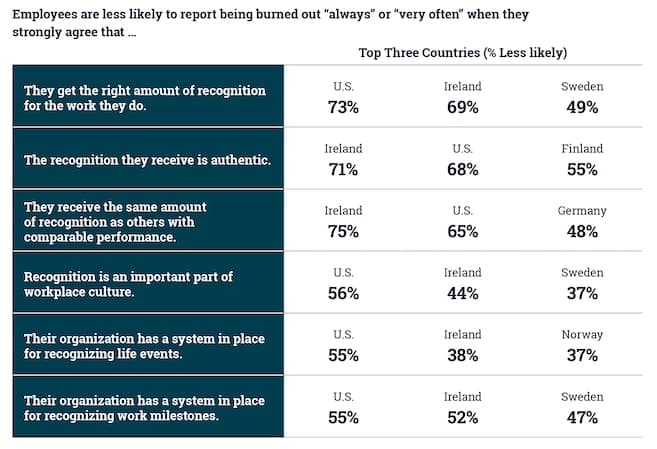
In fact, the new report found “employees that get fulfilling employee recognition are up to 90% less likely to report being burned out at work ‘always’ or ‘very often’.” Not only that, but employees who strongly agree that recognition is an important part of their work culture are up to 91% more likely to be thriving than where recognition is not important to culture.
The fast pace of business often makes workers feel like there is no time to stop and reflect— just one of the main drivers of work exhaustion. Research shows, however, taking a moment to do just that is a game changer.
7 ways to prevent burnout at work
Here are seven ways to protect your employees and organization from burnout.
1. Amplify wellbeing through employee recognition
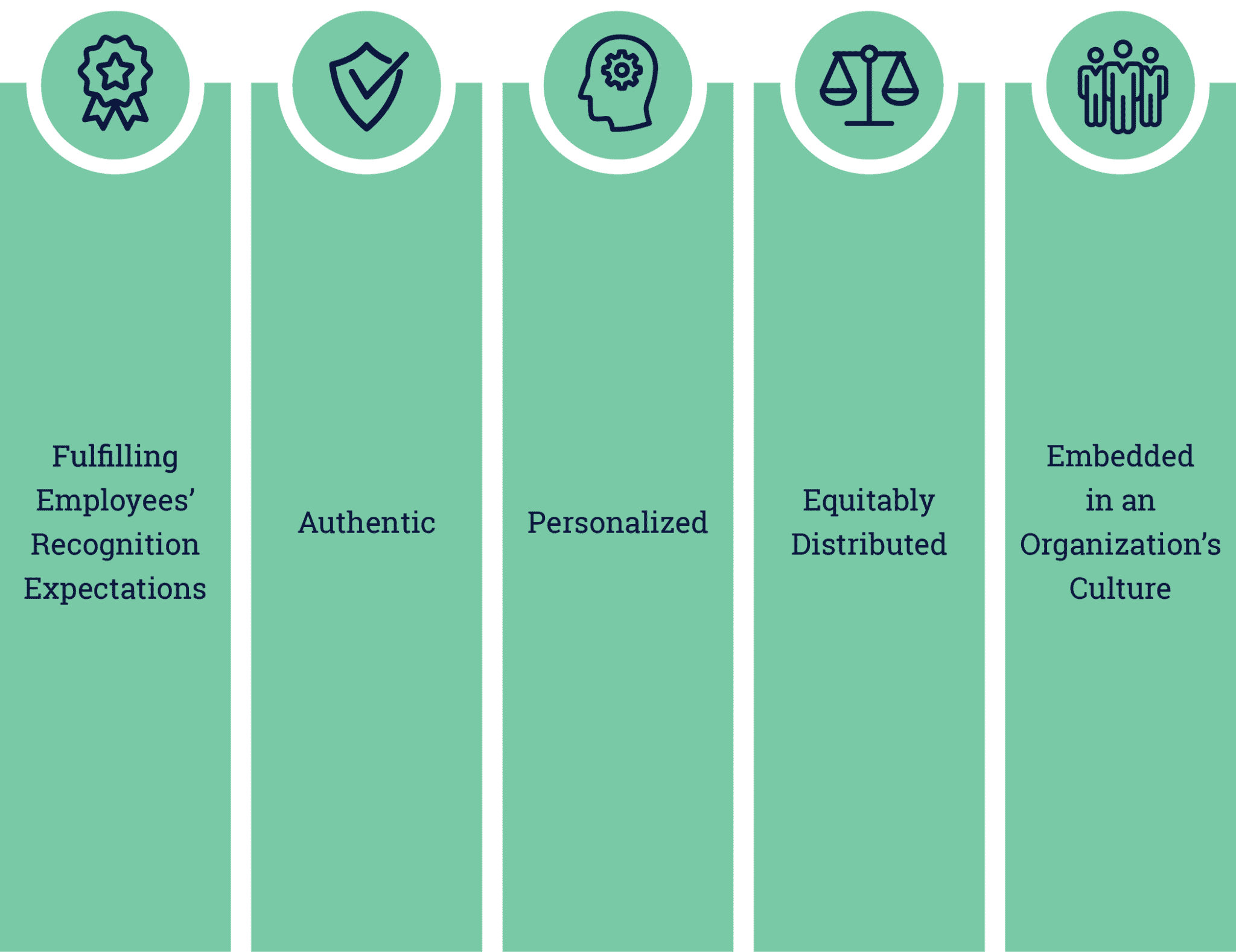
Recognition is a simple and incredibly effective way to boost employee morale and engagement, but it’s most powerful when done right. A previous Gallup report defined five pillars of good recognition as: fulfilling, authentic, personalized, equitable, and embedded in the culture.
Employees who receive recognition from managers and leaders at least a few times per month are up to 2x as likely to be thriving. And the best part about public recognition?
Its impact on wellbeing spreads throughout the whole organization; in fact, employees who report giving recognition a few times per month or more are nearly 2x as likely to report having experienced gratitude the day before. And gratitude is the ultimate burnout anecdote.
2. Utilize check-ins
Low wellbeing in the workplace can manifest as burnout if the causes are not addressed. Managers should take the time to check-in with their people on a weekly or bi-weekly basis to ensure they aren’t feeling overworked or under-appreciated. If employees are struggling, check-ins can be focused on collaborative problem-solving that provide regular support and motivation, boosting employees’ reliance through challenging periods.
Check-ins, along with a peer-to-peer employee recognition program are two of the best ways to make employees feel heard and appreciated. And as the new report explains: “When employees feel like their hard work is seen, appreciated and valued, they are more resilient and less susceptible to feeling burned out at work. They feel motivated to give a little extra — and ideally going the extra mile is rewarding, not a burden.”
3. Conduct frequent and actionable pulse surveys
Managers who take the time to listen to their employees’ desires and needs are on the front-line of the fight against burnout, but battles this size can’t be won alone. Organizations should look into pulse survey tools to assess the entire organization’s aggregate responses to questions about burnout, stress levels, and social support, among many other things.
While pulse surveys can cover any topic, using them to gauge wellbeing is a smart move. Whether they are monthly or quarterly, leaders should conduct anonymous surveys for employees to share their thoughts, concerns, and levels of stress. With the results leaders will be able to pin down pain points affecting different teams and departments and take action to alleviate them.
4. Make time to celebrate
Celebrations are a time of joy and connection, two things that are extremely powerful in repelling burnout. And at one point in time, work may not have been a place to celebrate, but that is no longer the case.
The new report actually finds celebrating life events makes employees feel seen as people and builds the social connections that allow them to truly flourish. Employees at companies that celebrate life events are up to 7x as likely to strongly agree they have meaningful connections with their co-workers.
Despite this positive impact on mental health, depending on the country only 11%-24% of employees strongly agree their organization has a system in place to recognize life events.
5. Set Boundaries
Work-life balance isn’t easy to attain; in fact, it’s almost impossible for employees to achieve if their organizations are not committed to that balance as well.
A previous Workhuman/Gallup report found that when employers recognize life events and work milestones, employees are 3x as likely to strongly agree their organization cares about their wellbeing. Why? Because the employer is acknowledging and celebrating the life of an employee, non-work related.
Promoting work-life balance gives employees more feelings of appreciation and less stress, quelling any signs of potential burnout.
6. Assess Benefits Packages
If your organization is struggling with exhausted and overwhelmed employees, it may be time to do a systematic review of the benefits being offered to them.
Does the company offer flexible working hours? Are the health insurance offerings up to par with competitors? Do employees have access to mental health resources such as online therapy or group counseling? Do employees receive additional time off for mental health reasons?
Depending on the answers, you may not have the structural support to help employees fighting burnout, not to mention reducing or preventing burnout in the first place.
7. Live Your Values
The mission and values of an organization are the foundation in which company culture is built on. When these core values don’t match with the actual culture, employees and the organization suffer.
Spend time reflecting on whether or not the workplace experience matches up with the intended company mission. Ask employees what additional support they need to be able to do their best work - and feel good while doing it. And then it’s time to make it happen.
FAQs
What does burnout feel like?
While it’s different for everyone, burnout usually stems from feeling overwhelmed, overworked, and underappreciated. It can present itself as irritability, chronic stress, increased mental distance or dissociation, and emotional exhaustion.
How long does burnout recovery take?
Just as it takes people different amounts of time to recover from an illness with physical symptoms, the road to recovery looks different for everyone. The most important thing to remember is that if employees do not have the time to recover fully, the symptoms of burnout will continue to come back stronger and faster.
How can employers help with burnout?
The best way for employers to prevent employees from burning out is by investing in their wellbeing. To do that, employers should implement a recognition program that calls employees out for their good work - bringing a moment of positivity to the forefront, even during the most stressful of situations.
Conclusion
When asking how to combat burnout, employers should look at the environment they are building for their employees.
Is it an equitable workplace where workers feel valued and appreciated for their work? Is the culture aligned with the company’s core values? Are you giving employees the space to be human? If the answer to any of these questions is no, your people are going to be more susceptible to feeling burned out - causing both employee morale and business metrics to suffer.

Sarah Bloznalis
Sarah Bloznalis is a content marketing specialist at Workhuman from Dorchester, Mass.
Recommended for you