
How Recognition Turns Frontline Workplaces Into Communities
by Lou Evan
Last updated
3 min read

Frontline employees are the people who keep organizations moving. They're cleaning hospital rooms before the next patient arrives, maintaining buildings before anyone notices something needs fixing, manufacturing products, welcoming travelers, delivering care, and solving customer problems long before an issue ever reaches corporate.
Ironically, they're also some of the employees least likely to feel connected to the broader organization. They're often less likely to work near senior leaders, less likely to spend their days in internal meetings or near a computer, and less likely to hear an unexpected "thank you" from someone outside their immediate team. Their work is highly visible to customers, but it can be surprisingly invisible inside the company itself.
Raúl Valentin, Chief Human Resources Officer at ABM Industries, described what recognition should look like for every frontline employeeOpens in a new tab in a podcast filmed at Workhuman Live.
"Can that frontline team member feel that they can show up and give their best every day and be recognized for that, be appreciated, and also have a chance to proceed regardless of whether they went to school or not, regardless of English might be a second or third language for them."
That’s the point of meaningful recognition. It provides a decentralized and equitable voice to celebrate great work which reverberates beyond the moment. It helps to create an understanding of how the work gets done and by who.These are the factors that drive and shape culture. Anyone at an organization can share in that process, regardless of their title, location, education, or language. And when people consistently feel seen, it's much easier for them to believe they belong.
The motivation is already there. Recognition helps people see a future.
One of the most encouraging findings from the 2026 Humans at Work Barometer is that deskless employees (those who are often on the frontlines of plants, hospitals, or hospitality settings without a “desk”) don't have a motivation problem. In fact, 70% say they're motivated to do their best work, almost identical to their desk-based colleagues. The challenge isn't convincing frontline employees to care, they already do. The challenge is making sure they know their work matters.
Unfortunately, too many don't receive that message. The report found that only 57% of deskless workers have access to a recognition program, and just 33% have been formally recognized during the last quarter.
When recognition does happen, though, its impact extends far beyond making someone's day. Employees who had recently been recognized were dramatically more likely to see a future with their organization. In fact, 77% of recently recognized deskless workers said they see a path for career growth, compared with just 46% of those who hadn't recently been recognized.
For frontline employees, work can feel surprisingly solitary despite being surrounded by people. Herein lies the importance of a quality employee recognition program: It’s not because people are looking for applause, but that recognition reminds them they're part of something bigger than the shift they're working or the building they're standing in. Its foundation for turning a collection of employees into a community.
On the HR Leaders podcastOpens in a new tab at Workhuman Live, Julie Stone, Chief Learning Officer at TTEC, captured that idea perfectly:
"You can't over-recognize. You just can't. When you recognize somebody, they feel valued. When you recognize somebody, they feel like they belong. And when you do those things, they're going to be more willing to put aside their fears and stay with you."
There's a lot packed into that quote, but the three words, valued, belong, and stay, carry critical significance, beyond the measurement of simple performance reviews and engagement scores. They're the foundation of a workplace where people trust one another and see a future they can thrive in.
Belonging doesn't happen by accident
It's difficult to build a community when people aren't sure anyone sees them. Recognition changes that by creating a ripple effect throughout an organization. One thoughtful thank you encourages another. Managers become more intentional about noticing great work. Peers start celebrating one another's contributions instead of simply moving on to the next task. Over time, appreciation stops feeling like an occasional gesture and starts becoming part of how people work together every day.
The workplace begins to feel less transactional and more connected. More human. In fact, Workhuman iQ researchers found that for newly hired frontline workers, receiving just one recognition moment increases their likelihood of staying.
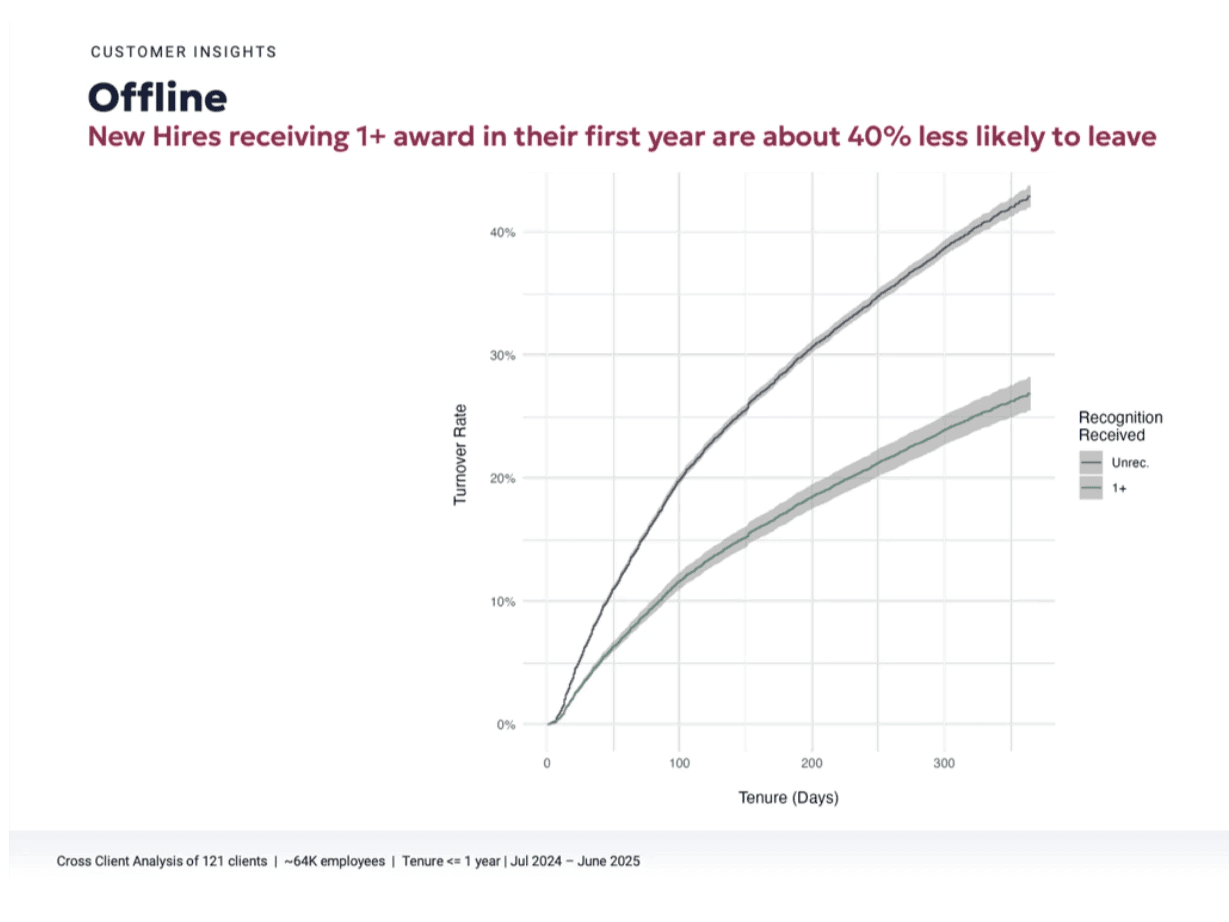
Frontline workforces thrive on connection – recognition supports that.
For frontline organizations especially, recognition can be how employees come to trust one another, feel connected to the organization, and believe their work has purpose beyond the task in front of them.
Traditionally, recognition programs are designed for desk-based employees, relying on systems not designed for frontline environments. As a result, a systemic gap in experience emerges, one that can potentially lead to resentment, detachment, and lower performance. The very opposite of what a recognition program aspires to accomplish.
Patch-gap solutions, such as gift cards, often are loosely governed, and invite fraud and compliance nightmares. Workhuman eliminates risk with a secure, data-rich system where every award is verified, traceable, and tied to a real identity. This ties to built-in admin, reporting, and spend management for real-time oversight, which provides complete engagement, performance, and skills visibility across the workforce.
Frontline Recognition brings everyone in and gives every employee the same meaningful recognition experience, optimized for their role, environment, and working style.
- Multiple ways to recognize: email, SMS, QR, physical cards, kiosks
- Digital and physical awards, securely captured in one place
- Optimized for the frontline flow: shift changes, team huddles, etc.
If your frontline employees deserve to feel like they're part of something bigger than today's shift, it may be time to rethink how recognition happens across your organization.
Workhuman's Frontline Recognition solution brings everyone in and gives every employee the same meaningful recognition experience, optimized for their role, environment, and working style.
Lou Evan
Lou Evan is a Senior Content Specialist at Workhuman. Having worked most of his career in the employee recognition space, he brings a firsthand perspective to the cultural, psychological, and ultimately financial impact of tailored, strategic recognition programs. Lou believes in friendship, family, and creativity.