
From Human Intelligence to Business Intelligence: How HR Leads Strategy Through Recognition Data
Last updated
7 min read

Table of contents
- The HR opportunity: from support function to strategic leader
- Recognition as strategic infrastructure, not tactical initiative
- The eight elements of recognition done right
- From data-light to data-rich: the AI coaching difference
- Human Intelligence: when AI meets authentic human data
- Skills intelligence: beyond self-reported capabilities
- Topics: real-time strategy execution intelligence
- The CPO as enterprise leader: HR's seat at the strategy table
- Building communities and connection in times of change
- The crisis is real. The opportunity is now.
Share this article
Europe faces an engagement crisis. According to Gallup's 2025 State of the Global Workplace report, the region has the lowest percentage of engaged employees globally, with engagement tumbling and costing the global economy €400 billion in 2024 alone. For HR leaders navigating workforce challenges, economic pressure, and the rise of AI, the question isn't just how to survive, it’s how to thrive.
The answer lies not in more surveys or lagging indicators, but in a fundamentally different approach: turning the collective human intelligence within organizations into actionable business intelligence that positions HR as a strategic driver of growth, execution, and competitive advantage.
The HR opportunity: from support function to strategic leader
HR departments today face a familiar paradox. Senior leadership expects them to deliver on critical business outcomes—improving manager effectiveness, designing talent processes around skills, attracting and retaining top talent, advancing people analytics capabilities, and redesigning work for AI and automation. Yet these same HR teams often struggle to demonstrate the strategic value and business impact that CEOs demand.
As Mark Cowlard, Chief People Officer at Arcadis, recently observed, CEOs don't fail from lack of strategy—they fail from lack of execution. And the biggest constraint to execution isn't capital or ideas; it's leadership, talent, clarity, and accountability. This is where HR should be leading from the front, not supporting from behind.
The gap between CEO expectations and HR delivery is stark: CEOs want outcomes, but HR often shows up with activity. CEOs expect execution, but HR presents initiatives. CEOs demand accountability, but HR offers alignment. Closing this gap requires HR to shift from being a functional leader to an enterprise leader—and that shift is powered by data.
Recognition as strategic infrastructure, not tactical initiative
For 25 years, Workhuman has championed a truth that's now becoming undeniable: recognition is not a "nice-to-have" employee perk—it's strategic infrastructure that generates the most valuable source of workforce intelligence in any organization. When recognition is designed and executed properly, it delivers dual value. First, it creates measurable cultural and business impact. Employees who feel appreciated and recognized are:
- 4x as likely to be engaged in the workplace
- 56% less likely to be looking or watching for job opportunities
- 5x as likely to see a path to growth at their organization
But the transformative power of recognition extends far beyond engagement scores. When employees recognize each other authentically and frequently, they create what Dr. Meisha-ann Martin, VP of People Research at Workhuman, calls "the richest source of information in your company"—a continuous stream of peer-verified micro performance reviews happening at every level of the organization, capturing how work actually gets done, who drives results, which behaviors embody company values, and where strategic priorities are truly gaining traction.
The eight elements of recognition done right
Not all recognition programs generate this quality of data. To unlock workforce intelligence, organizations need what Workhuman and Gallup identified as the eight critical program elements:
- Peer-to-peer recognition (not just top-down)
- Frequent award distribution (creating volume and recency of data)
- Multiple levels of monetary, points-based awards (matching rewards to effort and impact)
- Descriptive, authentic, and personalized language (enabling natural language processing to extract deep insights)
- Equitable participation across the organization (ensuring representative data)
- Calibration (matching rewards to achievement impact)
- Values alignment (connecting recognition to strategic priorities)
- Data richness (generating statistically relevant volumes for analysis)
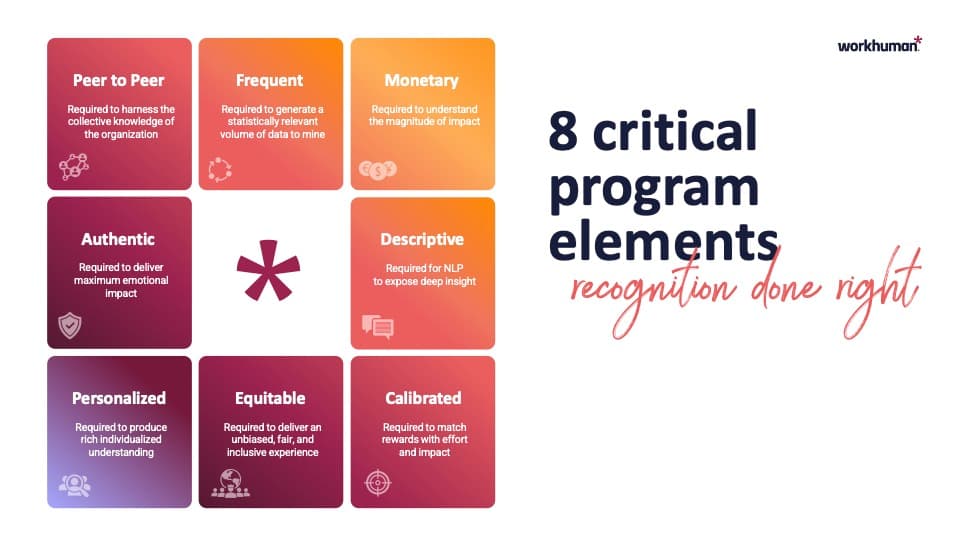
These elements constitute a commitment to strategic recognition—the foundation for generating gold mines of human data that can be transformed into business intelligence.
From data-light to data-rich: the AI coaching difference
Consider two recognition messages. The first: "Layla, thank you for your participation and ideas in the meeting yesterday. Great work." This message delivers positive reinforcement, but it's data-light. There's little information for AI or analytics to work with.
Now consider this: "Layla, thank you for your strategic insights during the Q2 planning session. By bringing a team-first attitude, you identified potential roadblocks beyond those facing product development, and set the tone for a candid, productive afternoon. We're lucky we found a colleague so invested in the success of others as you are. Here's to crushing it in Q2!"
This data-rich message reveals multiple dimensions of intelligence:
- Skills and competencies: Strategic thinking, problem identification, facilitation
- Values alignment: Team-first attitude, investment in others' success
- Performance and impact: Identifying roadblocks, setting productive tone
- Relationships and influence: Cross-functional collaboration, cultural contribution
- Strategic context: Connection to Q2 planning and organizational priorities
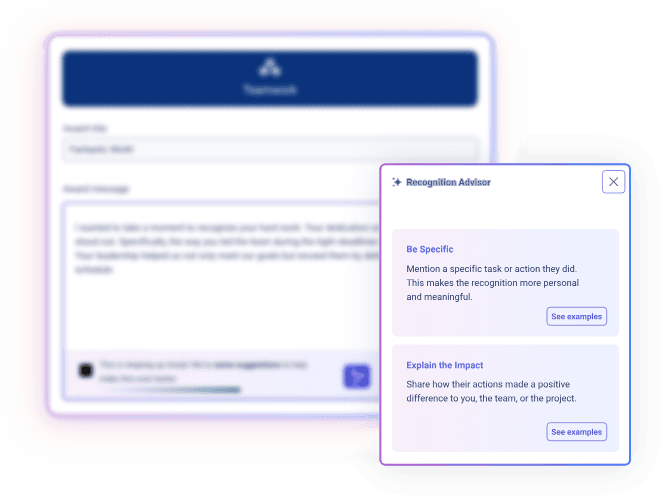
Workhuman's AI doesn't write recognition messages for employees, it coaches people to add detailed, genuine insights in their own words. This ensures authenticity while dramatically increasing the quality and depth of workforce data flowing through the system.
Human Intelligence: when AI meets authentic human data
When hundreds of thousands of authentic, information-rich recognition messages are transformed through advanced AI, they become what Workhuman calls Human Intelligence, a knowledge base representing the collective people insights of the organization.
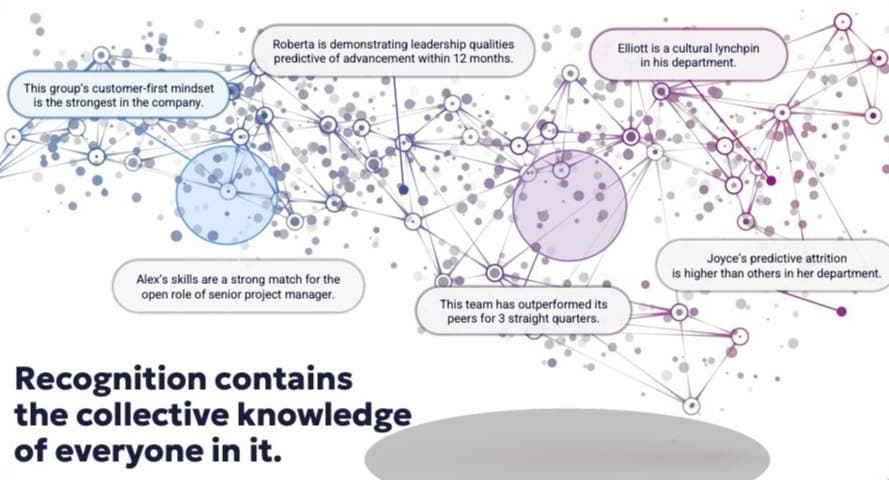
This isn't theoretical. Organizations using Workhuman's Human Intelligence platform (Workhuman iQ and AI Assistant) can now answer questions that were previously impossible to address with confidence:
- Who is demonstrating leadership qualities predictive of advancement within 12 months?
- Who is a cultural lynchpin in their department?
- Which group's customer-first mindset is the strongest in the company?
- Whose skills are a strong match for an open senior project manager role?
These insights emerge not from self-reported survey data or annual reviews, but from the crowdsourced, real-time observations of employees recognizing each other's contributions in the flow of work.
Skills intelligence: beyond self-reported capabilities
Skills and skills-based talent management have become a top-tier strategic priority for HR leaders, with 87% of HR buyers highlighting that being a skills-based organisation is a critical part of their HR agenda, according to Fosway’s HR Realities research 2025Opens in a new tab. But Deloitte reports that fewer than 20%Opens in a new tab are achieving truly adopting skills-based approaches to a significant extent. The challenge these organisations are facing isn’t a lack of intent towards being skills-forward, it’s a lack of accurate, real-time skills data.
Traditional skills taxonomies rely on employee self-reporting or static job descriptions. Recognition data reveals how skills actually show up in real work, day to day. Using natural language processing and machine learning, Workhuman's platform analyzes recognition messages to surface evidence of both hard and soft skills—from adaptability and empathy to strategic thinking and technical expertise—as they're demonstrated and validated by peers.
As one customer leader noted, this capability helped surface "people who are not typically seen and who are more unusual... and the impact that's had on them has been so profound". Recognition data democratizes visibility, ensuring high performers across the organization are identified and developed, not just those in high-profile roles.
Topics: real-time strategy execution intelligence
Every company has a strategy. Few can see if it's working in real time. KPIs are lagging indicators. Engagement surveys are too infrequent. Topics, Workhuman's newest breakthrough feature, changes this dynamic entirely.
Topics enables organizations to input company-wide or department-level strategic initiatives directly into the recognition system. Using natural language processing, each recognition message is scanned for keywords and phrases associated with those priorities. The result: a real-time, trended view of how much work, energy, and alignment is really being applied to what the organization has defined as most critical to deliver.
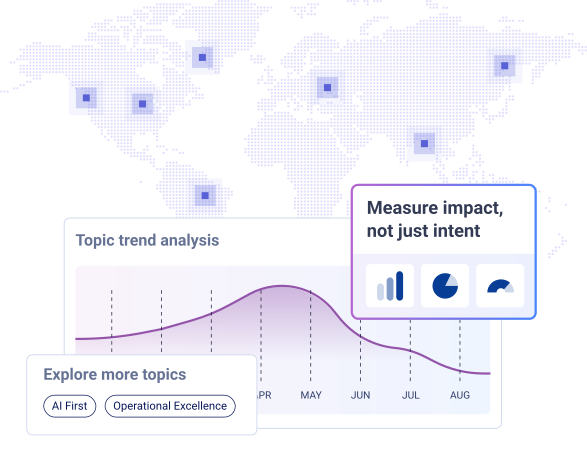
Topics creates a living map of what's actually valued and reinforced on the ground. It shows where strategy is sticking—and where it's not—so leaders can act faster, coach better, and course-correct in the moment. It's the emotional pulse and behavioral fingerprint of culture, captured not in spreadsheets or surveys, but in the language employees use with each other.
For CHROs and HR leaders, Topics provides the missing link: proof of how transformation efforts are landing, and where to focus next. For CEOs, it answers the question that keeps them up at night: "How is my organization really supporting our strategic priorities?"
The CPO as enterprise leader: HR's seat at the strategy table
Recognition data doesn't just help HR do HR better—it fundamentally repositions HR as an enterprise leader capable of co-steering business strategy.
Mark Cowlard's framework for CPO influence is instructive. The CPO must be the CEO's coach, confidant, conscience, navigator, thought partner, and stabilizer. To fulfill these roles, CPOs need evidence, not just intuition. They need to demonstrate how workforce decisions connect to business outcomes. They need to speak the language of execution, accountability, and speed—not just engagement and culture.
Recognition data powered by Human Intelligence enables exactly this. When a CPO can show the CEO:
- Which teams are driving strategic priorities in real-time
- Which leaders are modeling the behaviors that drive performance
- Where skill gaps are emerging before they become crises
- Which high-potential employees are demonstrating readiness for advancement
- How recognition correlates with retention, productivity, and business results
...they're no longer presenting HR activity. They're delivering business intelligence that informs strategic decisions.
A Director of Total Rewards from one of our professional services clients captured this shift perfectly:
"What was key for us was the data insights that came through really, really strongly in working with Workhuman... We were looking for a vendor to provide the experience that the data would give us, but also something that would have a vested interest in the success of our program such that it wasn't just something that we launched and then left—that we really had this collaboration together to look for opportunities for improvement, to use the data to communicate in a different way".
After three years with Workhuman, this organization now uses recognition data to inform leadership decisions, development strategies, and retention initiatives. This leader noted, "Our analytics around certain data and the points between our retention and recognition—that's a really powerful statistic to share back into the business that shows that recognition delivers those outcomes".
Building communities and connection in times of change
While the business intelligence value of recognition is transformative, it's essential not to lose sight of the human impact that makes this data authentic in the first place.
A Global Head of Rewards from a manufacturing client reflected on the early results just two months into implementation:
"In this very short time frame, I have seen people connecting with one another in a different way. I've even heard from our CFO that people who are not typically seen and who are more unusual—scientists—have been valuably celebrated, being put in the spotlight and celebrated—and the impact that's had on them has been so profound. It does indeed build communities and it does indeed give people energy in a time when we're under pressure".
Every 3.2 minutes, someone at this organization is being recognized. That's not just data generation—it's culture creation. It's turning colleagues into communities. It's giving visibility to contributions that would otherwise go unseen. It's reinforcing the behaviors and values that define how the organization works at its best.
As Tom Libretto, President & CEO of Workhuman, puts it: "If you back your people, your people will back your business".
Recognition done right is how you back your people—and the intelligence it generates is how you prove it to the C-suite.
The crisis is real. The opportunity is now.
Engagement is falling. Economic pressure is mounting. The pace of change driven by AI and automation is accelerating. HR departments are being asked to do more with less, to prove value with greater rigor, and to demonstrate strategic impact in a language that resonates with boards and executive teams.
These challenges are real. But so is the opportunity.
People data is the key—and HR teams are ideally positioned to leverage it. Recognition done right transforms the collective knowledge of an organization into interrogable, actionable intelligence powered by Human Intelligence. It enables HR to:
- Show the C-suite how work actually gets done
- Surface hidden talent and emerging leaders
- Track strategic execution in real-time
- Predict attrition and retention risks
- Map skills and competencies dynamically
- Demonstrate ROI on people investments
- Build cultures of connection, belonging, and high performance
This isn't about doing more HR activity. It's about leading from the front with data-first, outcome-oriented strategies that position HR as an indispensable partner in business strategy and growth.
As Dr. Meisha-ann Martin concludes: "You as HR professionals have an incredibly compelling story to tell—and it's backed up by data from across your organizations. That data is critical in making strategic business decisions that stand up to scrutiny today and the challenges of tomorrow. If you want help writing the story of how work gets done at your business, let's talk about recognition done right".
The path from human intelligence to business intelligence isn't theoretical. It's happening now, at organizations across the globe. The question for HR leaders is simple: Will you lead this transformation, or watch from the sidelines?

Workhuman Editorial Team
More by Workhuman Editorial TeamRecommended for you