
AI and Creativity: Exploring the Impact on Modern Professionals
Last updated
6 min read

Generative AI vs. human creativity — this polarizing topic is making heads hurt in the creative industry. Fear is rife as AI is quickly becoming adept at mimicking human innovation.
But should you open your mind to the possibilities that AI can bring?
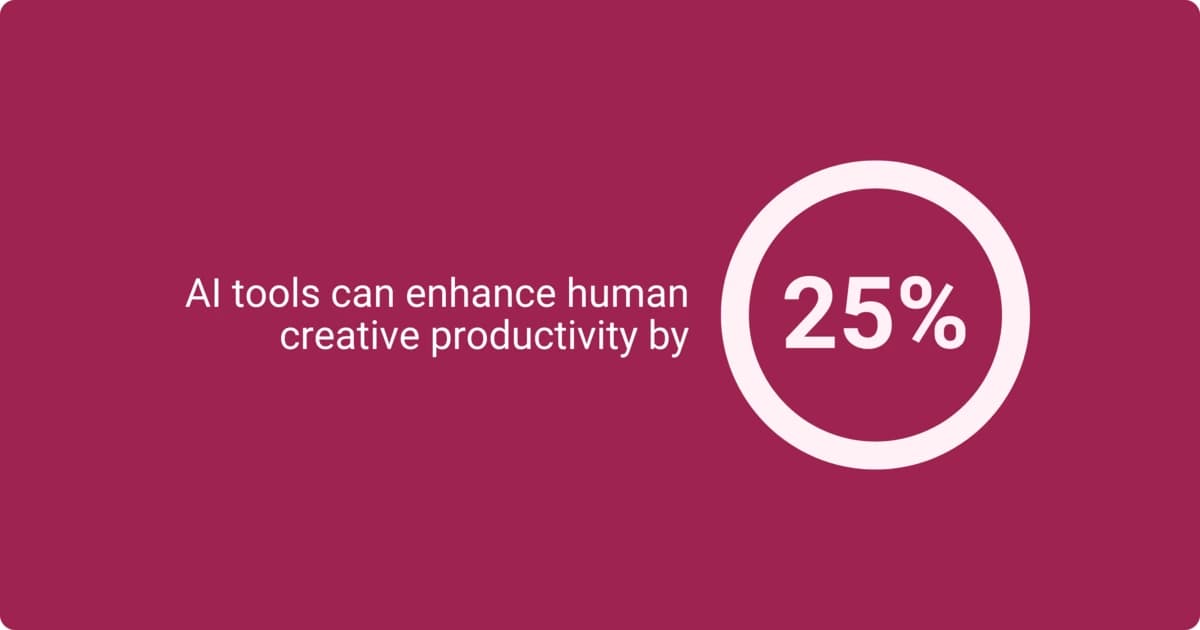
Research by Oxford Academic on "Generative artificial intelligence, human creativity, and art Opens in a new tab" certainly says so. It shows that AI tools like text-to-image enhance human creative productivity by 25%.
Learn how AI and creativity can complement each other in the workplace, some practical applications, related ethical challenges to consider, and more.
How does AI enhance human creativity?
Creative professionals often seek new sources of inspiration and tools to extend their capabilities. AI has significant potential in both areas by handling the more routine aspects of creative work.
From ideation to execution, artificial intelligence can imitate or even exceed human abilities in some ways. While this can pose some threats to the creative community, it also can provide massive gains.
Promoting divergent thinking for innovative ideas
One of AI’s most helpful abilities is to take large volumes of data and produce unexpected combinations that translate into innovative ideas.
Tools like ChatGPT and Midjourney pull from a huge library of content to generate unique text and AI art. Effective in the brainstorming phase, AI can help you rapidly ideate multiple possibilities and quickly experiment with iterations, enhancing intellectual and creative skills during the brainstorming phase.
Challenging expertise bias to uncover new possibilities
Relying on past experiences can limit your ability to see alternative possibilities. In other words, biases can kill your culture. You can deploy AI to combat these biases by objectively offering fresh insights grounded in data.
This uncovers patterns and opportunities you might overlook due to cognitive blind spots. For example, tools that use predictive modeling can highlight untapped markets or innovative design opportunities that human intuition might miss.
Think of it as an expansion of your perspective.
Assisting in refining creative concepts
Gaining feedback based on various datasets like trends and audience preferences helps you refine ideas so your work is both practical and impactful. Here are some areas where AI can help you improve your creative concepts:
- Idea generation
- Content personalization
- Pattern recognition
- Collaborative tools
- Visual and textual support
In product design, AI tools like Adobe Sensei and AutoDesk’s generative design software evaluate prototypes. The systems test the feasibility and can suggest improvements or changes.
Supporting collaborative brainstorming and teamwork
AI can work with your team to synthesize unstructured work and brainstorming sessions into structured work. It can take diverse viewpoints and organize ideas effectively.
Artificial intelligence collects input from multiple team members and identifies connections or trends that might go unnoticed. This means sessions, whether in person or using collaboration tools for remote teams, can become more productive as every voice is heard.
Collaborative platforms like Miro and Workhuman offer AI-powered tools to structure discussions. They collate group-related ideas and augment brainstorming sessions with fresh insights.
Virtual assistants Otter.ai and Notion AI summarize conversations, highlighting and connecting the dots in ways you may miss.
Streamlining repetitive tasks to free time for creativity
Expanding access to creative tools and resources
AI democratizes creativity by making advanced tools available to everyone regardless of skill level. Because it simplifies complex processes, it allows individuals and teams to produce professional-quality work without extensive training or resources. This enables more people to participate in creative projects.
AI-driven platforms like Canva and Adobe Express offer intuitive design tools that are simple to use. Their automation of layout design and color matching democratizes creativity and helps less skilled users create.
Content generators like ChatGPT and Jasper AI assist with language-based modeling, which is useful for writing and ideating. This makes content creation faster and more accessible. These tools empower users to bring their ideas to life, no matter their experience or budget.
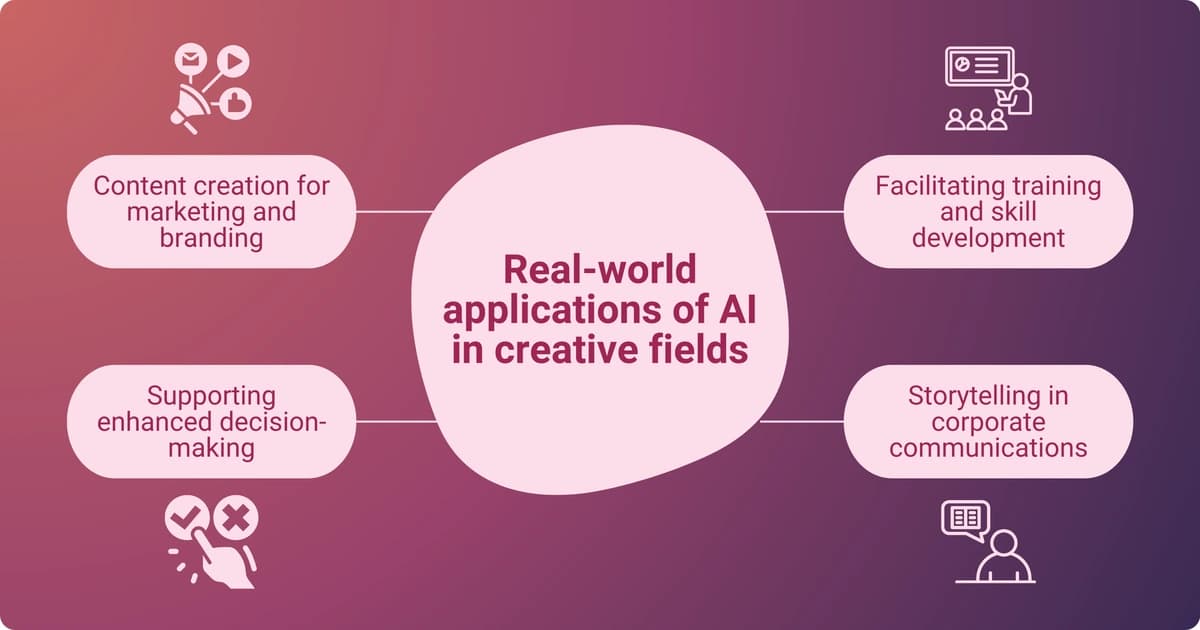
Real-world applications of AI in creative fields
From marketing to design and entertainment, AI is transforming and innovating in ways never thought possible.
Content creation for marketing and branding
Capturing attention with relevant content is a constant battle. Manual content creation is time-intensive, and marketing teams can struggle to keep up. Generative AI is a game-changer that helps marketing professionals attain consistency in their branding.
Across campaigns and social media, AI can:
Enhancing decision-making
Machine learning processes vast volumes of aggregated data from multiple sources at unprecedented speed. Identifying patterns or anomalies can offer you real-time actionable insights to inform decisions.
Tools like Natural Language Processing (NLP) enable AI to include unstructured data, such as text or speech, alongside structured data. Here are other tools that support enhanced decision-making:
- Pattern recognition
- Predictive analytics
- Prescriptive analytics
- Visualization and interpretation
Facilitating training and skill development with AI tools
AI-powered platforms are transforming how teams in creative fields learn and grow. These tools provide personalized learning paths, helping employees upskill at their own pace. AI helps track progress and recommend training based on individual needs, improving the learning experience.
A report by Gallup and Workhuman states AI supports upskilling by making learning more accessible and efficient. Whether it's mastering new design software or improving digital marketing strategies, artificial intelligence helps bridge the gap between current skills and future needs.
Storytelling in corporate communications
AI can produce compelling narratives by analyzing large volumes of data to uncover winning themes. It can also tailor messages that resonate with target groups. Effective storytelling can drive engagement and build stronger relationships with employees and customers alike.
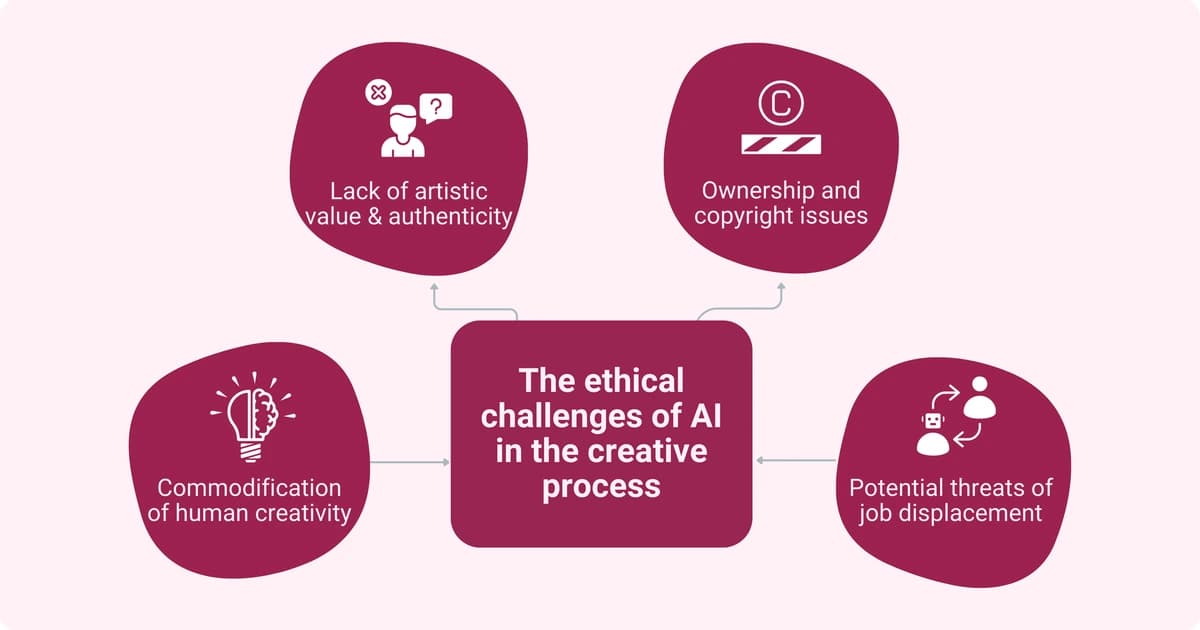
The ethical challenges of AI in the creative process
The integration of AI into your organization's processes brings the possibility of job displacement and other ethical challenges. Because of the huge amounts of data involved and the legal implications regarding intellectual property, understanding who owns the rights to what becomes complex.
The challenges of AI raise important questions about its role in shaping creativity. It's important that you implement AI with strong ethical frameworks.
The commodification of human creativity
It would be a travesty to undervalue the unique and emotional aspects that underscore human-driven creative work. AI risks turning creativity into a commodity by reducing it to processes that can be easily replicated.
If AI can generate content at scale, it might be difficult to distinguish between machine-generated ideas and those driven by human experience. This commodification could make creative industries more competitive, with AI as a cheaper and faster option. As a result, human creatives may face challenges in maintaining their value and relevance.
Authenticity vs. machine-generated art
Ownership and copyright issues
AI-generated works raise complex legal and ethical questions about intellectual property and authorship. Since AI is not a legal entity, it’s unclear who owns the rights to the work it produces. Should the credit go to the AI developer, operator, or the AI itself?
For example, if AI generates a painting or piece of music, who holds the copyright? Traditional copyright laws were created with human creators in mind, and they may not adequately address machine-created works.
Job opportunities and threats
There are opportunities and risks in the creative job market in the age of AI. On the one hand, AI can create new roles, particularly in AI training and hybrid creative positions where humans collaborate with machines. It can also open doors for those in creative fields to leverage technology and expand their capabilities.
However, AI also threatens traditional creative roles. New tools like Sora text to videoOpens in a new tab can rapidly create content. This raises concerns about roles in projects that involve long and complex creative processes. To stay relevant, professionals will need to reskill and embrace new tools that incorporate AI in ways that complement their creativity.
It will be important to cultivate adaptability to change in this evolving landscape to secure long-term career success.
Balancing AI and human creativity
AI will not entirely replace creative jobs, but it will certainly change the nature of many. Creative professionals will see their jobs evolve as AI augments roles in projects that require data-driven content creation or automates repetitive aspects of design.
Humans will still drive the creative vision and conceptualization, but upskilling should be a major focus. Professionals who learn to use AI tools will stay ahead of the curve and be better equipped to harness the potential of this technology.
For AI to truly enhance creative work, it needs human direction to guide it. Emotional resonance embedded in cultural sensitivity are aspects of creativity that are uniquely human. These qualities will always be necessary to connect with audiences in ways AI cannot achieve alone.
Collaboration between humans and AI
Refik Anadol is a leading example of creators collaborating with AI. He embeds media arts into architecture with data sculpting via machine learning. He creatively combines massive quantities of open-source data with human emotion and cultural contexts.
Why will AI never replace human creativity? Artificial intelligence lacks the capacity for emotional intuition and true innovation, and it is fundamentally limited by its reliance on existing data. The emotional depth and imagination created from seemingly nowhere is unique to humans.
How managers can foster AI-human collaboration effectively
Managers will be pivotal in encouraging collaboration between artificial intelligence systems and human teams. Here are some strategies you can use to create harmonious and productive partnerships:
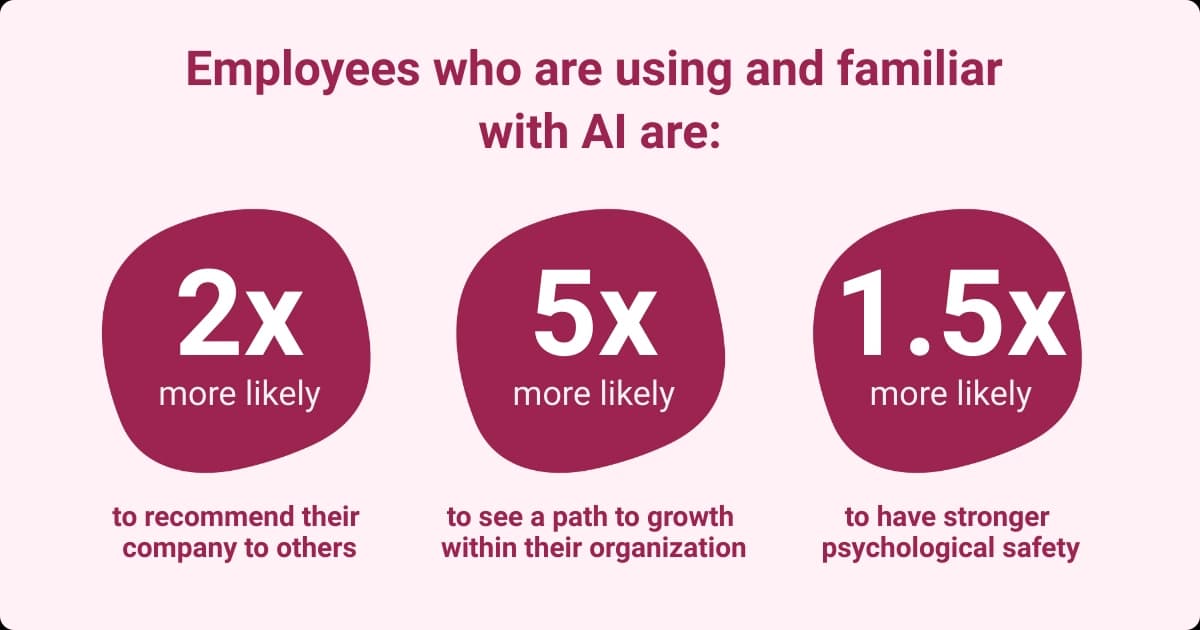
- Train and upskill: Providing employee AI training and development keeps workers relevant and can help alleviate fears and increase acceptance.
- Appoint AI champions: Leaders advocating for AI adoption and guiding its implementation can drive innovation and bridge gaps between technical teams and decision-makers.
- Create a collaborative culture: Building a working environment where employees view AI as a supportive tool rather than a replacement can encourage teams to experiment with AI to improve processes and enhance creativity.
The future of AI and creativity
In the age of AI, we find ourselves in a continuously evolving relationship. AI is not just a tool that assists creatives anymore; it's becoming a partner in the creative process.
As AI's capabilities grow, it will continue to impact how we approach art, design, marketing, and even problem-solving. The future lies in a collaborative process where human insight and AI's computational power work together to drive innovation and artistic expression.
Evolving definitions of creativity
Existing theories of creativity determine that AI is incapable of being authentically creative. However, the standard definition of creativity is not comprehensive enough to reject the pseudo-creative work of AI. As AI continues to challenge these boundaries by producing novel ideas, two options come to mind:
- Accept AI is creative
- Update definitions to distinguish authentic human work from artificially created work
AI will transform the way we approach problem-solving by helping us see undiscovered patterns and possibilities. In artistic expression, AI will continue to serve as both a tool and a collaborator, offering fresh avenues for exploration.
What industries need to adapt to harness AI's creative potential
From marketing to entertainment to less creative businesses like healthcare, many industries must adapt to fully harness AI's creative potential.
You can take these steps to embrace AI’s possibilities:
Conclusion
AI is redefining the relationship between humans and AI in creativity. Blending efficiency with originality will be critical for staying ahead in an already highly competitive industry.
While you need to leverage AI's potential, you also need to draw clear lines. A major challenge in this is balancing AI's advancements with human intuition to ensure creativity retains its emotional depth and authenticity.

Workhuman Editorial Team
More by Workhuman Editorial TeamRecommended for you