
After The Leadership Reset: Five Ways to Put the Ideas to Work
by Lou Evan
Last updated
4 min read
Table of contents
- 1. The HR Manager Infrastructure Audit: Look at what managers are carrying
- 2. The Manager Field Guide: Choose a behavior to practice
- 3. Scripts for Moments That Matter: Find the words before you need them
- 4. AI Prompts for Better Management: Prepare with more curiosity
- 5. Your 30-Day Leadership Reset: Test one change
Share this article
The Leadership Reset, Workhuman’s Spotlight documentary, explores what happens when the familiar ways of managing people start to fall short. Through the experiences of Amy Edmondson, Joanne Chang, Dr. Syra Madad, KeyAnna Schmiedl, and Dr. Meisha-Ann Martin, it examines leadership in settings ranging from a growing bakery to a global health crisis. Across those conversations, we see leaders learning to share responsibility, invite uncomfortable information, and support people whose contributions they can’t always see firsthand.
If, when watching The Leadership Reset, you recognized a few things happening in your own organization and thought, “we should do something about that”, then its companion playbook offers specific actions to do that "something." The documentary explores how leaders can help people work through uncertainty, share what they know, and develop the capabilities around them. The playbook brings those ideas into the situations HR leaders and managers encounter every day.
The full toolkit has five sections, each offering a different place to begin. You can work through them with your people leadership team or choose a tool for something happening at the moment. There’s no requirement to launch a company-wide initiative. Your calendar can relax.
1. The HR Manager Infrastructure Audit: Look at what managers are carrying
Managers are asked to deliver results, develop people, communicate change, recognize contributions, and keep an eye on how everyone is doing. Often, they’re also expected to maintain a substantial workload of their own. Before asking them to improve, it’s worth looking at whether they have the time, information, and support to do what’s already expected.
The HR Manager Infrastructure Audit helps HR examine eight areas: role clarity, capacity, learning and practice, information, feedback, recognition, visibility, and escalation. These questions make broad concerns easier to investigate. When managers struggle to explain a change, for instance, did they receive enough context to understand it themselves? When development conversations keep slipping, what else is taking up that time?
Use the audit with your HR or people leadership team and choose one consequential gap. Identify who experiences it, what it costs, and what needs to change. That gives you a concrete starting point, whether it’s removing an administrative task or creating more opportunities for managers to practice difficult conversations.
2. The Manager Field Guide: Choose a behavior to practice
The Manager Field Guide gives managers tools they can use in the moment: receiving bad news, delegating work, communicating uncertainty, and noticing contributions they might otherwise miss. It’s designed for the ordinary interactions through which people learn what to expect from their manager.
Start with a situation that happens regularly. If problems tend to surface late, try the Bad News Test. The next time someone raises a concern, pause long enough to understand what they’re seeing, what remains unclear, and who else might have useful information. Your response helps determine whether they’ll bring you the next concern while there’s still time to act.
Or use the Delegation + Capability Checklist when you’re tempted to take a task back. Consider whether you’ve explained the standard, provided enough context, and agreed on ownership and check-ins. Doing it yourself might be faster today. Giving someone room to learn can make next month considerably easier.
The visibility exercises are useful here too. Ask about work you didn’t witness, including the people who helped colleagues succeed or prevented a problem. Specific recognition gives those contributions attention and helps people understand what others value about their work.
3. Scripts for Moments That Matter: Find the words before you need them
Even experienced managers can struggle to find useful words when someone challenges a decision or a team is worried about change. Under pressure, it’s easy to reach for familiar phrases that close a conversation before it has really begun.
Scripts for Moments That Matter offers starting points for those exchanges. The talk tracks cover uncertainty, team changes, recognition, delegation, disagreement, and bad news. They’re meant to be adapted to your own voice, so the employee in front of you still recognizes the person speaking.
One especially practical approach is to explain what you know, what you’re still trying to understand, and when you’ll return with an update. That gives people something dependable even when the answer is incomplete. Another is to invite someone to explain what you may be missing before you respond to their disagreement.
HR teams can use these talk tracks for practice with managers. Try a realistic scenario, then discuss how the response might land and what could make it more useful. A little rehearsal helps when the real conversation arrives with considerably less warning.
4. AI Prompts for Better Management: Prepare with more curiosity
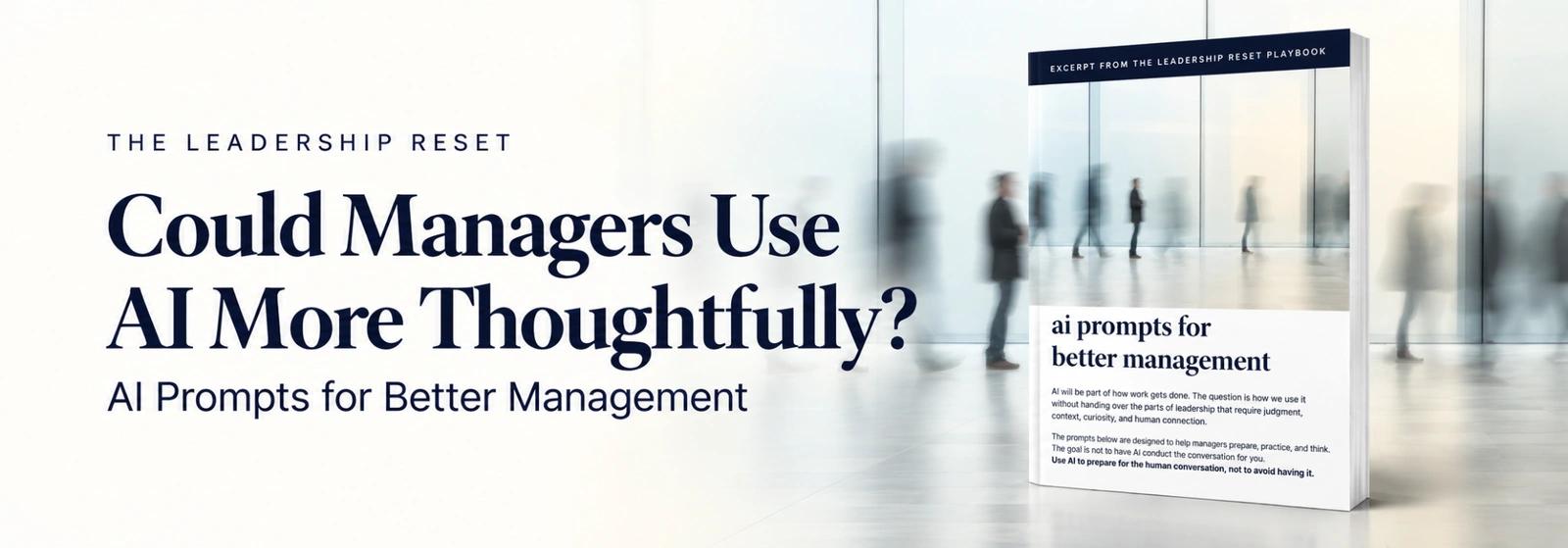
AI can help managers examine their thinking before a conversation. The playbook’s prompts focus on preparation, practice, and reflection, while keeping responsibility for the relationship and the decision with the manager.
For a difficult conversation, one prompt asks AI to identify assumptions, suggest questions, and flag language that could sound defensive or dismissive. Another invites alternative explanations for why an employee, team, or project is struggling. That can be useful when your first explanation has started to feel suspiciously like the only possible one.
There are also prompts for practicing how to receive bad news, preparing to delegate, and exploring contributions that may be hidden in a project’s final outcome. The recognition prompt asks for patterns supported by concrete examples and development questions to discuss with the employee.
Choose a prompt that helps you enter the next interaction better prepared. Then bring your attention, judgment, and curiosity to the person involved. They’re the one who can tell you what you still need to understand.
5. Your 30-Day Leadership Reset: Test one change

The final toolkit section gives the work a manageable timeline. In week one, look closely at one question: what are you failing to see, what are people reluctant to share, or what are managers carrying that the organization should own? In week two, define a specific problem. In week three, test one small change. In week four, review what happened and what you learned.
Your experiment could be a weekly visibility question, a clearer communication rhythm during change, or a new opportunity to practice delegation. Keep it small enough to try and specific enough to learn from.
At the end of the month, ask what people experienced differently and what needs adjusting. You’ll have something more useful than an intention waiting for a quieter week: an experience your team can build on.
Watch The Leadership Reset on demand, then open the companion playbook and choose your first next step.
Lou Evan
Lou Evan is a Senior Content Specialist at Workhuman. Having worked most of his career in the employee recognition space, he brings a firsthand perspective to the cultural, psychological, and ultimately financial impact of tailored, strategic recognition programs. Lou believes in friendship, family, and creativity.