
10 Stats You Should Know from the Recognition Intelligence Report
by Erika Roemer
Last updated
3 min read
Organizations can measure engagement, performance, retention, skills, productivity, and increasingly, AI adoption. But some of the most important things about work remain difficult to see.
- What are people actually contributing?
- Which skills are showing up in real work?
- How are people adapting?
- Which behaviors are helping teams succeed?
Every recognition moment creates human-authored data: an observation of what someone did, how they did it, or why it mattered. At scale, those observations can reveal patterns that conventional workforce data may miss.
In the Workhuman® Recognition Intelligence Report, we looked at how signals emerging from millions of recognition messages can reveal key business questions. We also did a deep language analysis across 2.6M recognition moments. Together, these analyses show that the people doing the work are one of the richest sources of information about it. Read on for some highlights of what we found.
49% of awards were sent by managers, 51% by nonmanagers.
This finding sets the tone that recognition is nearly evenly distributed across workers. Managers are important catalysts, but recognition is far from a purely top-down activity.
43% of awards crossed departmental boundaries.
Recognition often makes contributions visible beyond the structures shown on an org chart.
13% crossed country borders among organizations operating internationally.
Recognition is not confined to one level, function, or geography. It moves across the globe, creating a measurable record of how international workforces communicate and see one another’s contributions.
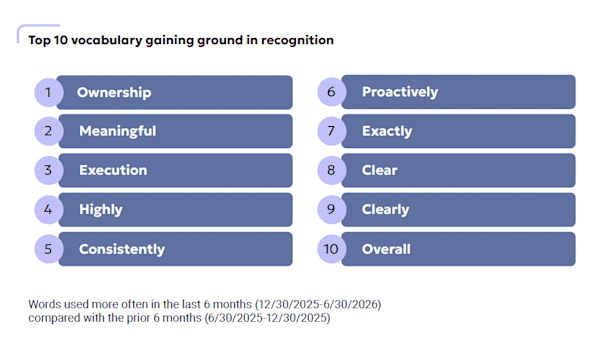
The #1 term gaining ground in recognition is “Ownership”.
Across seven industries, the vocabulary of recognition varies with the context — offering a view into what people notice and value in different kinds of work. The words change with the work when you view by industry.
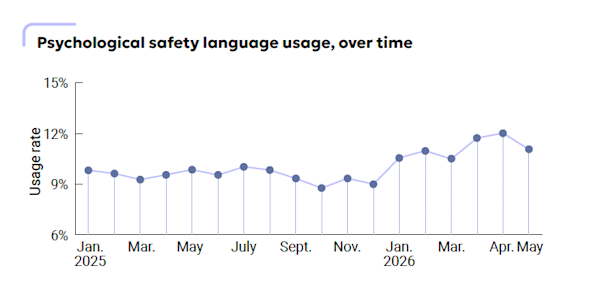
Psychological-safety-related language rose from approximately 9.8% to 11.1% of recognition messages.
Recognition makes behaviors like asking questions, raising concerns, and surfacing risks visible. It can show
patterns around which behaviors are being celebrated or not and that can help organizations be more deliberate in their efforts in to create a psychologically safe environment.
Burnout-related language remained persistent, reaching approximately 17.2% in June 2026.
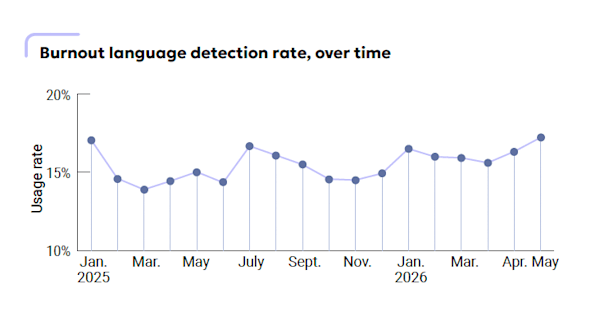
By industry, healthcare services see the highest detection rate of burnout language.
The question is not whether recognition can diagnose burnout. It can’t. It can, however, raise a useful question: When extraordinary effort becomes something people repeatedly recognize, what does it tell us about the system around that work?
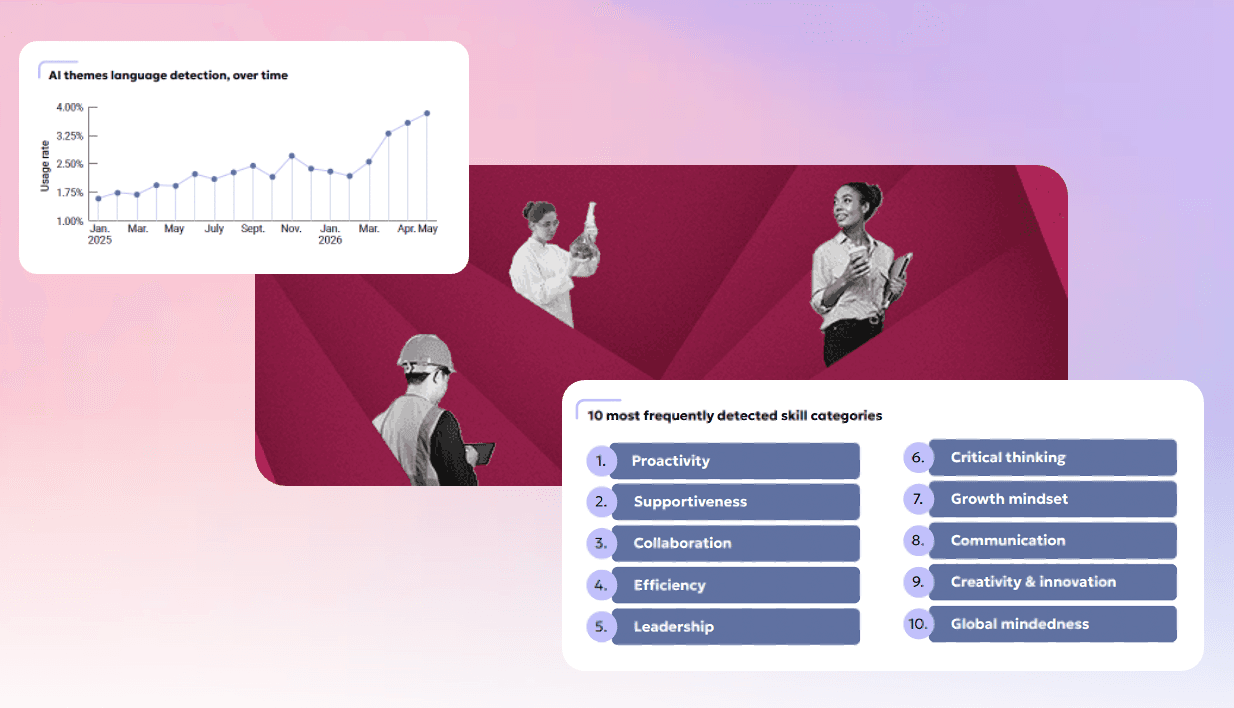
AI-related language increased from approximately 1.6% to 3.8%.
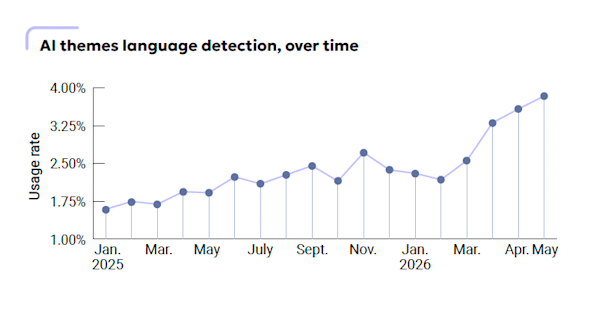
By industry, tech sees the highest detection of AI language.
Recognition can show not simply whether people are using AI, but what they are doing with it — experimenting, solving problems, improving processes, and helping turn technology into something useful.
4 in 5 recognition messages contain at least one identifiable skill. The #1 most frequently detected skill was Proactivity.
The most frequently detected include:
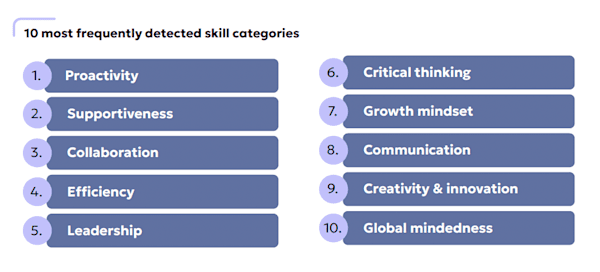
Of the top ten skills detected, Creativity & Innovation and Global Mindedness ranked #9 and #10.
This replicates findings from our research with the World Economic ForumOpens in a new tab, which found that systems thinking, teaching, and creative thinking are among the least acknowledged skills. We know that these skills are not the least used at work. Instead, our research continues to reveal what is harder to see and celebrate. It prompts us to be more intentional about highlighting the work – and the contributors – that may be overlooked.
Safety language appears visible during 100% of the period studied.
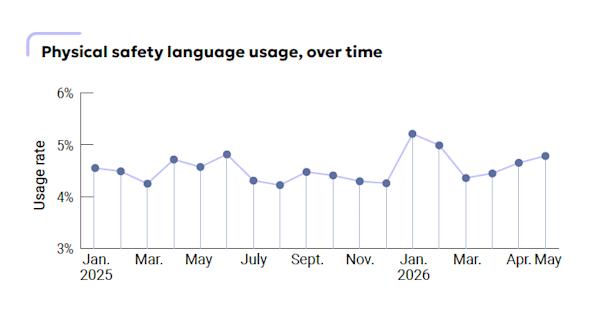
Our physical-safety model identifies recognition language associated with proactive behaviors people notice in the moment — identifying risks, stopping unsafe work, following safe practices, and speaking up.
What’s notable is that in this study, physical safety related language appears consistently across the period. This proves that safety remains visible in the recognition record over time, and that recognition is a useful way to track its strength.
The next generation of workforce intelligence
Strategic recognition adds something conventional workforce systems often struggle to capture: the perspective of the people experiencing the work. That perspective can make hidden patterns more visible — from the skills people use and the behaviors they reinforce to the ways work is changing and the conditions surrounding it. The next generation of workforce intelligence will not come from collecting more data. It will come from seeing more in the data you already have.
Read the full report →
Analysis draws on 2.62M English-language recognition messages from 35 Workhuman customers across seven industries, January 2025–June 2026. Additional analyses use customer-specific workforce data as noted in the report. Recognition-language analyses identify signals, not diagnoses or direct measures of underlying workforce conditions.
Erika Roemer
Erika Roemer is a writer, editor and dog mom to Oscar the Boston Terrier. She oversees the customer evidence and proof points program at Workhuman.