
What Is Strategic Recognition & Its Benefits?
Last updated
6 min read

Too often, recognition programs are treated as a “nice-to-have,” a pat on the back that fades quickly. But recognition has real power. Findings from Workhuman, Gallup, and Everest Group show that when recognition is approached strategically, it can transform engagement, culture, and business performance.
Across more than 25 years of studying what drives impact, one pattern stands out: recognition works best when it’s intentional, consistent, and aligned with business goals. When done right, everyday appreciation becomes a source of insight and connection. Employees feel valued, teams feel stronger, and organizations gain the intelligence to make smarter decisions.
What is strategic employee recognition?
All recognition matters, but not all recognition is created equal.
Many companies still rely on occasional thank-yous or one-off awards, with little connection to how employees’ work drives business results. It feels nice in the moment, but the effect fades quickly.
Strategic recognition is different. It’s deliberate, consistent, and meaningful. It aligns with business priorities, fuels culture, and generates data that leaders can use to guide decisions about talent, engagement, and performance.
Think of it this way: one approach is a random sprinkling of praise, the other is recognition built into the rhythm of work, tied to results, and designed to make employees feel seen and motivated.
Shift from traditional to strategic R&R
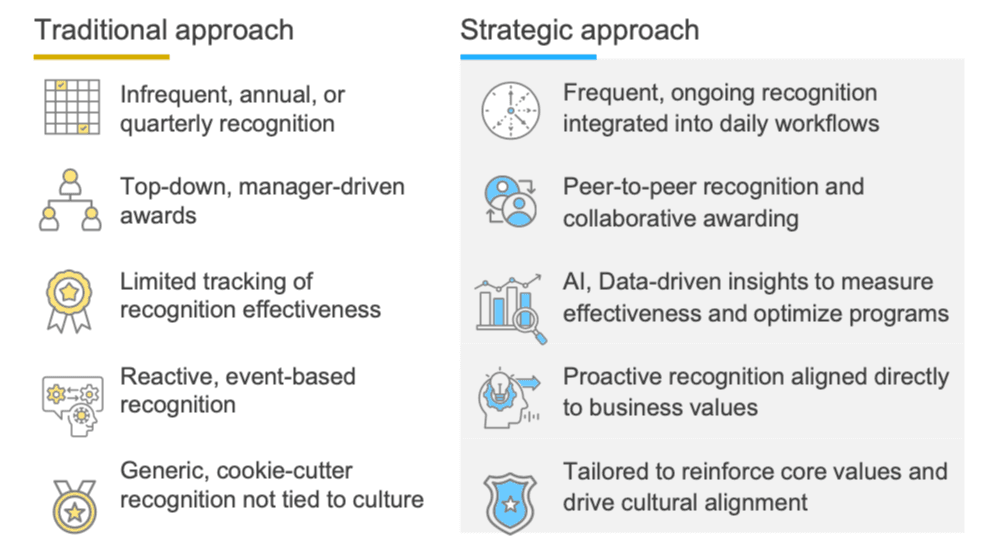
Source: Everest Group, Recognition as a Strategic Lever: Driving Data-Driven Decisions and True Business Impact (2025)
Through decades of experience and partnerships with Gallup and Everest Group, Workhuman has studied what makes a successful employee recognition program. Together, these insights reveal how peer-to-peer recognition, when designed intentionally, turn everyday gestures of appreciation into a strategic lever for business growth and organizational intelligence.
Let’s take a closer look at each in more detail:
Five pillars of recognition
At its core, strategic recognition is about the human experience – meeting employees’ needs for validation, fairness, and belonging. Gallup and Workhuman research shows there are five factors that are critical to driving the impact of recognition.
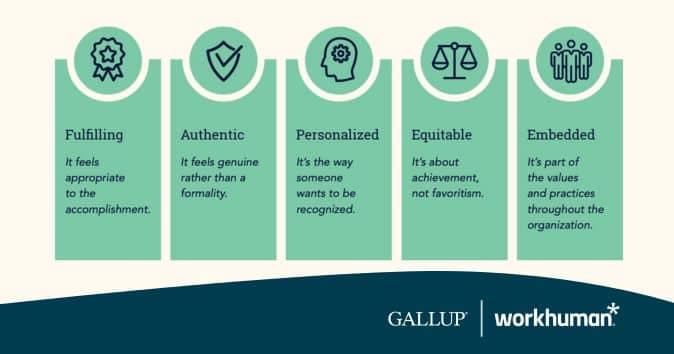
We call this the five pillars of strategic recognition. Let’s explore each in further detail:
Fulfilling
There is no “magic number” for how frequently recognition should be given. Peoples' needs vary. Most employees want to be recognized at least a few times a month, but this should be regarded as the bare minimum. In fact, 40% of employees Gallup surveyed view the right amount of recognition as a few times a week or more.
Meeting this need consistently can make employees 4x more likely to be engaged, 56% less likely to seek new jobs, and 44% more likely to thrive.
Recognition isn’t about checking a box. It’s about creating a fulfilling experience that validates effort and impact – a steady rhythm of appreciation that fuels motivation and pride.
Authentic
Recognition only works when it feels genuine. Empty words or routine praise can backfire, leaving employees skeptical or disengaged.
Only about one-third of employees strongly agree the recognition they receive at work is authentic.
Recognition lands best when it’s specific – when it explains what someone did, why it mattered, and how it connected to results. Tying monetary rewards to a specific achievement or goal sends a different message than everyone getting a bigger paycheck at the end of the quarter.
Spontaneous, in-the-moment feedback often carries more weight than formal or routine praise.
Personalized
No two employees experience recognition the same way. Some value a public spotlight; others prefer a quiet “thank you.”
64% of surveyed employees prefer a mix of public and private recognition.
Offering flexibility shows respect for individual preferences and cultural differences. Technology-enabled recognition platforms make it easier to strike the right balance – creating visibility without forcing anyone into unwanted attention.
Equitable
Recognition must feel fair. When employees see others celebrated disproportionately — or not at all — it undermines trust and belonging.
Recognition patterns can reveal hidden gaps or biases, reflecting the inclusivity of an organization. Gallup data show that some groups receive recognition less often, which can mirror deeper inclusion challenges.
If recognition is about giving credit where credit is due, then the general lack of perceived equity in recognition signals a serious failure.
Embedded in organizational culture
Recognition can be a practice, or it can be the way of life at an organization. The distinction between the two makes a noticeable difference in the daily experience of employees.
A true culture of recognition is one where gratitude flows freely, appreciation happens regularly, and every employee – regardless of level or location – feels seen. When recognition becomes part of daily interactions, not just milestone moments, it reinforces belonging, resilience, and shared purpose.
Critical components of strategic program design
Even when the principles are clear, program design determines whether recognition truly drives results. Everest Group identified five components that make recognition programs consistent, scalable, and measurable.
Integrated in daily workflows
Recognition must live where work happens. Embedding recognition into everyday tools, peer interactions, and manager feedback ensures it’s timely, authentic, and widely shared.
“It’s about that consistency of recognition over the course of the year. It’s not about one major thing someone was involved with, it’s about seeing who’s been constantly receiving recognition from their peers.” -Chris Jones, Colleague Recognition Manager, British Airways
Integrated programs make recognition data richer and more representative of performance, improving productivity, safety, and retention.
Aligned with performance and culture
Recognition drives results when it’s tied directly to business goals and company values. Employees need to see how their actions contribute to outcomes that matter – innovation, collaboration, and customer success.
Recognition grounded in performance priorities reinforces both what people achieve and how they achieve it.
Data-driven and measurable
A strategic employee recognition program is intentional and informed by analytics. Tracking who’s recognized, how often, and for what behaviors reveals inclusion patterns, engagement trends, and skill strengths.
These insights give HR leaders real-time visibility into culture health and workforce performance, helping them refine recognition programs for greater equity and impact.
Scalable and adaptable
Business priorities evolve – your recognition system should too. The most successful programs flex across teams, geographies, and work models without losing meaning.
Scalability ensures recognition continues to reflect organizational values and reward the right behaviors, even as the business grows or transforms.
Supported by strategic partnership
Technology alone isn’t enough. The right provider offers strategic guidance, governance, and optimization that align recognition to measurable business outcomes.
A strong partner helps HR leaders translate recognition data into insights that drive performance, inclusion, and retention.
For example, Workhuman’s partner R1 RCM saw a 10% decrease in turnover for employees who received frequent recognition, rather than those who didn’t. Also, employees who were recognized by both peers and managers had a 13% turnover rate, compared to 35% for those who never received recognition.
Curious to learn more? Check out the full case study from our partner R1 RCM.
When these components come together, recognition becomes a system of organizational intelligence – a continuous source of insight into how people work, connect, and contribute.
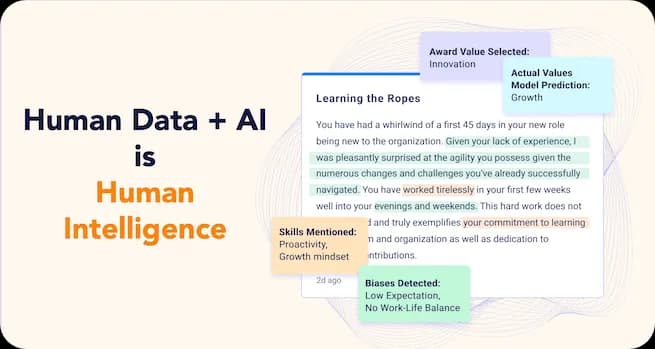
What kind of business intelligence can come from recognition data?
Recognition data offers one of the clearest views into the human side of performance. Every moment of appreciation generates behavioral signals that reveal how work happens – who collaborates, who leads, and what drives success.
Over time, these patterns uncover:
- Engagement and inclusion gaps
- Emerging leaders and collaboration networks
- Skill strengths and development opportunities
- Early signs of burnout or attrition risk
Analytics use cases and benefits
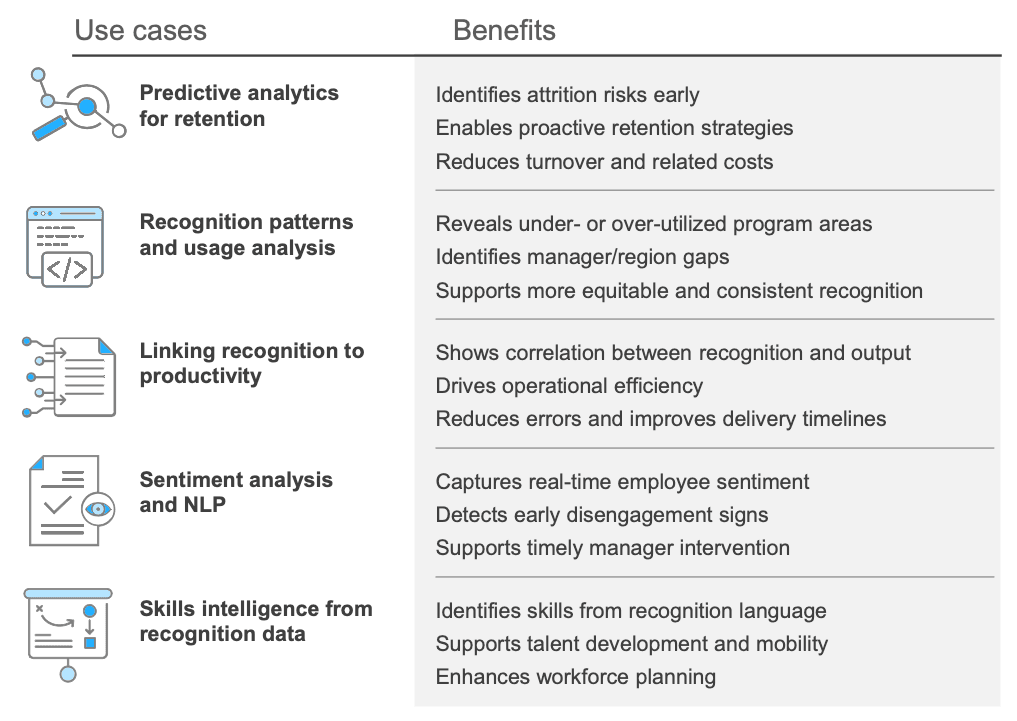
Source: Everest Group, Recognition as a Strategic Lever: Driving Data-Driven Decisions and True Business Impact (2025)
Organizations can turn these insights into strategy, using recognition data to strengthen company culture, guide talent decisions, and align people programs with measurable business outcomes.
A partnership with Workhuman helps turn moments of appreciation into a feedback loop that fuels data-informed, people-centered decision-making.
The benefits of strategic employee recognition
Recognition not only boosts morale but also drives meaningful business results. Let’s dive deeper into the impact:
Boosting productivity
Extrinsic factors at work, such as getting paid, are the motivators we often think about. But extrinsic factors alone can only go so far.
Intrinsic factors, on the other hand, do much of the motivating on a typical business day. Intrinsic motivation is like a magnet that draws people toward activities that are fascinating, enjoyable, and fun for their own sake.
Work feels intrinsically engaging when people:
- Like the work they do.
- Like the people they are around.
- See the meaning and purpose in their efforts.
Strategic recognition supports all three of those criteria: It celebrates individual work, it bonds teams together, and it connects personal achievement to organizational success.
At Morgan Truck Body, one of Workhuman’s partners, it was found that 70% of the sites with quality recognition programs scored highly on internal favorability and engagement surveys.
When employees feel happier and more engaged, they work harder, are more productive, and are less prone to burnout. It’s just that simple.
Improving workplace safety
Many factors influence why safety incidents occur, but attention to detail is among the most important. A recognition-rich culture communicates the idea that people are paying attention to how work gets done.
Another important factor is caring – and recognition increases social bonding. When employees are singled out for praise, or when personal milestones or important life events are celebrated, it increases their value to the team.
Lastly, recognition affirms the importance of quality. It says excellence is better than cutting corners, a job well done is better than hiding mistakes. Recognition likely increases conscientiousness on a work site, which in turn improves safety outcomes.
Reducing absenteeism
It may sound surprising that something as simple as praise for excellent work would make people show up more often. The fact of the matter is that most people are motivated by caring relationships.
When people receive recognition, they take pride in what they do and put in extra effort to feel part of the team. What’s more, the likelihood of positive social interactions plays a major role in where employees choose to be on any given day. A consistent environment of appreciation makes the workplace a place where people want to be rather than where they have to be.
This is where, once again, recognition plays an important role. It bolsters wellbeing because it draws attention to what employees do well, making them feel good about themselves, their one-of-a-kind strengths, and what they uniquely bring to the table.

Final Thoughts
When recognition is embedded in workflows, aligned with values, powered by data, and supported by expert partnership, it becomes a source of human intelligence – helping leaders understand, motivate, and retain their people in real time.

Workhuman Editorial Team
More by Workhuman Editorial TeamRecommended for you