Spark to Signal: How an Impactful Recognition Message Becomes Workforce Insight
Every impactful recognition message has one thing in common: it is an honest, specific message about work and outcomes. It tells you who did what, why it mattered, and how the moment ties to values and goals. It shows you that someone noticed your effort and cared enough to say it out loud. It conveys not only appreciation but a clear signal of “what good looks like” for that person and everyone watching. And it lifts both a person’s day and their work.
In the beginning, “thanks for all you do” was all we really expected from impactful recognition. But as we sought to make recognition more impactful, we began to notice something more. That spark of joy was better when it was informed by behavioral science. And the spark didn’t have to begin and end with the receiver – or even the giver – of recognition. It could be much more.
When a thoughtful message is captured and shared well, it doesn’t stop at “thank you.” First, it lands as that spark of joy, but then it catches fire, and becomes a catalyst for the work around it – as others see it, learn from it, and copy the behavior.
And finally, with enough quality and reach – and a science-led, AI-native platform – that same message has deeper impact and shows up as a real-time signal leaders can act on.
But there’s a lot of not-impactful recognition out there, that lacks the basis in real science and end up as so many empty words. “Thanks for all you do” is kind and I’ll never argue against kindness, but on it's own it’s thin. Thin inputs make thin impact, and thinner insight. If you want real impact on behavior and decision-grade signals, the message has to carry information: who did what, where and when it happened, why it mattered, and how it ties to values and outcomes.
Do that at scale and you don’t just brighten days, you actually light up the whole business.
In this post, we’ll talk about how a single recognition message grows up – from spark, to catalyst, to signal – and why “science-led, AI-native, human-first” recognition has become a people operating system capable of not only elevating humans but leading HR and work forward through the AI age.
A brief history of impactful recognition
It’s human to say thank you, and human to be moved by appreciation – but it took a while for recognition and reward to evolve from a simple expression of gratitude to something with real business impact.
We can break that evolution down into roughly five eras:
The Employee of the Month Era
Saying thanks at work started with simple gestures, like handwritten notes, “Employee of the Month,” parking spots, pizza parties and the proverbial drawer of gift cards. Those kudos felt good in the moment, but their impact quickly vanished. Moreover, some of them felt less than fair, or set up a system of haves and have-nots. And though the gratitude was real, there was no lasting reward, no shared experience, no data trail to revisit, no pattern to learn from, nothing to build on.
The Tactical Program Era As recognition matured, companies centralized it. Shout-outs got recorded and reported. Reach improved, but impact still lived in the words. Specific, timely, values-linked notes moved behavior; generic praise didn’t.
The Culture-Lifting Era The next leap happened when recognition became a shared practice, not a manager perk. Messages turned into short stories of values in action, localized so no team was left out. Early analytics started shaping culture instead of just counting moments.
The Impact Era From there, recognition moved into the operations of the business. Leaders used it to advance programs and goals, like safety, quality, CSAT, velocity, innovation, and to keep strategy visible. Patterns became a barometer for alignment and spread what worked across functions and regions.
The Insights Era We’ve come a long way. Today, with clear recognition science and AI advisors, millions of messages can be combined into deep workforce insights. Through Human Intelligence®, we can see and affect things like skills and strengths, talent mobility, performance and potential, succession, where and how work is actually getting done, and who is driving the business forward.
We’ve come a long way from pizza parties and plaques. But it all rests on the intersection of impactful recognition messages and science-led AI.
An impactful recognition message: the base atom
We talk a lot about why the science of recognition matters so much, and why Workhuman’s data is unique in the marketplace.
Let’s break it down.
A well-formed message offers both more human meaning and better structured metadata, Here’s the information density you can find inside one short note when it’s backed by good science and a robust platform:
| Who: Who is collaborating and connected to who in your organization – within and across teams. |
| What happened: The specific behavior or contribution that is worth replicating. |
| Alignment: The business relevance and how the behavior aligns to your mission, values, strategic initiatives and rally cries. |
| Skills and strengths: The capabilities people are exhibiting that contribute to the business. |
| Magnitude: The calibrated level of recognition – a proxy for the size of their impact. |
| Contextual signals: NLP can examine the language for cues and additional nuance and evidence of morale, engagement, connection and impact. |
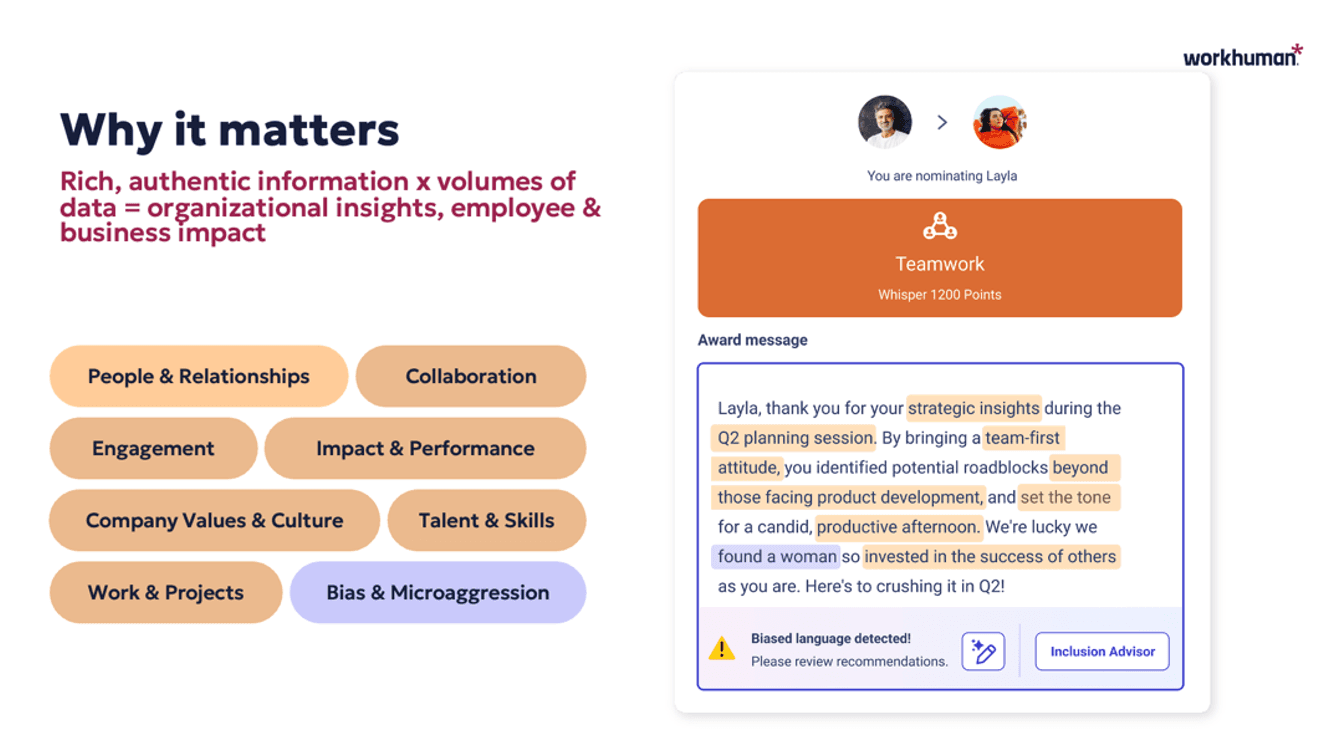
You will not get this level of detail in a program that is simply delivering thank you messages and perks. The virtue here is in the detail.
Science-led recognition data captures something most systems miss: behavior. What people did, how they describe it, how it aligns to values and priorities – and how they’re likely to grow. And because the signal is human and voluntary, we can also influence it, with messages of encouragement, reinforcement, and calibrated rewards.
With the program set up and the message packed with real signal, you can watch a message travel: first as a human spark, then as a catalyst for the work around it, and, with enough quality and reach, as decision-level insight.
The spark (impact on the individual)
A good message becomes a moment. It tells someone, plainly, “you matter here.” It restores energy, clarifies what good looks like, strengthens belonging and self-efficacy, and nudges intent to stay. Even without a mature program, a specific, timely, values-linked note lands.
The catalyst (impact on teams and the work)
When messages are shared, they also teach. One person’s moment becomes a pattern others can copy. Collaboration gets easier, onboarding is faster, cross-team trust climbs. Gratitude connects giver and receiver – but also positively impacts observers.
The signal (impact on the workforce and organization)
Recognition data is a powerful force that drives attitudes, behaviors and beliefs, but – in the same way that light is both a wave and a particle – every recognition moment is also an incredibly powerful data point.
Each message is a star in a constellation of data, and when thousands of messages combine, it’s like an MRI for your organization. Put that data into AI and you can turn it into skills heatmaps, surface hidden influencers, see execution against priorities, and measure the true reach and ROI of rewards. The more data points you have, the clearer the picture becomes. That picture reveals allies across teams – and the silos that still need breaking. It highlights bright spots you will want to replicate and dark areas you may want to interrogate, perhaps where recognition isn’t reaching people, or where alignment is drifting.
The practices that make impactful recognition
As an aside, it’s worth also naming the program practices that make it possible to deliver and collect impactful recognition messages. Based on our decades of leadership in this area, we’ve identified these key components of a high-quality recognition approach.
- Peer-to-peer: when everyone can recognize everyone, you capture the collective knowledge of your organization, not limited by a manager’s line of sight.
- Frequent: many small, specific moments beat the annual “big one.” Frequency creates learning loops and the volume of recognition needed for real insight.
- Monetary: rewards with value give your recognition weight and a redemption experience that extends a recognition moment.
- Authentic: don’t let AI ghostwrite your gratitude – use it instead to coach nominators and help them write better, more impactful messages. Human-written, AI-coached.
- Descriptive: name the behavior and the outcome. That’s the raw material AI and NLP need to get deeper insights.
- Personalized: make sure the whole recognition and reward experience feels personal and resonates with your humans. It increases emotional lift and sharpens alignment.
- Equitable: design for fairness, with native, consumer-grade mobile apps that increase accessibility – and back-end tools that create an equal, unbiased, and culturally inclusive experience.
- Calibrated: match the award level to the lift. When the stakes fit the story, the system earns credibility.
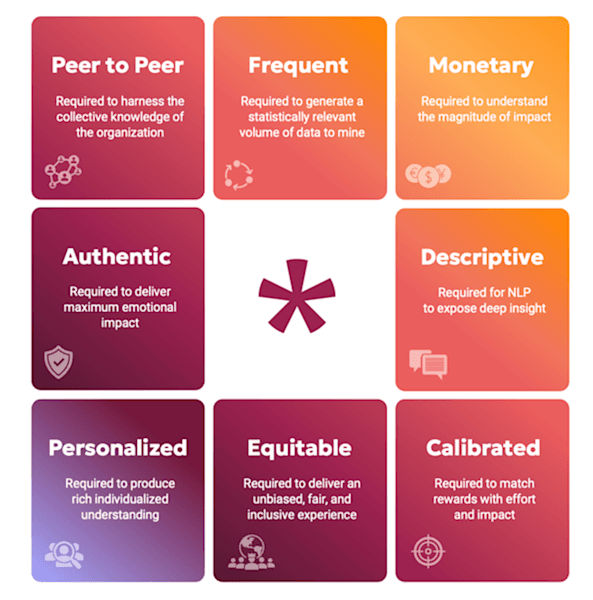
Get these practices right and every message has a better chance to do its three jobs – lift a person, teach a team, and resolve into a signal leaders can use.
HR’s best on-ramp to AI
Hopefully it’s clear by now just how powerful recognition can be. If you’re still thinking about recognition mainly as a “nice-to-have” box for employee experience or employer brand, you’re leaving a powerful lever on the table.
We hear from HR leaders every week who want to use AI but are overwhelmed by its velocity. They often aren’t sure where to start, or how to do it responsibly. But in most cases, their best AI advance is already in mix. If you want AI to do anything useful, you need a reliable source of data first. In workforce management, the best source of truth is people data, which tells you who’s creating value, how work really flows, which skills are emerging, where execution is stalling, and how closely teams are aligned to your goals.
That’s exactly what high-quality recognition data gives you. When a message names who did what, why it mattered, and how it ties to values, it becomes trustworthy, voluntary, in-flow behavioral data. It’s not scraped, inferred, or after-the-fact. It’s people telling you, in the moment, what happened and why it mattered. And if you already have a program, you probably have a goldmine of it sitting in plain sight. Raise the bar on the message and let it travel, and AI suddenly has real fuel. Now it can:
- Surface strengths and skills with evidence
- Reveal collaboration networks across silos
- Show progress on priorities in real time
- Deliver plain-language guidance to managers in the flow of work
As you can see, recognition data is a goldmine of information not just for understanding but changing and growing your company. And it’s not all or nothing, you can use recognition to solve real problems today while you build toward richer signals – bridge the “moonshot vs. now” gap. As programs mature, the same messages that lift a person and teach a team also strengthen talent decisions, skills development, mobility, succession, and workforce strategy.
Practically, that means clearer answers to board-level questions, fewer dashboard tours, and a credible path to human-machine teaming that keeps people at the center. You don’t need to be at the end state to see value. Better messages today clarify “what good looks like” on a new initiative, stabilize teams after a reorg, and surface cross-team help where work is stuck – while you build the reach and density that create richer signals over time.
Recognition as an "AI-age" people operating system
This is the leap that pays off. A simple atom of recognition gives HR the power to leverage AI and revolutionize HR, making technology work for humans, making HR (in our CEO Eric Mosley’s wordsOpens in a new tab) a steward of business clarity and powering a people operating system of the future.
When your base atoms are designed well and captured widely, as they are in Workhuman’s Human Intelligence layer, they are fuel for a people operating system that gives you:
- Backward-looking insight: Clear, evidenced stories of what actually happened in your organization, where your culture energizers are and who is contributing most.
- In-the-flow guidance: Real-time signals and witnessed messages that surface data in the moment, shape beliefs and behavior as work happens.
- Forward-looking guidance: The ability to see where you’re headed: flag crucial skill strengths or deficits, spot emerging leaders, and help leaders course-correct before it’s too late.
For HR, this convergence of people data and AI represents a huge leap forward in how we measure and manage – all from a system that has already earned a place in your HRIS stack.
Gratitude has always been powerful. Harnessed with intent, it’s transformational. One message, written well and witnessed widely, pays an organization three times over – first in how it impacts a human, then in how it impacts the work around them, and again in the clarity to manage both. That’s how a spark becomes a signal.
Want to see these signals in the wild? Reach out for a tour of Human Intelligence.
About the author
Darcy Jacobsen
Darcy is a passionate storyteller and champion of workforce transformation, human connection, and recognition-driven culture. As an author on the Workhuman Live Blog, she loves to connect deep research insights with modern workplace dynamics to uncover what really drives engagement, belonging, and happiness at work. With a background in communications and a master's in medieval history, she brings a unique perspective to her writing, taking deep dives into all topics around organizational psychology and the science of gratitude.