Creative Skills: How to Identify, Develop, and Measure Them at Work
Table of contents
- What are creative skills? Definition and core characteristics
- Types of creative skills and real-world examples
- Creative skills vs. other skill categories
- Why creative skills matter in today’s workplace
- How to develop and improve creative skills
- How to measure and assess creative skills
- Emerging creative skills to learn in 2025 and beyond
- FAQ
- Conclusion
Your teams already have the technical skills to execute. But can they reimagine what's possible when the market shifts or a competitor disrupts your space?
Creative skills are the cognitive and interpersonal abilities that enable people to generate novel ideas, connect disparate concepts, and approach challenges from fresh angles. Unlike domain expertise or artistic talent, these are learnable, transferable thinking approaches that drive innovation across every function, from finance to operations to HR.
For HR leaders and executives, understanding creative skills matters because they're increasingly what separates adaptive organizations from those stuck reacting.
This guide defines creative skills with clarity, explores their types and real-world applications, and provides actionable strategies to identify, develop, and measure them across your workforce. You'll learn how to distinguish creative skills from technical or artistic abilities, see concrete examples by role and industry, and discover practical exercises that build creative capacity at individual, team, and organizational levels.
What are creative skills? Definition and core characteristics
Creative skills are the thinking and behavior patterns that help someone produce ideas or solutions that are both new and useful in context.
That “novel and appropriate” framing is common in creativity research, and it’s what separates creativity from random originality. In practice, creative skills show up when people reframe a problem, connect the dots across different inputs, or communicate an idea in a way that others can act on.
They are not the same as domain expertise (what you know) or technical skills (how you execute). Instead, they describe how you approach ambiguity and change, whether you’re in engineering, HR, finance, or customer service.
Workforce frameworks reinforce this broader view: the World Economic Forum continues to highlight creative thinking among the skills expected to riseOpens in a new tab in importance. That matters for leaders because it encourages spotting creativity beyond “artistic” roles and building it intentionally as a business capability.
The four core components of creative skills
- Ideation: generating multiple, diverse options.
- Connection-making: linking seemingly unrelated concepts into new patterns.
- Experimentation: testing ideas with comfort in ambiguity and iterative failure.
- Adaptation: pivoting based on feedback, data, and changing conditions.
Common misconceptions about creativity
Creativity is not limited to aesthetic output, and it is not reserved for extroverts. It’s also learnable: strong creative outcomes typically blend divergent thinking (generating options) with convergent thinking (evaluating and selecting).
Creative skills vs. creativity skills
“Creative skills” and “creativity skills” are interchangeable. You may also see synonyms like innovative thinking, inventive skills, or creative thinking abilities. The key is not to confuse skills (observable, developable behaviors) with personality traits or artistic talent alone.
Types of creative skills and real-world examples
If you’re looking for a list of top creative skills, most job and skills frameworks point to a blend of creative thinking, human skills, and tech fluency, especially as work changes faster and roles evolve.
Here are 15 commonly cited creative skills (with quick examples) that show up across roles:
- Creative problem-solving (reframing a recurring customer issue into a self-serve fix)
- Brainstorming & divergent thinking (generating 20 campaign angles before narrowing)
- Critical thinking & evaluation (stress-testing ideas for risks, assumptions, and tradeoffs)
- Pattern recognition (spotting a trend in churn data that suggests a new onboarding step)
- Conceptual/strategic thinking (connecting a product roadmap to a changing market)
- Storytelling (turning insights into a narrative leaders can act on)
- Visual communication (sketching a workflow so teams align faster)
- Design thinking (starting with user needs, prototyping, iterating)
- Analogical reasoning (borrowing a solution from a different industry)
- Collaboration (building on others’ ideas, not just presenting your own)
- Active listening (surfacing the real constraint behind a stakeholder request)
- Conflict reframing (turning “either/or” debates into “yes, and” options)
- AI literacy / AI-assisted creativity (using gen AI to explore variations, then refining)
- Experimentation mindset (A/B testing a process change, learning, iterating)
- Adaptability (pivoting when feedback or conditions shift)
Key creative thinking skills
- Curiosity & imagination: Envisioning what could be and actively seeking new inputs, experiences, and knowledge.
- Open-mindedness: Staying receptive to new ideas, evidence, and perspectives—even when they challenge assumptions.
- Creative problem-solving: Reframing challenges and generating novel options by making unexpected connections.
- Adaptability & flexibility: Shifting thinking when conditions change, priorities evolve, or new information emerges.
- Collaborative ideation: Building on others’ ideas to improve concepts through shared exploration and refinement.
- Experimentation mindset: Trying small tests, learning quickly, and treating setbacks as data—not defeat.
Interpersonal creative skills
Are communication and collaboration creative skills? They enable creativity by helping people exchange ideas, build on each other’s thinking, and earn buy-in. Examples: storytelling in a pitch, visual facilitation in a workshop, or reframing conflict into a shared design constraint.
Digital and tech creative skills
Examples include UX/UI creativity, multimedia creation, 3D modeling/simulation, and AI-driven concepting – using tools to generate possibilities quickly, then applying human judgment to choose what fits.
Applied creative skills by function
- Digital marketing: campaign ideation, segmentation, content innovation (e.g., tailoring messages to micro-audiences).
- Operations: process redesign and workflow experimentation (e.g., removing steps to cut cycle time).
- HR: employee experience design and culture-building (e.g., reimagining onboarding).
- Finance: scenario modeling and data storytelling (e.g., visualizing risk in a way leaders understand).
Arts, crafts, and everyday creative hobbies
Creative pursuits outside of work can strengthen the same “muscles” that matter on the job: observation, iteration, experimentation, and comfort with ambiguity. For leaders, the takeaway isn’t that employees should list hobbies on a resume – it’s that the capacity for creative output is often built and reinforced in many places, then expressed at work through better problem framing, stronger storytelling, and more adaptive decision-making.
Examples:
- Visual arts (drawing, photography, design): builds visual thinking and the ability to simplify complexity into clear signals (useful for aligning stakeholders).
- Writing (blogging, journaling, fiction): strengthens narrative structure and sense-making – critical for change communication and executive alignment.
- Music and performing arts: develops pattern recognition, improvisation, and audience awareness (useful in facilitation and influence).
- Cooking and baking: reinforces iterative testing, constraints-based creativity, and learning from “failed” trials (useful in continuous improvement).
- Making and handcrafts (DIY, woodworking, knitting): builds prototyping mindset, patience, and practical problem-solving under real constraints.
How to use this in talent conversations: these examples can help managers recognize and discuss creative capability in more inclusive ways – especially for roles where creativity is essential but not traditionally labeled “creative.”
Personal attributes that support creativity
Traits like curiosity, empathy, persistence, self-motivation, and openness often underpin creative output – and are increasingly highlighted alongside core skills in workforce outlook reports.
Creative skills vs. other skill categories
Creative skills don’t compete with other capabilities—they amplify them. In most roles, the strongest outcomes come from a matrix of strengths: high creative skill (novel options) paired with high technical or functional skill (feasible execution).
Creative skills vs. technical skills
Technical skills answer “how do we execute?” Creative skills answer “what else could work?” Technical expertise ensures feasibility; creativity expands the solution set when conditions shift.
Artistic skills vs. creative skills
Artistic skills are a subset of creative skills focused on aesthetic creation. Creative skills also include analytical, strategic, and social creativity (e.g., reframing a process problem or designing a better employee experience).
Soft skills that foster creativity
Soft skills like curiosity, emotional regulation, resilience, and collaboration act as enablers—helping people stay constructive in ambiguity and build on others’ ideas.
Creative skills vs. critical thinking
Creativity leans on divergent thinking (many possibilities); critical thinking emphasizes convergent thinking (evaluate, select, refine). High-performing teams deliberately switch between both modes.
Why creative skills matter in today’s workplace
In volatile conditions, leaders need teams that consistently generate new ideas—and translate fresh ideas into tested pilots. Creative thinkers have become a practical differentiator because they help teams respond when the “right answer” isn’t obvious—reframing constraints, generating options, and making smarter tradeoffs under pressure.
According to Mercer and Workhuman’s Unlock the Skills-Powered Organization report, skills are fluid, and organizations need timely signals about what people can do in real work, not just in job descriptions.
Business outcomes linked to creative skills
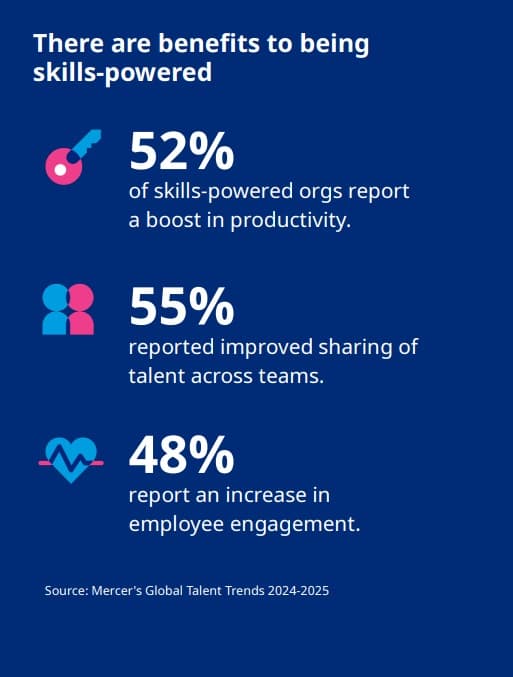
Creativity shows up in outcomes leaders care about: faster iteration, better cross-functional problem solving, and stronger internal mobility. In Mercer’s Global Talent Trends data, 52% of skills-powered organizations report a boost in productivity, 55% report improved sharing of talent across teams, and 48% report an increase in employee engagement.
Benefits for individual careers and well-being
When people are recognized for growth and contributions, they’re more likely to see a future with the organization. The report found 72% of people recognized for learning a new skill say they see a path to growth vs. 34% of those not recognized.
The automation paradox: why creativity becomes more valuable
As AI absorbs more routine execution, human value shifts toward higher-order work: problem definition, judgment, influence, and novel solution design. That’s why 79% of C-suite executives say talent processes need greater agility to pivot with changing demands.
Future trends leaders should watch
Creative cultures scale faster when organizations can see skills in action. Mercer and Workhuman describe recognition data as a “treasure trove of behavioral insights” that provides a more continuous view of skills than one-time assessments—useful for spotting emerging creative problem-solving across teams.
How to develop and improve creative skills
Creative skills improve the same way other high-value capabilities do: through deliberate practice, feedback, and an environment that makes experimentation safe and repeatable. For HR leaders, that’s the foundation of effective upskilling and reskilling strategies, because creativity can be developed systematically, not simply “hired in.”
Research by Sio and Lortie-Forgues (2024)Opens in a new tab suggests that creativity isn’t a fixed trait: well-designed training programs can measurably improve creative performance, even though results vary by approach and implementation quality—good news for leaders who want to scale creativity through development, not just recruiting.
Individual development strategies
For leaders and managers, the goal is to help employees build creative range in the flow of work:
- Practice divergent thinking: pick a small friction point and generate 10 solutions in 10 minutes (quantity first, quality later).
- Cross-pollinate: rotate inputs—read outside your function, sit in on another team’s standup, or interview internal “power users.”
- Use constraints as catalysts: time-box decisions, limit resources, or impose a format to force sharper prioritization.
- Document and reflect: keep a lightweight “decision log” of ideas tested, what changed, and what you learned.
Team-level creative skill building
Creativity rises when teams separate idea generation from idea evaluation. Use structured sessions with explicit divergent and convergent phases, and build perspective-taking into the process. Psychological safety matters here: when people fear judgment, they share fewer unconventional ideas.
To get the team’s creative juices flowing, start with low-stakes idea sprints before moving into evaluation.
For hybrid teams, add asynchronous channels (shared docs or virtual whiteboards) so the best thinking isn’t limited to the loudest voice or the best time zone.
Organizational enablers for creativity
Creativity scales when leaders design for it—not when they hope it appears. That means protecting time for experimentation, building teams with diverse perspectives, and investing in rapid prototyping so ideas can be tested quickly and cheaply. Just as important is reinforcement: organizations need visible signals that smart risks, learning, and iteration are valued—not punished.
Peer-to-peer recognition can make that reinforcement systematic by spotlighting experimentation and “productive failures” as progress, not detours.
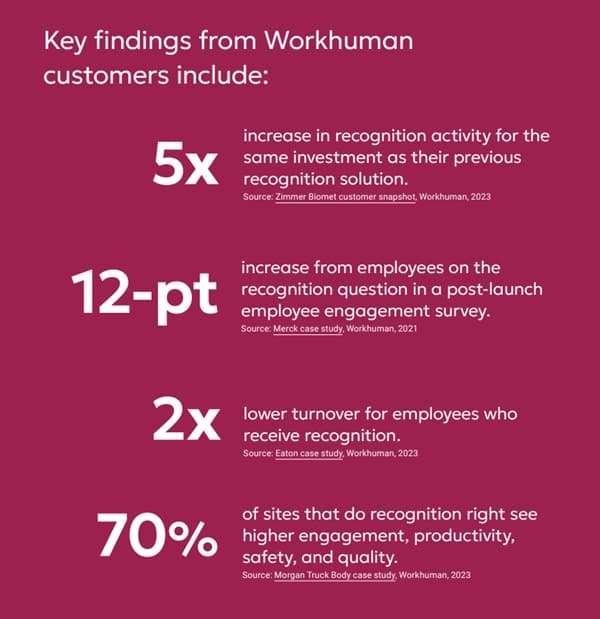
In Workhuman customer case studies, recognition programs were associated with a 12-point increase on a recognition-related engagement survey item and 2x lower turnover among employees who receive recognition—evidence that celebrating the right behaviors can strengthen both creative capacity and retention.
Workhuman is the #1 provider of employee recognition software. When you opt for recognition done right from Workhuman, you don't have to settle for second-rate recognition.
Practical exercises to try
These techniques give teams repeatable creative processes—not one-off brainstorms.
- SCAMPER: Substitute, Combine, Adapt, Modify, Put to another use, Eliminate, Reverse—use it to rethink an existing process or program.
- Six thinking hats: force balanced exploration (facts, risks, benefits, emotions, creativity, process).
- Random word association: spark new connections when teams feel stuck.
- Reverse brainstorming: ask “how could we make this worse?” then invert the answers into solutions.
Overcoming creative blocks and maintaining momentum
Most blocks come from perfectionism, overload, or fear of judgment—not lack of ability. Counter with smaller bets (prototype-first), tighter constraints, and clear feedback loops. Alternate divergent and convergent work, protect deep-work time, and celebrate learning milestones so creative effort stays sustainable.
How to measure and assess creative skills
Measuring creative skills is less about counting how many ideas someone generates and more about evaluating how they work through ambiguity: how they frame the problem, generate options, test assumptions, and translate insights into outcomes.
To make this consistent, many organizations start by building a skills taxonomy—a shared language that defines what “creative” looks like by role and level—then assess against it using multiple inputs. This multi-method approach (structured observation, practical work, and feedback data) helps ensure creativity doesn’t become a “vibe-based” rating.
Behavioral indicators of creative skills
Look for repeatable signals such as: reframing the brief, challenging assumptions respectfully, proposing multiple options before converging, running low-risk experiments, and integrating diverse inputs to improve the solution. Document these behaviors in a simple rubric (e.g., problem framing, option generation, experimentation, learning, impact).
Assessing creative skills in hiring
Use structured interviews and work sample/case exercises to see creativity under realistic constraints—then score with clear criteria. Selection research consistently shows structured methods and work samples are stronger predictors of job performance than informal approaches. Ask candidates not only what they did, but how they chose among options, sought feedback, and iterated.
Measuring creative skills in current employees
Build creative behaviors into performance conversations and goal-setting: pilots launched, process improvements shipped, cross-functional contributions, and lessons learned. Encourage teams to capture “before/after” impact (cycle time, quality, customer effort, adoption) so creativity stays tied to business outcomes.
Using recognition and feedback data
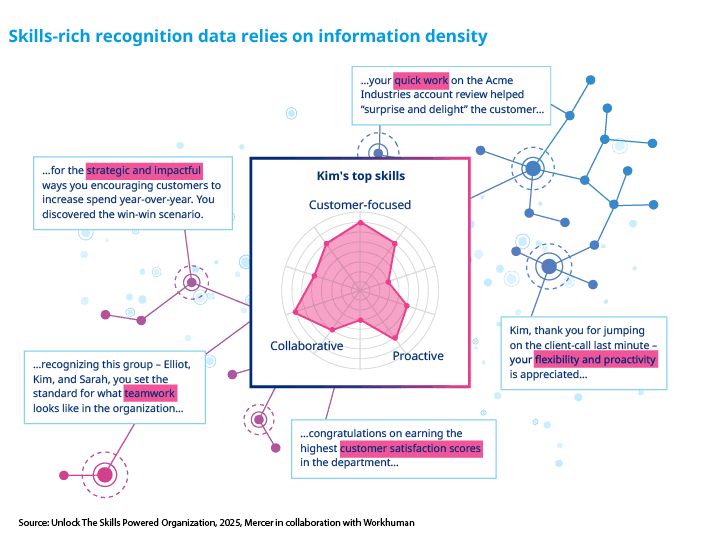
Multi-rater input often surfaces creative contributions that formal metrics miss. Mercer and Workhuman point to recognition data as a continuous, crowd-sourced signal that can uncover “hidden skills” and reduce reliance on self-reporting or manager-only validation. When mined with AI, this human data can become Human Intelligence™—a richer view of skills and performance patterns over time.
Formal creativity assessments: pros and cons
Psychometric tools can add insight, but creativity is context-dependent, and research notes real challenges in predicting creative achievementOpens in a new tab from any single measure. Use tests as supplemental inputs, and keep the center of gravity on job-relevant behaviors and evidence.
Emerging creative skills to learn in 2025 and beyond
“Creative skills to learn” is becoming a common search because creativity is increasingly tied to how organizations adapt—especially as AI takes on more routine execution. The World Economic Forum’s Future of Jobs Report 2025 highlights rising demand for creative thinking alongside resilience and agility.
And with 75% of global knowledge workers reporting they already use generative AI at work, the creative advantage is shifting toward how humans direct, judge, and improve machine output.
AI-assisted creative workflows
One of the most practical “future creative skills” is human–AI collaboration:
- Prompt engineering (clear, testable instructions)
- AI tool evaluation (fit-for-purpose, quality, and risk)
- Workflow design (what humans do vs. what AI accelerates)
- Ethical AI use (IP, bias, authenticity)
For HR teams, this is also where people analytics becomes more creative. Workhuman iQ’s AI Assistant, for example, applies AI to recognition data to surface patterns in skills, collaboration, and team dynamics via open-ended prompts—turning “what happened” into “what to do next.”
Data-driven creativity
Data-driven creativity blends visualization, pattern synthesis, and an A/B testing mindset—treating creative decisions as hypotheses you can validate and refine. This helps leaders scale creativity beyond a few “idea people” and into repeatable operating rhythms.
Sustainability-focused design and cultural intelligence
Sustainability constraints are increasingly a design brief, not a blocker, fueling skills like circular thinking and systems-level problem framing. In parallel, cultural intelligence and inclusive design improve relevance across global, diverse workforces and customer bases.
Creative networking and community building
Finally, innovation is more distributed. Skills like facilitating cross-functional communities, running asynchronous ideation, and enabling “cross-pollination” across teams help organizations generate better ideas faster, without relying on proximity or hierarchy.
FAQ
Can you teach someone to be creative, or is it innate?
Creative ability isn’t fixed. While people vary in starting point, creative skills improve through deliberate practice: generating options, reframing problems, experimenting, and learning from feedback. Leaders can accelerate growth by providing psychological safety, diverse inputs, and clear reinforcement for smart risk-taking and iteration.
How do you measure creative skills in job candidates?
Use structured interviews plus a practical case or work-sample exercise. Evaluate how candidates frame an ambiguous problem, generate multiple options, prioritize tradeoffs, and iterate based on feedback. Score responses with a simple rubric (problem framing, option generation, experimentation, learning, impact) to reduce subjectivity.
What are the most common barriers to creativity in organizations?
The biggest blockers are fear of judgment, perfectionism, overload, and cultures that reward only “safe” execution. Creativity declines when teams lack time to explore, don’t have diverse perspectives, or get punished for experiments that don’t work. Psychological safety and visible reinforcement remove these constraints.
How can managers balance creative exploration with deadline pressures?
Make creativity time-bound and outcome-linked. Separate divergent and convergent phases, use constraints as catalysts, and run small experiments that fit the delivery plan. Protect short “explore” windows early, then commit to clear decision points. Recognize learning milestones so teams don’t default to the safest option.
Do remote work environments help or hinder creative skill development?
Remote and hybrid work can do both. Creativity improves when teams have psychological safety, diverse inputs, and time to explore, regardless of location.
Remote setups help when leaders use structured brainstorming, virtual whiteboards, and asynchronous idea channels; they hinder when collaboration becomes transactional and unplanned conversations disappear.
Conclusion
Creative skills are no longer a “nice to have” reserved for traditionally creative roles—they’re a business capability that improves how teams solve problems, adapt to change, and turn uncertainty into progress.
For HR leaders and executives, the opportunity is to treat creativity like any other strategic skill: define it clearly, build it through deliberate practice, and measure it through observable behaviors and outcomes.
The organizations that win won’t rely on a few standout innovators; they’ll create the conditions for many people to contribute ideas, test intelligently, and learn quickly.
Start small: embed structured ideation into team rhythms, reward experimentation and iteration, and use recognition and feedback signals to spot creative strengths where they already exist. Then scale what works.
About the author
Ryan Stoltz
Ryan is a search marketing manager and content strategist at Workhuman where he writes on the next evolution of the workplace. Outside of the workplace, he's a diehard 49ers fan, comedy junkie, and has trouble avoiding sweets on a nightly basis.