How Employee Recognition Programs Unlock Skills Insights to Drive Upskilling and Reskilling
Recent insights from the World Economic Forum found that 39% of key skills required for today’s employees will changeOpens in a new tab in the next five years.
Due to these rapid technological evolutions, organizations face a common challenge: how do you truly know which skills your employees have and how they’re evolving? Outdated reporting tools, insufficient performance review processes, and unstrategic upskilling and reskilling efforts simply aren’t enough to support today’s employees.
However, the solution to this dilemma may lie in a surprising place: employee recognition programs. Done right, recognition is more than a morale booster. It’s a powerful data engine that surfaces real-time insights and workforce data which helps leaders drive smarter workforce planning.
In this post, we’ll explore Workhuman and Mercer’s research regarding:
- Why skills are so difficult to measure
- How recognition programs solve the skills data gap
- The business outcomes of using recognition data for upskilling and reskilling
- Practical tips for building a recognition program that fuels workforce development
The Limits of Traditional Skills Tracking
For decades, leaders have struggled to get reliable visibility into employee skillsets. Most current approaches are flawed because:
- Self-reported skills rely on employees’ self-assessments, which are useful for reflection but inconsistent and prone to underreporting or exaggeration.
- Manager assessments provide a limited view, often miss day-to-day contributions or cross-functional work, and are prone to bias.
- Annual performance reviews happen infrequently with a strong recency bias, and can’t capture how employees develop and apply skills over time.
- Job titles and descriptions are outdated proxies that fail to reflect the actual skills people use on the job or how those skills are changing.
Staying agile isn’t just a business imperative, it’s a necessity for any organization to survive in today’s ever-evolving world of work. Employees are constantly learning through professional development, exposure to new technologies, or even day-to-day problem-solving. Entire industries are being reshaped by artificial intelligence, automation, and shifting market demands.
The result? Leaders face “skills blindness,” or a lack of insight into the full capabilities of their workforce. This makes it difficult to direct development programs effectively. It makes it harder to match the right people to strategic initiatives to optimize outcomes. Attempting to direct employees toward new opportunities becomes a foggy endeavor, as does planning for future business needs. Traditional tools and assessments struggle to keep up with these ongoing changes, often providing only a static or delayed view of employee capabilities.
Without accurate skills data, organizations risk wasting resources, slowing innovation, and losing employees who feel invisible.
Skills in Action: Recognition as Real-Time Data
A quality recognition program changes the game. When recognition is structured to highlight specific contributions and skills, every recognition moment becomes a valuable data point. Instead of a vague “great job,” recognition messages capture:
- Which skills were applied (e.g., problem-solving, leadership, creativity)
- How those skills were demonstrated in context
- The impact on the team, customer, or business outcome
This makes recognition data:
- Real-time: Skills are captured as employees display them.
- Crowdsourced: Feedback flows from peers, managers, and cross-functional colleagues.
- Contextual: Recognition provides detail on why the skill mattered.
- Continuous: Insights grow richer over time as more recognition moments are logged.
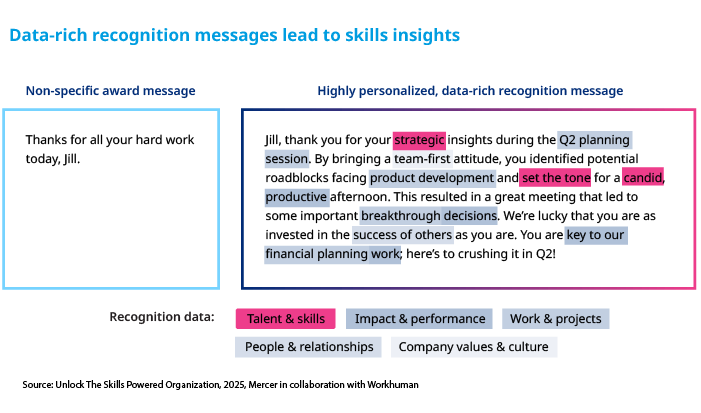
Captured consistently across an organization, these moments create a stream of real-time signals. Unlike static dashboards or periodic reviews, this data evolves in real time and captures skills as employees demonstrate them.
At scale, recognition becomes more than positive feedback. It becomes a rich layer of Human Intelligence™ — organic, people-powered signals that help leaders see beyond roles and titles to how work really happens. Recognition surfaces hidden skills, validates existing ones, and highlights opportunities for growth and development. To unlock this kind of insight at scale, recognition programs need to be thoughtfully designed. That’s what transforms recognition from a feel-good benefit into a strategic source of workforce intelligence.
“Workhuman has proven that you can look at this vast amount of recognition data and see reinforced patterns of certain skills that are driving success in the organization.” -Josh Bersin, Global HR Industry Analyst
How to Build a Recognition Program That Fuels Skills Insights
Not all recognition programs are created equal. To unlock skills intelligence, recognition must go beyond surface-level praise. Here’s how to design a more data-rich recognition program:
1. Encourage thoughtful, detailed messages
Encourage employees to highlight specific skills and outcomes in recognition messages. For example:
- Instead of: “Thanks for your hard work.”
- Say: “Your strategic thinking during the client call helped us salvage the deal and strengthen the relationship.”
“If you build a really robust recognition program, your employees’ messages will include data on why they're saying this, what the behaviors were, what the skills were, and which activities created this level of recognition. So, what you've now created is a massive culture map of your company where you're seeing the relationships between every individual and all the other people that they work with.” -Josh Bersin, Global HR Industry Analyst
2. Encourage frequent recognition
Recognition should happen often enough to capture skills in the flow of work, but not so often that it feels trivial. Encourage meaningful acknowledgments for contributions that truly drive impact.
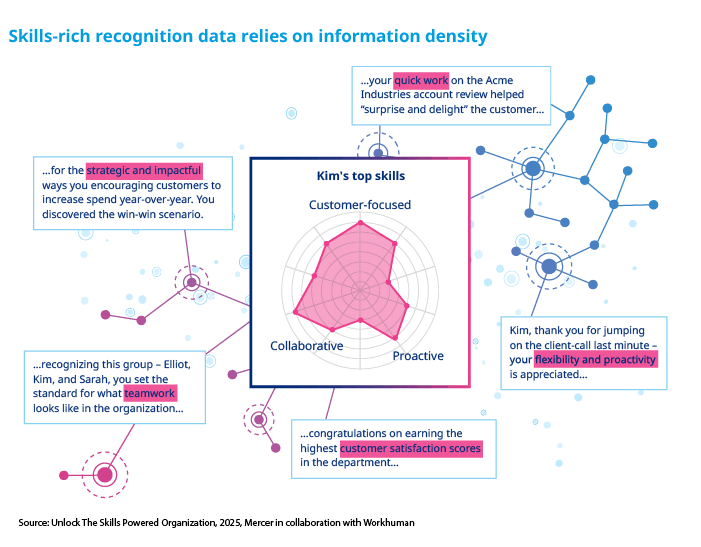
3. Strive for personalized, meaningful messages
Avoid generic or automated praise. Recognition should be personal, authentic, and thoughtful. Employees can sense the difference, as meaningful recognition has up to 8X the impact on engagement compared to shallow gestures.
4. Ensure that your program is organization-wide
Recognition should flow not just from managers to employees, but also peer-to-peer and upward from employees to leadership. This inclusivity uncovers hidden skills and prevents data silos by creating a continuous feedback loop.
5. Tie recognition data to business outcomes
Don’t let recognition data sit unused. Connect it to workforce planning, learning and development, and succession strategies. Recognition insights can directly inform:
- Growth and revenue strategies.
- Retention and career development.
- Health and safety outcomes in risk-sensitive industries.
When recognition data is treated as a strategic people analytics tool, it can help create measurable business impact.
“One of the things about Workhuman that sets you apart is your ability to be really sophisticated about how you think about telling a story with the data. You’re doubling down on that through the Human Intelligence tools – and the functions you have embedded in the organization, like Workhuman iQ, who can really do this work and be an extension for our companies. I think this is so very valuable.” -Lisa Monaco, SVP, Employee Experience at Moody’s
Related reading: The Recipe for Recognition
Powering Upskilling and Reskilling Through Recognition Insights
When leaders harness recognition data, they unlock a wide range of workforce benefits, including:
1. Holistic and unbiased skills insights
Because recognition comes from multiple sources, it provides a more accurate picture of an employee’s skills than any single manager or self-assessment could. This reduces bias, validates real-world performance, and helps employees feel seen for the value they bring.
2. More strategic and successful upskilling and reskilling
According to research from Mercer, 79% of C-suite executives worldwideOpens in a new tab recognize the need for greater agility in talent processes to help lead their workforce through ever-changing industry demands. Recognition highlights which skills are emerging in practice, making it easier to target upskilling investments. For example, if several employees are consistently recognized for creative use of AI tools, the organization can invest in deeper AI training for that group.
According to a case study from Workhuman’s partner Morgan Truck Body, LLC, more than 90% of their sites that properly used the recognition program have an internal promotion rate greater than the company average of ~13%.
This precision ensures training resources are used effectively, closes real skill gaps, and helps employees grow in areas most relevant to the business.
3. Stronger team structures and peer mentorship
Recognition data also provides insights into team dynamics. Leaders can see who collaborates well, who steps into leadership roles, and who demonstrates niche skills. This allows for better team design and natural peer-to-peer mentorship opportunities. In fact, Mercer discovered in their Global Talent Trends research that 55% of skills powered organizationsOpens in a new tab reported improved sharing of talent across teams.
4. Higher engagement, productivity, and retention rates
Recognition already boosts morale, but when it’s tied to career development and growth opportunities, it drives even deeper engagement. Employees are more likely to stay when they feel valued and see a clear future with their organization. Recognition data is the missing link that makes this possible.
According to research from Mercer and Workhuman, 28% of workers who plan to stay with their organizations cite opportunities for development as a key reason why. Beyond that, 72% of people who were recognized for learning a new skill say they see a path to growth in their organization, compared to just 34% of those who were not recognized.
In fact, further research shows that skills-powered organizations see:
- 52% higher productivity
- 48% higher employee engagement
- Lower headcount costs through internal mobility
Using Recognition as a Strategic Engine for Workforce Development
In a world where skills are the new currency of work, organizations can’t afford to move forward without this valuable data. Traditional skills assessments are too static, too biased, and too limited.
Recognition programs provide the missing link. They capture real-time, authentic skills data that empowers leaders to:
- Validate and discover employee strengths.
- Direct upskilling and reskilling where it matters most.
- Build more functional, balanced teams.
- Increase engagement, productivity, and retention.
Related reading: Powering Up Recognition to Maximize the Potential of Your People & Business
Recognition isn’t just about boosting morale. It’s a strategic lever that helps organizations stay agile, resilient, and competitive.
Amanda Nipper, Director of Culture, Talent, & Performance at Arkansas Children’s, one of Workhuman’s partners, had this to say about the direct impact of their recognition program:
“Workhuman has truly been our strategic partner in enhancing our culture and fostering meaningful connections among our 5,600 team members. We've witnessed tangible improvements in retention, engagement, and the overall employee experience.
We’re particularly excited about the new Human Intelligence suite, which we believe will further elevate our outcomes. The Recognition Advisor empowers our employees to share heartfelt messages of appreciation more effectively. And through Culture Hub, compelling stories are now prominently featured across our diverse worksites, fostering greater unity.
This platform has not only made recognition more visible but also made it truly personal, proving that a little appreciation goes a long way in creating a culture of belonging.”
If you’re serious about unlocking the full potential of your workforce, it’s time to reimagine recognition not as a perk, but as the foundation of a skills-powered organization.
About the author
Anna Picagli
As an RYT500 yoga instructor and a Reiki Master Teacher, Anna is an advocate for holistic wellness, especially within the workplace. She’s extremely passionate about the brain-body connection and exploring how mental and physical wellness intersect.
Anna has experienced firsthand how chronic stress, overworking, poor management, and other organizational issues can lead to extreme burnout. Knowing the impact that a toxic work environment can have on a person’s body, psyche, and general sense of well-being, she now works to direct others away from facing the same fate.
As Workhuman’s Senior Content Specialist, Anna is a regular contributor to Workhuman iQ reports and aims to create resources that company leaders can reference to help improve their culture and empower their employees, creating healthier workplaces for everyone.
In her free time, she’s an avid solo traveler, a voracious reader, and a seasoned home chef. You can learn more about Anna’s work on LinkedIn or through the Yoga Alliance.